Viewpoint and cable car
Tromsø Cable Car Audio Guide (Fjellheisen)
Four minutes of cable separate Tromsdalen from the Storsteinen ledge, at 421 metres: the balcony that a polar-hunting shipping company strung up in 1961 and from which Tromsø reads at a glance as island, strait and bridge, under the midnight sun or the aurora.
- 60 min of audio
- Panoramic viewpoint
Fjellheisen opened on 22 February 1961, a few months after the Tromsø bridge first joined the city's island with Tromsdalen, on the mainland. It was built by Brødrene Jakobsens Rederi, a shipping company in polar hunting, fishing and expeditions to the Arctic and Antarctic, and inaugurated with the school band carried up the mountain and the foreign press invited. From the lower station at Solliveien, 50 metres above sea level, the cabin covers some 371 metres of climb to the Fjellstua, on Mount Fløya.
Up top, the summit has never stopped changing: a restaurant made ready for King Olav V, a fire that destroyed it in 1979, a complete demolition in 2015 and, today, the works for a new upper station. And behind the city rises Tromsdalstinden, the peak that in 2004 halted an Olympic project and that still divides those who argue over whether it is a Sami sacred mountain since time immemorial or only recently.
Highlights
- Polar bear and seal gondolas — the emblems of the polar-hunting shipping company that built the cable car
- Storsteinen ledge — a viewpoint at 421 metres, four minutes by cabin from Tromsdalen
- Tromsøbrua — a 1,016-metre bridge of 1960, the first in Norway built by free cantilevering
- Tromsdalstinden — a 1,238-metre peak at the centre of a debate on Sami sacred mountains
- Sherpatrappa — over 1,200 stone steps laid by Sherpas from Khumbu
The story of Fjellheisen, the Tromsø cable car, is that of a balcony strung up in the wake of a bridge. In 1960 Tromsøbrua opened, joining the city’s island with Tromsdalen for the first time, and on 22 February 1961 a polar-hunting shipping company, Brødrene Jakobsens Rederi, inaugurated the cable that climbs from Solliveien, 50 metres above sea level, to the Storsteinen ledge, at 421. There is no agreement on when work began: the official website speaks of 1958 and other sources of 1960. The ride lasts four minutes and, up top, Tromsø appears as what it is: a city on an island, ringed by straits, islands and mountains. In summer the cable car stays open until midnight for the midnight sun, and on New Year’s Eve it carries the city’s fireworks up the mountain. Anyone asking what to see at Fjellheisen finds something more than a view: the audio guide covers in four stops, with a story researched and checked against sources, the shipping company, the fire, the bridge and the mountain that rises behind the viewpoint.
At the foot of the cable car, a kilometre away, the aluminium panels of the Arctic Cathedral face the bridge, and the debate over Sami sacred mountains is better understood in front of the Sami collection at Tromsø Museum.
A bear and a seal at Solliveien
Fjellheisen
Summary of this stop
The visit starts in front of the lower station, in Tromsdalen, today surrounded by renovation works and with a street beside it named after Anton Jakobsen. The two gondolas that pass each other halfway up the slope give the first clue to the history of Fjellheisen: one has a polar bear painted on it and the other a seal, the two emblems of Brødrene Jakobsens Rederi, the shipping company in polar hunting, fishing and expeditions to the Arctic and Antarctic that built the cable car.
The inauguration of 1961 was very much a village fête with international ambition. It was organised with SAS for press and travel agencies from Norway and abroad, schoolchildren got the day off and the Tromsdalen school band was carried up the mountain to play. The banker Anton Jakobsen opened it officially, and among the speakers was Kåre Hansen, mayor of Tromsøysund, because Tromsdalen then belonged to that neighbouring municipality, which was not merged into Tromsø until 1 January 1964. What that detail says about the city of the time is told right there, with the cabins in view.
Fjellstua, the restaurant of a king that burned
Storsteinen
Summary of this stop
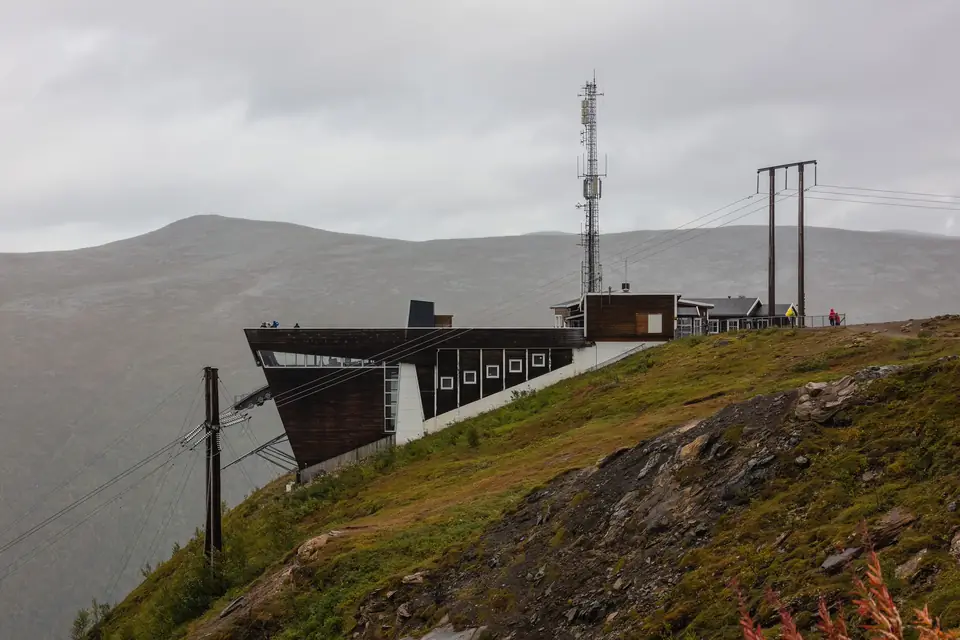
The cabin sets the visitor down at the upper station, on the Storsteinen ledge. Its restaurant was ready for the visit of King Olav V on 29 July 1961, five months after the opening, but on the night of 10 June 1979 a fire destroyed the building completely. The mountain went 13 years without a restaurant, until the new Fjellstua opened on 18 November 1992 after 20 months of building.
It was not the last great change. After the load-bearing cable was renewed in 2012-2013, the original cable car made its last trip on 31 August 2015 and the whole installation was demolished; the new one, with new gondolas, machinery and foundations, was inaugurated on 16 April 2016. In November 2021 the Jakobsen family sold it to The Norwegian Travel Company, of the Longship fund, and today the works of “Fjellheisen 2.0” are raising a new upper station: the original viewing platform is closed, a temporary café operates at the summit and the cable car does not admit wheelchairs until the end of 2027.
From this ledge, for years, Tromsø’s paragliders took off, with tandem flights that sometimes passed over the roof of the Arctic Cathedral. How that custom ended in 2026 is one of the episodes the audio guide reserves for this point.
The bridge that brought the cable car
Tromsøbrua over the Tromsøysundet
Summary of this stop
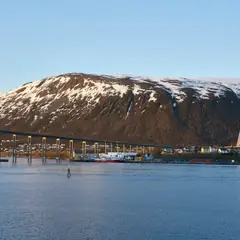
Looking towards the Tromsøysundet strait, the city shrinks to a model and one sees why the cable car stands where it does. Below runs Tromsøbrua, the concrete bridge that opened in 1960 with a length of 1,016 metres and 38 metres of clearance in its main span for ships to pass. It was the first bridge in Norway built by free cantilevering and has been protected since 17 April 2008. Fjellheisen opened only a few months later: without that link to the island, the Tromsdalen station would have been left on the other side of the water.
The valley that opens below also keeps a memory of June 2005, when some 18,000 people gathered in Tromsdalen for the 46664 Arctic Concert, the anti-AIDS concert that carries Nelson Mandela’s prisoner number. Mandela came on stage at 21:30, under a sun that did not set, and gave a farewell that the city still remembers; the audio guide tells it looking at that same valley.
Tromsdalstinden, the mountain that stopped an Olympics
View of Tromsdalstinden
Summary of this stop
With one’s back to the city, the view changes completely: the pointed peak of Tromsdalstinden, 1,238 metres, closes the valley far above the viewpoint. In Sami it is called Sálašoaivi, and a reindeer herder remembered that until the late 1930s it was not thought proper to sing joik or blaspheme in its presence. In 2003 Tromsø wanted to trace the downhill run of its bid for the 2014 Winter Olympics on it, and in 2004 a resolution of the Sami Parliament made the press with a blunt headline: “the peak is a sacred mountain”. The Olympic committee looked for another slope. The debate remains open: some hold that this status was born of recent politics and others that it was already sacred before Christianisation, and in 2020 the mountain reached the Storting in a proposal to protect five Sami sacred mountains by law.
The Sherpatrappa also climbs the slope, the stairway of more than 1,200 steps of local stone that Sherpas from Nepal’s Khumbu region built to curb erosion on the old path. Its last step reaches Storsteinen and recalls that this ledge has always been climbed on foot too: even during the building of the cable car the workers walked up while the machinery rode a lift. The audio guide closes here with a question that each visitor can answer while looking at the peak.