Polar history
Polar Museum Audio Guide (Polarmuseet)
A red customs warehouse of 1833, on piles at the last natural shore of central Tromsø, keeps the lives of the Arctic trappers and the punctured fuel tank of the seaplane in which Roald Amundsen took off from this city, never to return.
- 75 min of audio
- Arctic exploration
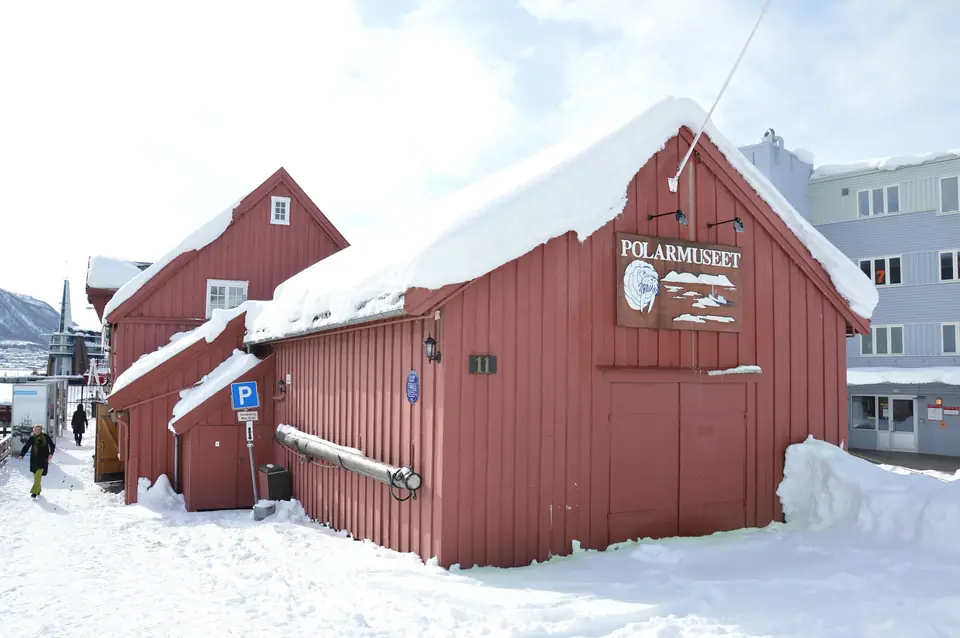
The Polar Museum of Tromsø opened on 18 June 1978, the exact day on which 50 years had passed since Roald Amundsen's last take-off from the city. It occupies the warehouse of the old customs house, built in 1833 and extended in 1843 to store the goods of the Skansen customs yard, protected since 2000 together with the other buildings of the complex. Today it is one of the four exhibition spaces of the Arctic university museum, Tromsø Museum – Universitetsmuseet.
It is the only one of Tromsø's old harbour warehouses still on its original site, on wooden piles with the sea running beneath. Around it, the whole waterfront was filled in with quays; under its red boards lies the last natural shore of the centre, the physical threshold of the nickname by which the city is known: the gateway to the Arctic Ocean.
Highlights
- 1833 customs warehouse — on wooden piles at the last natural shore of central Tromsø
- Hoisting dormers (kobbhus) — double doors through which cargo was winched up from the boats
- “Wanny og Henry” room — Svalbard's first woman trapper and the king of the polar bears, with 27 winters
- 1910 trapper's cabin — brought from Krosspynten, on Svalbard's Wijdefjorden
- Latham fuel tank — 500 litres, with the three cuts the investigation commission made in 1929
The story of the Polar Museum begins with a date chosen on purpose. At about 4 p.m. on 18 June 1928, Roald Amundsen, aged 55, took off from Tromsø with five crew in the French Latham seaplane to search for the survivors of Umberto Nobile’s airship Italia, and the aircraft vanished. On 18 June 1978, half a century later, the museum opened its doors in the red warehouse of the old customs house, a building of 1833 set on piles at the last natural shore of the centre. The State had handed the property to the municipality in 1975, the foundation “Polarmuseet i Tromsø” received the deed in 1990 and in 2010 the museum was merged into Tromsø Museum – Universitetsmuseet, whose spaces also include the sealer MS Polstjerna.
Anyone asking what to see at the Polar Museum finds two great narratives under one roof: that of overwintering hunting on Svalbard and Greenland, told through a trapper’s cabin and two lives from Tromsø, and that of the polar expeditions, with an exhibition of its own devoted to Amundsen, photographs of Nansen’s Fram (1893-1896) and a piece rarely seen so close: a fuel tank from the Latham. The audio guide walks around the outside of the building and through its rooms in four stops, with a story researched and checked against sources, from the hoisting wheels on the facade to the questions Amundsen’s last flight still leaves open.
Henry Rudi spent his retirement at Ølhallen, the oldest pub in Tromsø, less than a kilometre away, and beside the Polaria aquarium the sealer Polstjerna is preserved, a witness to Arctic seal hunting.
A red warehouse with the sea beneath
Polarmuseet
Summary of this stop
Before going in, the building itself is already the first piece of the museum. The warehouse, two storeys and an attic, is made of interlocked logs clad in vertical boards painted red, and rests on wooden piles over the shore. It is the only one of Tromsø’s old harbour warehouses still in its original position, with the sea running beneath, and the strip of shore under it, the byfjæra, is the last natural one in the centre: the rest of the waterfront was filled in with quays.
The architecture of the Polar Museum tells what it was for. Two dormers with hoisting wheels, known in Tromsø as kobbhus, crown the gable towards the sea and the long side; beneath each, double doors on every floor through which goods were winched straight up from the boats. The warehouse was raised in 1833 and extended in 1843 for the Skansen customs yard, whose other buildings, along with the museum, were declared protected in 2000. Behind it there also peeps out an old boat shed from around 1800, now a hall for temporary exhibitions on polar research. Why this wooden threshold explains the nickname of gateway to the Arctic Ocean better than any slogan is something the narration reveals in front of the facade.
Wanny and Henry, from Tromsø to the ice
“Wanny og Henry” room
Summary of this stop
In 2019, after a long time with its permanent exhibitions almost unchanged, the museum opened “Wanny og Henry: fangstliv i Arktis”, a room on Norwegian winter hunting told through two residents of the city. Henry Rudi (1889–1970), the “isbjørnkongen” or king of the polar bears, made 27 winterings on Hopen, Jan Mayen, Svalbard and Greenland between 1908 and 1948 and killed 713 polar bears. He called that existence “the real life” and maintained that his hardest winters were the ones he spent in Tromsø.
Wanny Woldstad (1893–1959) was the city’s first woman taxi driver and, from 1932, when she joined Anders Sæterdal’s expedition aboard the Maiblomsten, the first woman trapper on Svalbard. She was 1.57 metres tall and described herself with the masculine word fangstmann. The room shows bear hunting, the dogs, the cooking and even the Christmas preparations in the hunting grounds. And between the two protagonists runs a thread that passes through a bar in the city: according to a documented tradition, trappers who came back with earnings had the habit of taking a taxi to Ølhallen, and at the wheel of one of those taxis was Wanny. How the other end of that route ends, with Henry already on the scene, is told in the room itself.
A Svalbard cabin for the polar night
Trapper's cabin from Krosspynten
Summary of this stop
In the room devoted to the winter hunting of polar bears and Arctic foxes stands an authentic trapper’s cabin, built in 1910 at Krosspynten, on Svalbard’s Wijdefjorden, and later moved to Tromsø. It is a small, austere space, meant for spending months of darkness far from any neighbour, and seeing it whole helps to grasp at real scale what a winter on the ice meant.
Life inside those walls had its own alarm system. According to a documented tradition, at Wanny Woldstad’s main station, Hyttevika, in Hornsund, a string joined a lump of fat bait hung far from the cabin to a small stick inside from which empty milk tins dangled, and because of that invention the dogs had to sleep indoors. What happened when the tins began to rattle in the middle of the polar night, and when she shot her first bear, the audio guide saves for the moment of standing before the cabin.
The punctured fuel tank of the Latham
Latham fuel tank
Summary of this stop
The most unsettling piece in the museum is a 500-litre fuel tank, the smaller of the two the Latham carried. It turned up on 11 January 1929 on the beach of the Sortland farm, in Steinsfjorden (Lofoten); the float and the other tank are kept in a museum in France. The three large cuts through it were not caused by the accident: they were made by the commission investigating the disappearance, convinced that Amundsen might have used it as a message in a bottle. Inside there was neither message nor fuel.
Around that display case a debate remains open. For some, that take-off was the heroic gesture of an old explorer rushing to save Nobile; for others, an unnecessary risk, with an aircraft that, according to its critics, had not finished its flight tests and with no escort plane over the Barents Sea, which cost six lives. Nor is there agreement on where the seaplane ended up: the military search of 2009 concentrated on the area around Bjørnøya, while the polar researcher Monica Kristensen maintains it ended in a remote spot on Svalbard. What the last radio message from the Latham was, and why it still resonates in this city, is the closing the narration keeps for beside the display case.