Arctic aquarium
Polaria Audio Guide
Five concrete ice floes stranded on the shore of Tromsøysundet hold the northernmost aquarium in the world, where bearded seals born on Spitsbergen live a few steps from a sealer that brought more than 97,000 seals into port.
- 75 min of audio
- Arctic seals
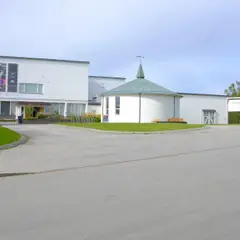
Polaria opened in 1998 beside the Framsenteret, the polar research centre inaugurated that same year, with the mission of bringing the public closer to what is studied there. The firm JAF Arkitektkontor built it between 1996 and 1998 as five tilted volumes of concrete and steel, five plates of ice pushed against the coast with strips of glass between them, facing the seven-storey tower of the researchers.
It was designed for 40,000 visitors a year and in 2019 received 140,000, ranking behind the North Cape and the Fjellheisen cable car among the most visited attractions in northern Norway; in 2025 there were 167,000. And in the city that for decades brought seals into port by the tens of thousands, a few with names of their own now hold the best spot on the shore, and their favourite treat is an ice cube.
Highlights
- Five-floe facade — tilted concrete volumes by JAF Arkitektkontor, 1998
- Sealer Polstjerna — a 1949 ship that in 33 seasons brought in more than 97,000 seals
- Glass tunnel — a walkway beneath the pool with the seals swimming overhead
- Bearded seals Bella, Mai San and Vlad — two born on Spitsbergen in 2003 and a male who came from Brest
- Enlarged pool — over a million litres of water, three times bigger than the old one
The story of Polaria begins in 1998, when Tromsø opened on the shore of Tromsøysundet two buildings conceived to speak to each other: the Framsenteret, a seven-storey polar research centre, tall and perpendicular to the water, and at its feet an aquarium laid out horizontally to tell the public what is researched there. The project by JAF Arkitektkontor, built between 1996 and 1998, drew five plates of ice pushed towards land, and that language of tilted planes often links it to the Arctic Cathedral, the church of Tromsdalen. Anyone asking what to see at Polaria finds much more than an aquarium: the architecture of Polaria, an old sealer in its dry dock, a glass tunnel under the water and seals that each have a name and a story. It was calculated for 40,000 visitors a year; in 2008 there were already 117,000 and in 2025, 167,000. Inside, a panoramic cinema screens films about the northern lights and Svalbard (some sources speak of a screen 21 metres wide; others, of five screens). The audio guide covers the complex in four stops, with a story researched and checked against sources, from the shore promenade to the stands where the seals are fed.
The Polar Museum tells in its customs warehouse the lives of the sealers and trappers who set out from this harbour, and 240 metres away Ølhallen has been serving beer since 1928. Sami culture and the science of the aurora await at Tromsø Museum, in Folkeparken.
Five ice floes stranded on Tromsøysundet
Polaria
Summary of this stop
From the shore promenade, to the north, the facade can be read whole: five volumes of concrete and steel tilted in a chain towards the water, with strips of glass between one and the next. The first, the entrance, is clad in Siberian larch and seems about to be knocked over by the blocks piling up behind it. At the back rises the tower of the Framsenteret, with its curved roof, and the contrast between the vertical of the researchers and the horizontal sculpture of the ice floes is the key to the ensemble.
Many people, however, do not see ice. For a good share of those who look at it from the shore, Polaria is a row of giant dominoes about to fall on one another; it is a popular comparison, not the idea behind the project, which pictured plates of ice dragged by the sea against the coast. The building also had another surprise in store: it was sized for 40,000 visitors a year and in 2019 received 140,000, behind only the North Cape and the Fjellheisen cable car in northern Norway. What that mismatch meant for so sculptural a building is told right there, facing the ice floes.
The sealer of the 97,000 seals
MS Polstjerna
Summary of this stop
A step from the aquarium, in a dry dock under a building raised around it, rests the Polstjerna. Launched in 1949, she went out sealing for 33 seasons, until 1981, and in that time brought more than 97,000 animals into port. Sources do not agree on when she came to rest here: the Ishavsmuseet catalogue gives 2003 and other references place her display in the dock from 2004.
The contrast is hard to avoid: the hull that filled its holds with seals shares a shore with the centre that now cares for them. And the hunt is not as distant as it seems. In May 2015, Bjørne Kvernmo moored his boat Havsel in Tromsø after the last campaign, and with that return the seal hunt of northern Norway came to an end. What that ending says about the city is unpacked by the audio guide beside the hull.
Whiskers from Spitsbergen over the tunnel
Glass tunnel under the seal pool
Summary of this stop
In the glass tunnel, the visitor walks beneath the pool while the seals swim overhead, and from the observation bubbles on the sides they can be seen up close. Here the seals stop being a group and become individuals. Bella and Mai San, two bearded seals, were born on Spitsbergen in May 2003 and arrived from Svalbard that same year; they are recognised by their big whiskers, Bella by a large pale patch on her back and Mai San by the pinkish rings around her eyes. Polaria boasts of being the only place in Europe where they can be seen up close, and the Tromsø tourist office goes further and speaks of the only place in the world.
Among the keepers, each has her reputation: Bella is “the diva”, the one who makes it very clear when she is bored in training, and Mai San, more patient and diligent, earned the nickname “Oisann”, “Oops!” in Norwegian, because she sometimes gets muddled with the exercises. Living with them is Vlad, the only male bearded seal, who comes from Vladivostok, from where he takes his name, and spent almost his whole life at the Océanopolis aquarium in Brest before moving to Tromsø in autumn 2024. He arrived together with Junior, a ringed seal born at Burgers’ Zoo in the Netherlands, who saw snow for the first time in the outdoor pool and began digging in it. And in July 2023 Leo was born, son of the harbour seals Loffen and Lyra, the first seal pup born at Polaria. Telling who is who from the tunnel is part of the game the audio guide proposes.
A million litres won from the tide
Enlarged seal pool
Summary of this stop
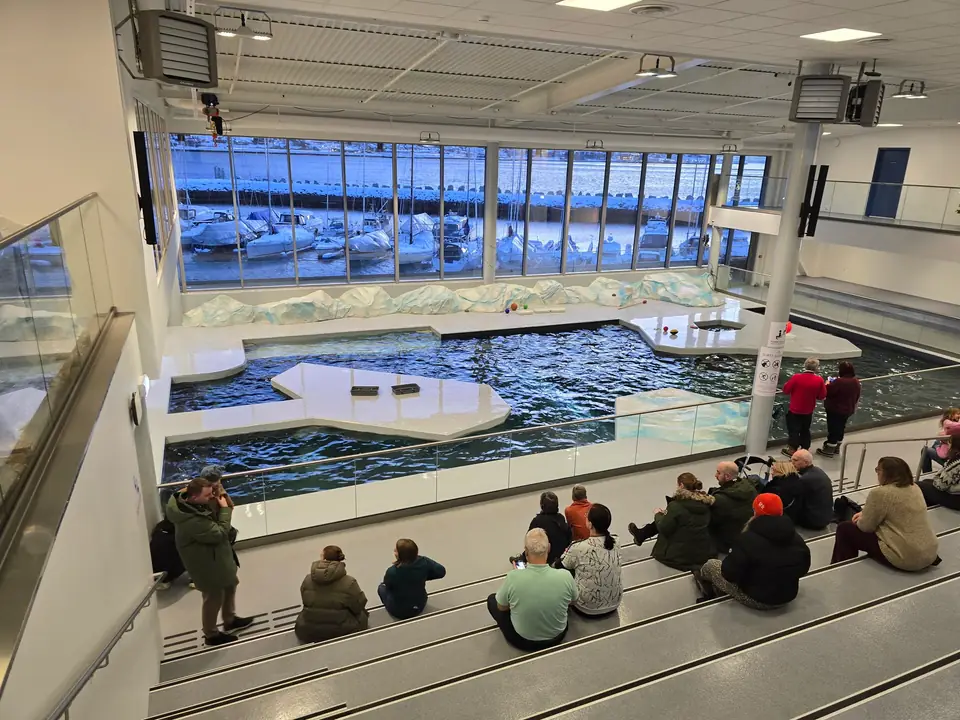
The new seal pool, with its stands, is the product of the expansion begun in 2023, budgeted at some 130 million kroner and designed by AT Arkitektur for the owner, Eiendomsspar. Its main aim was a pool of more than 1,000 cubic metres, a million litres of water, accompanied by a quarantine pool and an outdoor one. The result triples the previous one, adds large panoramic windows and natural light, and lets the seals choose whether to be inside or out, facing Tromsøysundet.
Building it was not simple: Polaria sits on the shore, with sea level above the floor of its basement. Excavation, piling and concrete pouring were scheduled by the tide, with night shifts, and part of the building was demolished while the centre stayed open. Today, from the stands, the daily training with positive reinforcement, rewarded with fish, can be followed; it stimulates the seals and prepares them for veterinary checks. After the meal comes Bella and Mai San’s favourite ritual, which has to do with ice, and it is the audio guide that tells it at the spot where it happens.