Sami culture and Arctic science
Tromsø Museum Audio Guide
A white building with a tower and a rotunda hidden in the woods of Folkeparken holds the largest Sami collection in Norway, a 240-million-year-old marine reptile and a glass box where visitors light their own aurora borealis.
- 90 min of audio
- Sami culture
Founded on 16 October 1872 through the determination of the geologist Karl Pettersen, Tromsø Museum is the oldest scientific institution in northern Norway. It arose from the regional exhibition of 1870, passed through two rented floors in the Baptist church and a classical building in Muségata, and since 1961 has occupied in Folkeparken a work by Gudolf Blakstad and Herman Munthe-Kaas made of pure geometric forms, protected in 2014.
The museum that now devotes whole rooms to the Sami of the coast was also, according to the researcher Cathrine Baglo, one of the stages where those same Sami disappeared from the display cases in the late 19th century. And some pieces it shows with pride came out of graves whose descendants ask for them to be returned to the earth. Meanwhile, the Norwegian government decided in January 2025 to move it to a new site in the centre of Tromsø.
Highlights
- Samekulturen hall — over 900 Sami objects with the visual design of Iver Jåks and the drum that is the museum's emblem
- Rávdnji and Sápmi — the Sami heritage of the Tromsø coast, Norwegianisation and the struggle for rights
- Svalbard ichthyosaur — about 6 metres of a 240-million-year-old skeleton, without head or tail tip
- Under the lights — a modern version of Kristian Birkeland's terrella for creating northern lights
- 1961 building — white concrete, pyramid-roofed tower and rotunda, protected since 2014
The story of Tromsø Museum begins with an exhibition. In 1870 the city held a regional show whose Sami and natural-history objects formed the core of a collection, and on 16 October 1872 the museum was officially born, driven above all by the geologist Karl Pettersen, who directed it until his death in 1890. It was financed by the king, the three northernmost counties of Norway and another 148 donors. Its beginnings were modest: until 1894, from 1873 or 1874 depending on the source, the whole collection fitted into two rented floors of the Baptist church and opened to the public only two hours each Sunday. Its first curator, the zoologist Jacob Sparre Schneider, held the post for 41 years, from 1877 to 1918, and for a long time was the only full-time professional in the house; almost every summer he went out to collect insects across the north of the country.
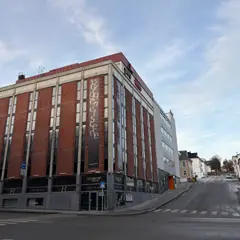
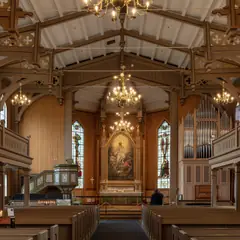
In 1894, the centenary of Tromsø as a city, the first purpose-built home arrived, a fireproof building of classical inspiration in Muségata, by Lars Solberg, with 1,500 m² on four floors, perhaps the largest in the city at the time. Today the museum is part of the university, and anyone asking what to see at Tromsø Museum finds much more than the Sami hall: medieval and Lutheran sacred art, with the winged altarpiece of Andenes and its double passion of Saint Olaf and of Christ; a small exhibition on Viking boat burials; and the small stone, of 1.17 kilos, of the largest meteorite in Norway, whose 77.5-kilo sister ended up cut into pieces and sold abroad, mostly to Vienna, because no Norwegian museum could afford it. Every 6 February, Sami National Day, the building also holds a party to which visitors are invited with or without a kofte, the traditional Sami dress. The audio guide covers five points of the museum with a story researched and checked against sources, from the facade of 1961 to the glass box where an aurora is made.
The discussion over Sami sacred mountains reaches Tromsdalstinden, the neighbouring peak of the Fjellheisen cable car, and the fauna of the living Arctic shows itself in the Polaria aquarium, beside the strait.
A white block among the birches
Tromsø Museum
Summary of this stop
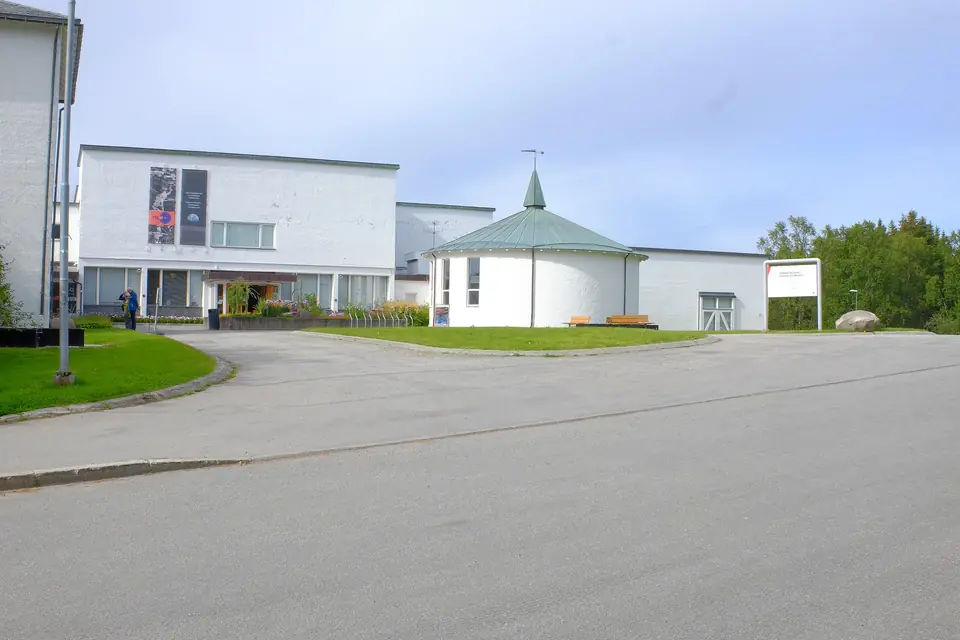
The building appears among the trees of Folkeparken, in the south of the island of Tromsøya, as a play of pure volumes rendered in white. The architecture of Tromsø Museum is read from the north entrance: a monumental access flanked by two wings of large blind panels; to the east, the long single-storey wing of the library, topped by a low tower with a pyramid roof; and to the west, a rotunda with a conical roof. It was designed by the studio of Gudolf Blakstad and Herman Munthe-Kaas, built in concrete between 1959 and 1961 and declared protected in 2014.
The move to this wood, in 1961 according to most sources (others say 1960 or 1962), left behind the house in Muségata, which passed to the municipality and since 1981 has housed the art association Tromsø kunstforening. Years later the museum wanted to be close to the new university, the fourth in Norway, which Parliament decided to create in Tromsø in 1968, but the State backed another site. In 1976 or 1977, depending on the source, the whole museum was merged into it as an institute, and even so it remains far from the campus. That distance has consequences that the narration reveals in front of the facade.
The drum and the display cases that come from graves
Sami drum in the Samekulturen hall
Summary of this stop
The permanent exhibition “Samekulturen” opened on 15 June 1973. It was produced by Professor Ørnulv Vorren and given its visual character by the Sami artist Iver Jåks, thanks to a grant he held from 1967 to 1972. More than 900 objects are arranged by types and series around reindeer herding, craft and pre-Christian religion, and in one of its display cases is the Sami drum that entered the collection on 28 March 1962 and has since been the emblem of the museum’s Sami outreach. That is no small thing in a house that keeps the largest collection of Sami objects in Norway and the main international archive of Sami song and music tradition, and that since 1943 has awarded the Rektor J. Qvigstad gold medal only eight times, for exceptional research on Sami ethnography and language.
The hall also raises an uncomfortable question. In 1958 the skeletons of 21 Skolt Sami were exhumed on the island of Hautasaari, in the Paatsjoki (Pasvik) river; the remains ended up at the University of Oslo, and the objects buried with them are displayed in this museum. In June 2024, the Skolts gathered at Neiden and Nellim asked that the remains be returned to the Svanvik cemetery and the grave goods buried with them, something that complicates Norwegian cultural-heritage law, because those objects legally belong to the State. It is a story still open, and the audio guide raises it before the display case without treating it as closed.
The sea Sami return to the display case
Rávdnji exhibition
Summary of this stop
Inside the Sami hall, the exhibition “Rávdnji – The Strong Current”, added in 2024, is devoted to the Sami heritage of the Tromsø area itself: the coastal Sami culture, the ties between coast and interior and the consequences of Norwegianisation and of changing borders. Since 2000 it has been joined by “Sápmi – a nation in the making”, on the Sami political awakening and its struggle for cultural and political rights.
That return of the coast has a background. At the Tromsø exhibition of 1870, the one that gave rise to the museum, the sea Sami held a prominent place; at the one held in the same city in 1894 that category no longer existed, and Sami life was shown only as the nomadic culture of reindeer herders. The researcher Cathrine Baglo links that change to the assimilation policy, which imposed reindeer herding as the only “authentic” Sami culture. In these rooms the narration tells how a people could vanish from the display cases without leaving the fjords.
Six metres of reptile without a head
Svalbard ichthyosaur
Summary of this stop
In the geological exhibition “TellUs”, beside a whale skeleton and a nugget of solid gold, lies the fossil of a 240-million-year-old ichthyosaur, a marine reptile from a vanished sea. It was found in 2001 in Sauriedalen, on Svalbard, excavated in 2006 and 2007 and has been on show in the museum since 2008.
It preserves some 6 articulated metres, but the head and the tip of the tail are missing, lost to erosion; complete it would have measured between 10 and 12 metres. The distance between what remains and what the animal was is the real spectacle of this stop, and the audio guide helps to reconstruct it with the eyes on the skeleton itself.
An aurora lit by hand
Under the lights plasma chamber
Summary of this stop
The exhibition “Under the lights”, of 2020, explains the aurora borealis as the physicist Kristian Birkeland understood it: in his laboratory he emptied of air a glass box holding a small magnetised Earth, the terrella, and by passing current through it he saw light appear around the poles. Here the visitor operates a modern version of that apparatus and creates their own aurora. The original, made in 1901 in Göttingen, is a piece of the Norsk Teknisk Museum in Oslo, whose record lists it as lent to the University of Tromsø; and the historian Terje Brundtland maintains that laboratory auroras were already being attempted around 1675, so the experiment may not have been as unprecedented as is usually told.
The stop also looks ahead. In January 2025 the Norwegian government decided to build a new home in the centre of Tromsø, so the museum will leave the Folkeparken building, some 30 minutes’ walk from the centre, though first Parliament has to approve an initial grant. The route ends with that idea, and the audio guide saves for the end what this change means for a museum that has been learning to tell the Arctic.