Sunrise ghat on the Ganges
Assi Ghat Audio Guide
Varanasi's southernmost ghat is named after a sacred river that no longer flows into it: a wide flight of steps open to the Ganges where the Subah-e-Banaras is sung every sunrise while the city keeps battling the silt.
- 45 min audio
- Sacred steps to the Ganges
Inscriptions of the Gahadavala dynasty, from the 11th and 12th centuries, already mention this ghat, and Varadaraja's Sanskrit text Giravana-padamanjari praises it in the 17th century. It is the first of the five Panchatirthi, Varanasi's baths of greatest merit, and represents the head of Vishnu lying along the river. Yet the stone steps seen today date from 1988: until the 19th century this was a natural bank, open and wooded.
Asi means sword, and legend says the river was born from the weapon of the goddess Durga to cut off evil at the southern border of the sacred city. Today that confluence is an absence: the mouth of the Assi was diverted south in 1981-1982, the administration treats it as a sewer and every year thousands of square metres of silt have to be cleared from the steps that the current once carried away.
Highlights
- Subah-e-Banaras — a Ganges aarti around 5:30, Vedas recited in unison, ragas and yoga
- Steps of 1988 — about 125 by 110 metres over what was a wooded bank
- Old mouth of the Assi — the river that, according to legend, sprang from Durga's sword
- Asi Sangameshvara temple — the plaque declaring it first of the five Panchatirthi
- Pappu's tea stall — chai since 1948 and the heart of the novel Kashi Ka Assi
The history of Assi Ghat is older than its steps. Inscriptions of the Gahadavala dynasty, between the 11th and 12th centuries, already name this point on the Ganges, and in the 17th century Varadaraja praised it in his Giravana-padamanjari. Even so, the flight of steps that now closes Varanasi to the south is recent: the ghat was natural, open and wooded ground until the 19th century, and in 1988 the Uttar Pradesh Irrigation Department faced it in stone with the support of the Ganga Directorate project. In 1902 Queen Dulhin Radha Dulari Kunwar, of the Sursand estate in Bihar, bought its southern part and built a small palace there, now the Hotel Ganga View, and the Lakshminarayana temple.
It is the city’s southernmost ghat, a strip of some 125 by 110 metres with room for about 22,500 people, which at Dev Deepawali receives more than 600,000 visitors. It is also one of the main places for Surya Shashthi, the sun festival of the month of Karttika, when more than ten thousand mothers make offerings for the wellbeing of their children. Beside the turn-off that goes down to the ghat stands the Jagannath temple, a replica of the one in Puri, whose god, according to tradition, falls ill every year after his ritual bath and convalesces for two days hidden from the faithful before setting out on his chariot. And neighbourhood memory places very close by the birthplace of Manikarnika Tambe, the future Rani of Jhansi, heroine of the rebellion of 1857, whose year of birth is still disputed.
What to see at Assi Ghat, and in what order, follows the thread of a loss: from the street of chai stalls to the top of the steps, from there to the southern end where the river used to flow in and, lastly, to the small temple that still honours that confluence. The audio guide covers those four stops with a documented narration that ties together the neighbourhood, the dawn rite and the missing river.
The tradition that links Assi to Tulsidas continues inland, less than a kilometre away, in the Sankat Mochan Temple, which is attributed to him. About two kilometres downstream, Dashashwamedh Ghat takes over each night with the Ganga Aarti, and on the opposite bank, somewhat further south, stands Ramnagar Fort.
Bhang, chai and a novel in the courts
Chai stall street
Summary of this stop
Before being a sacred backdrop, Assi is a neighbourhood with a character of its own, and the street that runs down to the ghat makes that clear: hundreds of small tea stalls line it. Among them is the shop that Baldev Singh opened in 1948, which served bhang alongside strong milky chai. Today it is known by the nickname of his son, Pappu, and it is the centre of Kashi Ka Assi, the novel that Kashinath Singh published in 2004 about the life and the gatherings of this neighbourhood.
The book was made into the film Mohalla Assi, and the film fought its own battle. In 2015, after the trailer, came a police complaint in Varanasi over its foul language and a petition from a group of lawyers asking the censors not to approve it. On 30 June of that year a civil judge in New Delhi banned its release because a character dressed as Shiva swore and charged a few hundred rupees to be photographed with people on the ghats, and shortly afterwards a court in Bihar ordered proceedings against the actor Sunny Deol, the director Chandraprakash Dwivedi and the novelist himself.
The film leaked onto the internet in August 2015, the Delhi High Court cleared it in December 2017 with a single cut and it reached cinemas on 16 November 2018. What that fight says about a neighbourhood used to laughing at itself is told right there, amid the smoke of the stalls.
Dawn over steps of 1988
Assi Ghat
Summary of this stop
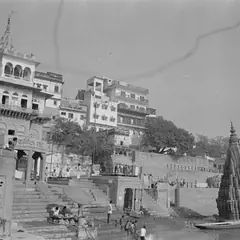
From the top, the wide stone steps descend towards the Ganges with an air of centuries, but they are a facing of 1988 over what was a wooded bank. In the lower part the silt the river leaves each season shows through. It is Varanasi’s southernmost ghat, and its breadth explains why crowds fit here during the great festivals.
Beside the water stands the stage of the Subah-e-Banaras, the programme with which the ghat wakes up. Around 5:30 the pandits offer the morning aarti to the Ganges, the students of the Panini Kanya Maha Vidyalaya recite the Vedas in unison, an hour of morning ragas follows and it ends with a yoga session. It is organised by Pramod Mishra’s Nagrik Samiti.
Its origin, however, is told in more than one way. The chronicle of its launch places it on 24 November 2014 at Malviya Ghat, at the hands of the magistrate Ratnesh Varma, with a stage, red carpet and halogen lights; other versions attribute it to an Uttar Pradesh minister or to Pramod Mishra himself and present it from the start as something of Assi Ghat. How so recent a rite has become the image of sunrise in Varanasi is what the narration unveils in front of the stage.
A river born from a sword
Old mouth of the Assi
Summary of this stop
At the southern end of the ghat, what one sees is an absence. Asi means sword, and a documented tradition tells that, after defeating the demons Shumbha and Nishumbha, the goddess Durga cast off her weapon and the river Assi sprang from it. Versions do not agree on the place: in one the goddess dropped it beside the Durgakund pond, in another the blade’s blow against the earth opened the stream and in another the water emerged from Mahadev Kund. The Kashi Khanda plays on the same word: the gods placed the Asi to the south of Kashi to cut down the evil intentions of sinners like a sword, and the Varana to the north to ward off obstacles. The belief that Varanasi owes its name to those two rivers remains very much alive, although historiography considers it more likely that the Varuna alone gave it.
That river of about 8 kilometres flowed in here until, in 1981-1982, its channel was diverted and the mouth moved some 500 metres south. According to one chronology, in 2017 a sewage pumping system shifted the confluence again, about a kilometre upstream. Without the current and with the bank faced in stone, some 8,200 square metres of silt are deposited every year along 60 metres of the Assi and Rivan ghats, and removing it is costly. On 8 November 2014 Narendra Modi launched the Swachh Bharat campaign here in his constituency, spade in hand alongside hundreds of people, and after the ferries that carried off the silt passed, steps that had not been seen reappeared.
The wound remains open in the courts. The Uttar Pradesh government’s plan classifies the Assi as a «drain», a sewer, in order to capture its waters; in February 2026 the National Green Tribunal recalled that it is a tributary of the Ganges protected by the order of 2016, and in August it summoned the director of the National Mission for Clean Ganga. In 2021, moreover, Varanasi received a Smart City award for the eco-restoration of a river that was still polluted. Whether the Assi is a river or a drain is the question the route poses with the empty bank in front.
Vishnu’s head beside the peepal
Asi Sangameshvara temple
Summary of this stop
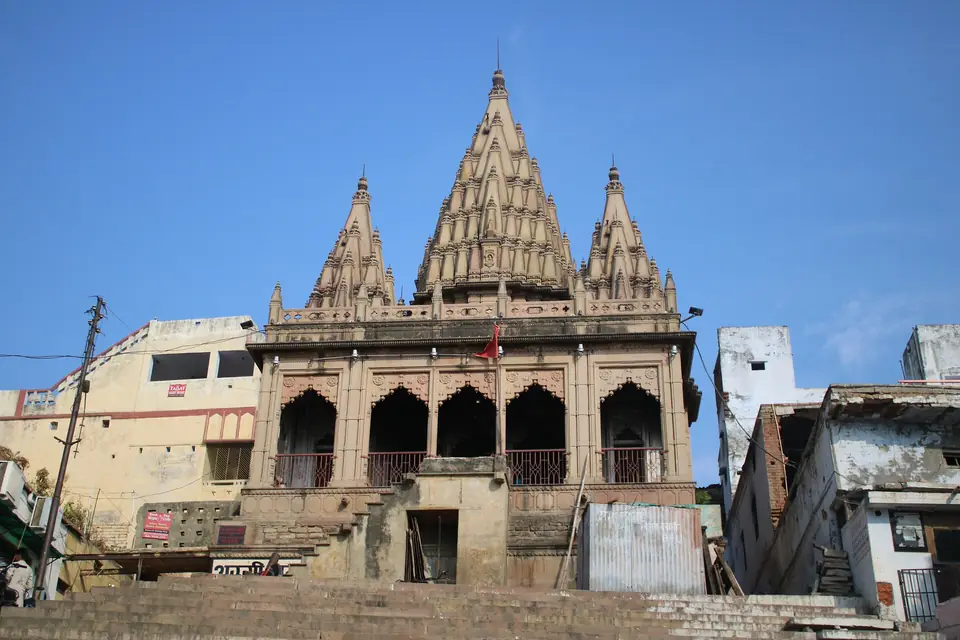
The last stop gathers the ghat’s oldest sanctity. At the foot of a peepal, the sacred tree, pilgrims venerate a lingam of Shiva, and right beside it stands the small marble temple of Asi Sangameshvara, the «Lord of the Confluence of the Asi». A marble plaque declares it one of the Panchatirthi.
Asi is the first of those five ghats of greatest merit in Varanasi, together with Dashashvamedha, Manikarnika, Panchaganga and Adi Keshava: bathing at all five is equivalent to bathing at all of them, and at this end of the river lies the head of Vishnu, stretched along the Ganges. It is the same place cited by the Gahadavala inscriptions and praised by Varadaraja centuries later.
According to tradition, the poet Tulsidas, author of the Ramcharitmanas, died here, on the banks of the Ganges, in 1623. The year is usually accepted, but the day and month are disputed and the verse that places his death at Assi Ghat has been called apocryphal. Why a temple dedicated to a confluence that no longer exists still stands, and what that means for the whole ghat, is the idea with which the audio guide closes.