Sacred cremation ghat
Manikarnika Ghat Audio Guide
On the steps of Manikarnika the pyres burn day and night with a flame that, according to tradition, has never gone out: here death is not hidden, it is managed, prayed over and rebuilt every day against fire, silt and the Ganges itself.
- 45 min audio
- Sacred cremation ground by the Ganges
Manikarnika already appears in a Gupta inscription of the 5th century, and the Matsya Purana counts it among Kashi's five sacred water sites. It was Varanasi's first stone ghat, built in 1372 by two brother kings according to its oldest inscriptions, and it has never stopped being remade since: Bajirao Peshwa renewed the steps around 1730, Queen Ahilyabai Holkar rebuilt it entirely in 1791 and in 1912 Raja Sir Moti Chand raised its platform above the floods.
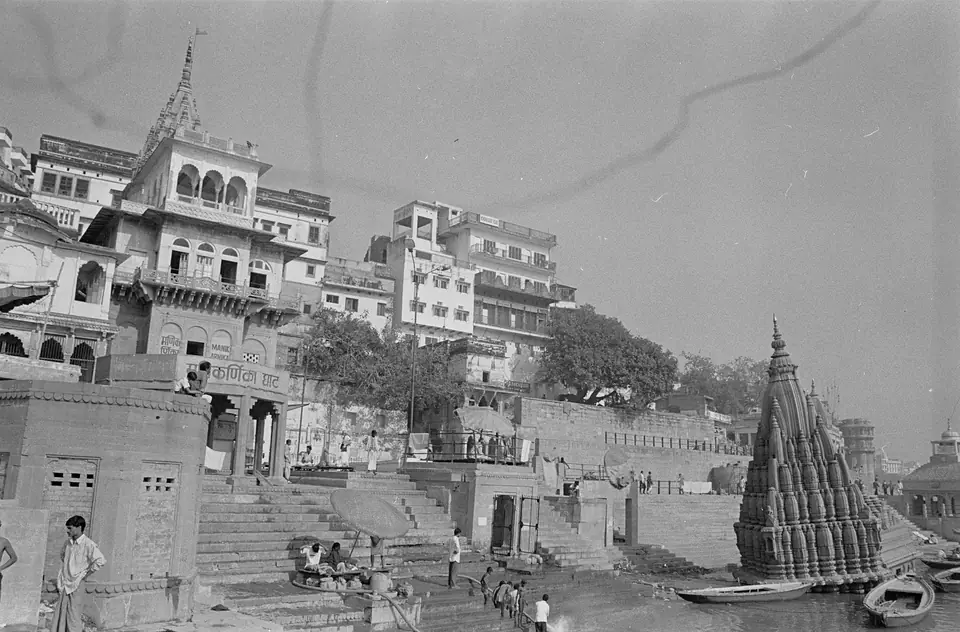
Benares's holiest cremation ground owes its name, according to tradition, to a marital ruse: Parvati hid her earring, the manikarnika, here to keep Shiva in Kashi, and the god is still looking for it. A few metres from the pyres, the Ratneshwar temple leans about nine degrees and spends most of the year under water.
Highlights
- Cremation terraces — pyres lit day and night with the fire kept by the Dom
- Tarakeshwar temple — a work of Ahilyabai Holkar from 1795 with a four-faced lingam
- Manikarnika Kund — a sacred tank some 18 metres wide that is rescued from silt every year
- Charanpaduka — a marble slab with Vishnu's footprints, the holiest spot according to Prinsep
- Ratneshwar temple — tilted about nine degrees and submerged much of the year
The history of Manikarnika Ghat begins long before its stone. An inscription from the Gupta period, of the 5th century, already names it, and the Matsya Purana, around the 6th and 7th centuries, includes it among Kashi’s five sacred water sites. The stonework came later and its date is debated: the ghat’s oldest inscriptions speak of 1372 and of two brother kings, while another source mentions stone steps of 1303 with no known builder. In any case, it was the first stone ghat of Varanasi.
Since then, the ghat has been remade again and again. Bajirao Peshwa paid for the reconstruction of the steps around 1730 (other sources say 1735), the Maratha queen Ahilyabai Holkar, ruler of Indore, rebuilt it entirely in 1791, and there were new repairs in 1872 and in 1965, this time by the Uttar Pradesh government. In 1912 the work of Raja Sir Moti Chand was finished, raising the platform above flood level. The latest chapter is the redevelopment project launched in July 2023: in January 2026 its machines knocked down structures and set off protests over a century-old idol of Ahilyabai Holkar; the administration denied any damage to temples and said the removed pieces would be reinstalled. Its new steps now stand beside the old stretches.
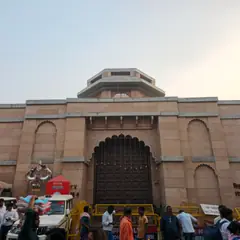
What to see at Manikarnika Ghat, and how to look at it, calls for some context: it is an active place of mourning, and photographing the cremations is considered a grave lack of respect. The audio guide’s route runs from south to north, from the cremation terraces to the Tarakeshwar temple, the tank that gives the ghat its name and the leaning temple that the river is slowly swallowing, with a narration documented and checked against historical sources.
A little over half a kilometre upstream, Dashashwamedh Ghat swaps the pyres for the lamps of the Ganga Aarti, and Queen Ahilyabai Holkar, who remade this ghat in 1791, also built the Kashi Vishwanath Temple, a short walk inland. The region’s other great religious chapter, the Buddhist one, waits on the outskirts, in Sarnath, around the Dhamek Stupa.
An inherited flame and a fee with a legend
Manikarnika Ghat
Summary of this stop
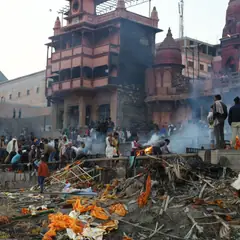
In the southern sector, on stepped platforms, several pyres burn at once. Logs are piled in mountains on the steps and in the alleys that run down to the river, and beside the water a multi-storey crematorium building lets ash escape through its metal chimneys day and night. Each cremation consumes on average some 500 kilos of wood. How many take place is another matter: the heritage dossier estimates that, of a little over 30,000 cremations a year in Benares, about 28,000 take place here, but other sources give very different figures, from 50 to several hundred a day.
The fire has keepers. The Dom, the caste of funeral attendants, hand the chief mourner the flame of the ghat, the one that never goes out, to light the pyre, and the family pays the so-called «Dom tax» even if it does not take it. Some 40 Dom families live in the ghat’s alleys and work for the Dom Raja, the «king of the Dom», hereditary keeper of that flame. That it has burned for thousands of years is a matter of tradition. In 1998 the municipality set a fee of 100 rupees for their work, which the Dom say they do not claim.
That fee has a mythological echo. Tradition places at this cremation ground the legend of King Harishchandra, the one who never lied, sold as a slave to a chandala who set him to collect from those who came to cremate their dead; the Dom of Benares say that master was Kallu Dom. What happened on the day the queen arrived with the body of her son, and who the master really was according to the Markandeya Purana, is told right there, in front of the pyres.
The promise of liberation
Tarakeshwar temple
Summary of this stop
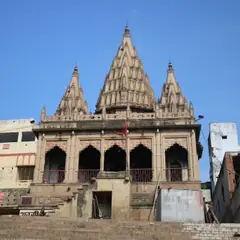
On the bank stands the Tarakeshwar temple, the «Lord of the Crossing», which Ahilyabai Holkar had built in 1795: a rectangular plan on six pillars, an image of Ganesh at the entrance and a four-faced lingam. It is worshipped at the end of each cremation, because here Shiva whispers to the deceased the mantra of liberation. It is the promise that gives meaning to the whole ghat.
Very close, beside a small Ganesh temple, rests the Charanpaduka, a marble slab with the footprints of Vishnu. In 1832 James Prinsep called the spot between the Tarakeshwar and Ratneshwar temples «the most sacred place in Benares», and only distinguished figures are cremated there.
When the pyre cools, whoever officiated at the cremation writes a number in the ash with a stick or a finger. The explanation that circulates at the ghat links it to each person’s qualities and to the surrender of their deeds to Shiva, but no sacred text mentions the custom and nobody knows when it began: it rests solely on the families who have been cremating here for generations. Which number it is and what it means is revealed in the audio guide.
Parvati’s hidden earring
Manikarnika Kund
Summary of this stop
In the centre of the ghat, behind a cast-iron railing, opens the Manikarnika Kund, also called Chakra-Pushkarini: a square, stepped tank about 18.3 metres wide at the top that narrows to about 6.1 metres at the waterline. Every year, when the Ganges flood recedes, it is left filled with alluvial silt, and its excavation is completed for Shivaratri, between February and March, when a great festival is held here.
The tank holds the legend that names the place. According to tradition, Parvati was tired of Shiva never staying at home, always surrounded by devotees, and to keep him in Kashi she hid her earring, the manikarnika, at this ghat. Shiva is still looking for it, and that is why, it is said, he asks every deceased person cremated here whether they have seen it. Not all versions agree on who owned the jewel: depending on the source, it is attributed to Shiva, to Parvati or to Sati.
The same jewel appears in the story with which the Dom explain their own origin, and the ghat’s calendar has room for festivals as singular as a Holi with ashes, whose antiquity is disputed. How that luminous legend connects with the fire of the pyres is discovered beside the railing, with the tank in front.
The fight with the river
Ratneshwar Mahadev Temple
Summary of this stop
At the foot of the ghat, the Ratneshwar Mahadev temple visibly leans backwards, its curved shikhara tilted about nine degrees, a tilt that does not appear in photographs from the 1860s. Depending on the season it is seen dry, with water up to the shrine or almost covered: it spends most of the year under water, and in August 2026 the flood submerged it completely. James Prinsep, assay master of the Benares Mint, drew it and noted that, when the entrance was under water, the priest dived in to perform the worship.
Who built it and when is a puzzle with several answers, from a servant of Raja Man Singh to Queen Baijabai of Gwalior, and false data about its height, which is around 13 metres, circulates on the internet. To the north, another trace of the wrestling with the terrain: around 1735 Bajirao Peshwa began a neighbouring ghat, but before the base had risen a few metres the weight of the masonry caused a slide and everything collapsed. Its unfinished, sunken façade is still in view, partly repaired in 1830 by Queen Baijabai of Gwalior.
Beyond that point, the northern sector, paved and devoted to ritual bathing, contrasts with the cremation terraces. Why Varanasi’s first stone ghat is also the one that fights hardest against the river and gravity, and what each version says about the origin of the leaning temple, is explained by the audio guide’s last stop.