Fortress-palace on the Ganges
Ramnagar Fort Audio Guide
Facing the ghats of Benares, on the other bank of the Ganges, stands a sandstone fort where the family of the former king of Kashi still lives, and which every autumn stops being a home to become the palace of Ayodhya.
- 75 min audio
- Inhabited royal palace
Ramnagar Fort was built in 1750 in sandstone by order of the maharaja Balwant Singh, ruler of the State of Benares, on the eastern bank of the Ganges, opposite Tulsi Ghat and on high ground above the floods. His son Chait Singh improved it greatly, and in 1781 its walls kept him safe during the revolt against Warren Hastings. Today it houses a museum in the former Durbar Hall and remains the residence of the Kashi Naresh's family.
The title of maharaja has been abolished since 1971, but the flag is still raised over the fort when Anant Narayan Singh is at home, and every autumn the residence itself serves as the palace of Ayodhya in a 31-day Ramlila, without microphones, with kerosene lanterns and with children venerated as gods who cannot touch the ground.
Highlights
- Walls and bastions of 1750 — the sandstone front seen from the ghats of Benares
- Flag over the fort — raised when the Kashi Naresh is in residence
- Ramnagar Ramlila — 31 days of sacred theatre with the fort as the palace of Ayodhya
- Astronomical clock — shows the hour, date and the positions of the Sun, Moon and planets
- Veda Vyasa temple — at the water's edge, with Benares across the river
The history of Ramnagar Fort begins in the mid-18th century with Balwant Singh, maharaja of Benares from 1738 to 1770. First he built a fort and a capital at Gangapur; then he moved the capital to Ramnagar and, in 1751, expelled the representative of the nawab of Awadh from Benares. The accepted date for the fort is 1750, although the inscriptions on the outer walls are dated to the 17th century, which points to an earlier fortification or to a dating that is still disputed. Nor is there agreement on the colour of the stone: some sources speak of red sandstone and others of cream-toned Chunar sandstone, which is what is seen from the ghats.
In March 1796, Thomas Daniell published an aquatint of the fort with a text describing it as the work of Balwant Singh greatly improved by his son Chait Singh, who also began a stone temple beside its walls of which only the base was completed. Fifteen years earlier, in August 1781, that same fort had served as a refuge for Chait Singh during the revolt of Benares against the governor-general Warren Hastings.
But Ramnagar Fort is not a monument at a standstill. It is still the home of the family of the Kashi Naresh, the former king of Kashi, and only part of it can be visited. What to see in it runs from the gate and the courtyard of the cannons to the Durbar Hall museum and to the Vyasa temple by the water, and the audio guide’s route ties those pieces together with the history of a court without a crown and of a sacred theatre that every autumn takes over the whole town.
From this bank, the nearest ghat on the city side is Assi Ghat. The Kashi Naresh managed the Kashi Vishwanath Temple until 1983, and the Ramlila has another stage of tradition in the city: that of Tulsi Ghat, which the Sankat Mochan Temple sponsors.
The flag that says whether the king is in
Ramnagar Fort
Summary of this stop
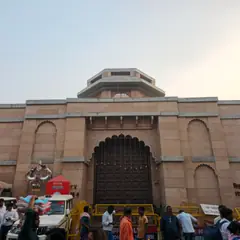
In front of the main gate one senses the threshold between the noise of the town and a royal house that is still inhabited. The palace’s private wings, to one side of the white towers, remain closed because the family of the Kashi Naresh lives there, today Anant Narayan Singh. The title of maharaja has been abolished since 1971, but an ancient gesture endures over the fort: the flag flies on the mast when the maharaja is at home.
That crownless power is still alive among the people. It is documented tradition that, each afternoon of the Ramlila, the performance does not begin until the Kashi Naresh’s elephant, coming out of the fort, reaches the day’s stage. On seeing it, thousands of spectators do not shout the name of Rama, the protagonist of the play, but «Har Har Mahadev!», the greeting to Shiva: in Benares the king of Kashi is held to be the religious head and it is believed that Shiva entrusted him with the throne. An elder then shouts «Shaant raho!», the murmur falls and the lila begins.
On the day of Dasahra, the maharaja Vibhuti Narain Singh used to ride out on an elephant with his court from the fort to the field that serves as Lanka, cross it and leave before the death of Ravana. The reason for that withdrawal, a rule among kings, is the first detail the narration reveals at the gate.
A courtyard of cannons that becomes Ayodhya
Courtyard of the cannons
Summary of this stop
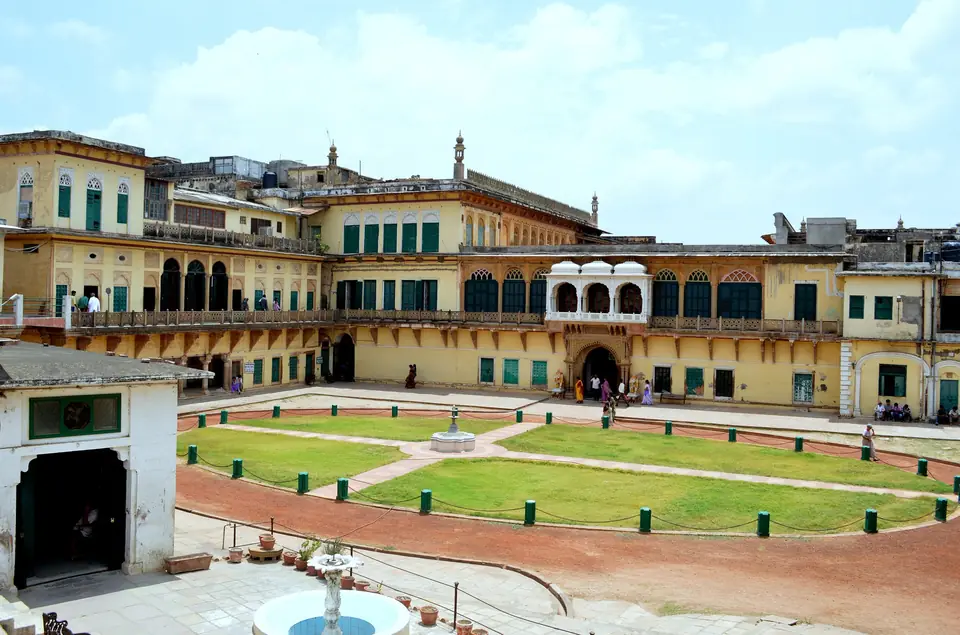
Past the arched entrance opens a large courtyard with a garden and old cannons, the antechamber of the palace. It is here that the way of looking at the fort changes: during the Ramnagar Ramlila, the king’s own house serves as the palace of Ayodhya, while other fixed stages spread over a radius of some 5 km stand in for Janakpur, Chitrakoot or Lanka, and the audience walks with the actors from one to another. It lasts 31 days, against the usual 10 of the Ramlilas that culminate at Dasahra, because the whole Ramcharitmanas is recited in it.
It is performed without microphones, with kerosene lanterns and flares. In the 1940s someone installed microphones and the audience, angry, stormed the stage and smashed the equipment. The children who embody Rama, Sita and their brothers are chosen by a voice test on the roof above the fort’s Jawahirkhana, before Anant Narayan Singh: in 2026, 23 children from Varanasi, Chandauli and Mirzapur applied.
According to a documented tradition, after the puja of each performance those children, aged 10 to 14, become swarups, living embodiments of the gods. While they wear the crown, their feet must not touch the ground: volunteers carry them on their shoulders from one stage to another, and throughout the month nobody calls them by name. That they remain children has its price, and the episode of 2018 that shows it is told in the courtyard.
A clock of 1872 that calculates the sky
Durbar Hall astronomical clock
Summary of this stop
The former hall of public audiences, the Durbar Hall, has housed since 1964 the museum founded by the maharaja Vibhuti Narain Singh, known as Saraswati Bhawan. It is toured in five galleries: antique carriages and palanquins, textiles, arms, personal belongings and photographs. In the half-light appear brocade palanquins, silver elephant howdahs, kimkhwab silk costumes, portraits of the maharajas and an armoury of swords, daggers and matchlock muskets from Burma, Japan and Africa.
In the fourth gallery waits the astronomical clock. According to the museum’s label, B. Mulchand built it in 1872, although another source dates it to 1852 and attributes it to the court astronomer. It shows the hour, day, month, year, week and the positions of the Sun, Moon and planets, and documented tradition adds that it is set to the latitude, longitude and altitude of the city, that it must be wound every eight days and that it has been repaired only once.
The museum also keeps a link with the present. When the State of Benares was integrated into the Indian Union in 1948, a clause of the merger agreement fixed an annual grant for the Ramlila, and the royal armoury, the elephants and the palace servants remain at the service of the performance. What connects the display cases of this hall with the theatre of each autumn is what the audio guide reveals between the galleries.
The bank of the sage exiled from Kashi
Veda Vyasa temple
Summary of this stop
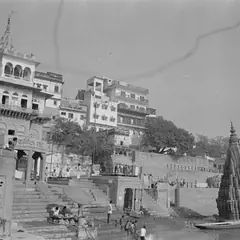
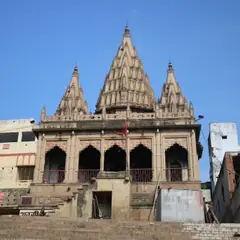
A passage in the fort leads to the Veda Vyasa temple, beside the water, with the ghats of Benares across the river. From here one understands why the fort was raised on this bank: facing the city, on high ground above the floods, and far enough away to serve as a refuge for Chait Singh in 1781, when Hastings had to flee to the fort of Chunar. It is also the image that Daniell engraved in 1796, with Chait Singh’s unfinished temple beside the walls.
Long before the palace, the legend says, this bank was an exile. Vyasa, to whom tradition attributes the Mahabharata, was expelled from Kashi: some say Shiva banished him for his bad temper, others that it was the goddess Annapurna, and others that he was badly treated in the city or that he swore never to set foot in it again. He settled here to meditate and the place came to be called Vyasa Kashi, «the Kashi of Vyasa». Inside the temple, three lingams under a copper cover represent Vyasa, his son Sukhdev and Kashi Vishwanath, and it is said that the pilgrimage to Kashi is not complete without stopping here.
Within the compound there are also the south-facing shrine of Dakshin Mukhi Hanuman and the temples of Durga and Chhinnamastika. The route closes at sunset over the Ganges, looking at Benares from outside, and what that exile’s gaze says about the whole fort is left for the audio guide’s last stop.