Hanuman temple and music festival
Sankat Mochan Temple Audio Guide
A Hanuman temple hidden in a grove of monkeys, where the phone stays in a locker: here tradition places Tulsidas's vision, here a bomb went off in the middle of the aarti in 2006 and here, every April, classical music plays for free until dawn.
- 40 min audio
- Living Hindu temple
In the south of Varanasi, near the Assi river, the shrine of Hanuman «the reliever of troubles» is attributed to Tulsidas, the author of the Ramcharitmanas, who is said to have had a vision of the god there. The inner image is associated with the poet's time, but most of the buildings in the compound date from the mid-20th century, when the temple gained weight with the city's expansion to the south and the founding of Banaras Hindu University. Its architecture is a devotional idea: Hanuman faces the shrine of Rama head-on, his heart aligned with Rama's feet.
This serene courtyard, among monkeys and marigold garlands, holds a harsh memory: on 7 March 2006, a Tuesday, a bomb went off during the aarti and caused 10 deaths and 40 injuries in the compound. The next day the faithful resumed worship. Since 1923 the same ground has hosted the Sankat Mochan Sangeet Samaroh, now six nights of free concerts where the audience, seated on the floor, acclaims the musicians with a cry to Shiva.
Highlights
- Hanuman facing Rama — the image looks at Rama's shrine, its heart aligned with the god's feet
- Monkey grove — a semi-wild reserve of about 3.4 hectares surrounds the compound
- Legend of Tulsidas — a thirsty ghost is said to have given away Hanuman disguised as a leper
- Memory of 2006 — the aarti interrupted by a bomb and worship resumed the next day
- Sangeet Samaroh — since 1923, six nights of free classical music from 7:30 pm to dawn
The history of the Sankat Mochan Temple begins with a poet and, according to tradition, a ghost. The shrine is attributed to Tulsidas (c. 1532–c. 1623), author of the Ramcharitmanas, and stands where he is said to have had a vision of Hanuman, beside the Assi river. The founding tale, with Hanuman disguised as an old leper who attends the poet’s recitation and guides him to a clearing in the forest, does not appear in writing until around 1713, in Priyadas’s Bhaktirasabodhini, almost a century after Tulsidas’s death. That is why the widespread claim that it was «founded in the early 16th century» does not fit the poet’s chronology, and what is seen today is largely of the 20th century: most of the buildings date from the middle of that century, tied to the growth of Banaras Hindu University, although one source attributes the present structure to Madan Mohan Malaviya at the start of that century.
Tradition also says that around 1607, afflicted by a sharp pain in his arms, Tulsidas composed the Hanuman Bahuk before this image. Since 1933 the temple has sponsored the Ramlila of Tulsi Ghat, eighteen days of Ramayana performed during Dussehra, and every morning and afternoon the Ramcharitmanas is recited before Hanuman, above all the Sundar Kand. On Hanuman Jayanti, the full moon of Chaitra, flag processions set out from different neighbourhoods, the most prominent from the Durga temple, and all end here.
What to see at the Sankat Mochan Temple goes well beyond the shrine: the walk among monkeys, the arrangement that sets Hanuman facing Rama, the courtyard that knew the violence of 2006 and the stage of a festival that lasts until dawn. The audio guide covers those four layers in the order in which they appear on crossing the gate.
From the grove it is less than a kilometre to Assi Ghat, where tradition places Tulsidas’s death. The devotion to Rama that runs through the temple reaches its greatest scale in the Ramlila of Ramnagar Fort, across the river, and the region’s other great religious tradition, the Buddhist one, lies in Sarnath, around the Dhamek Stupa.
From the security check to the grove
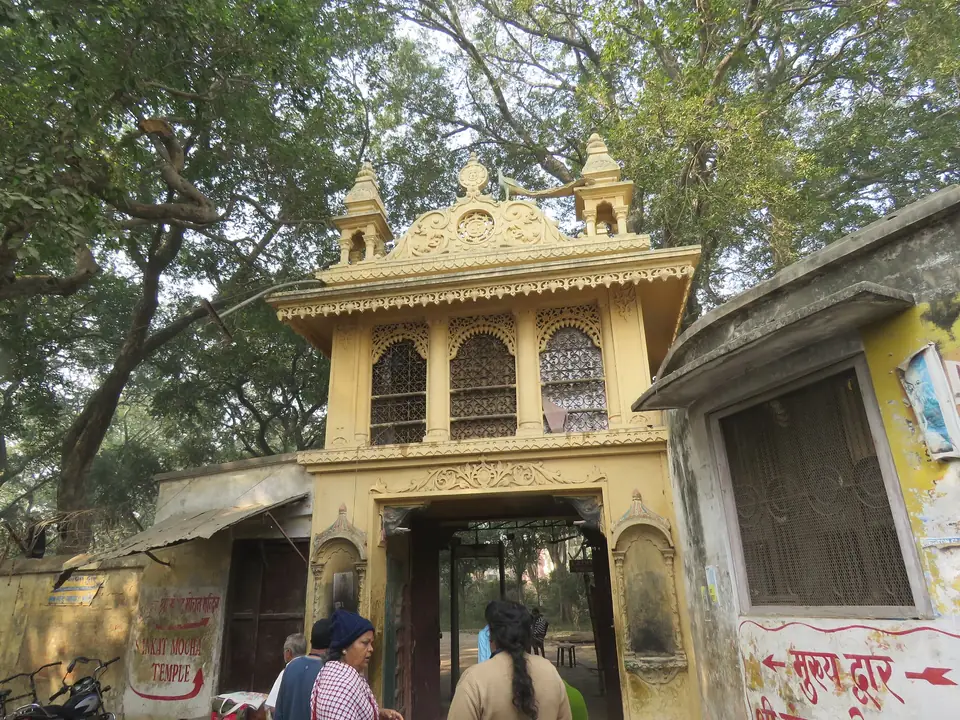
Shri Sankat Mochan Hanuman Temple
Summary of this stop
The visit starts with an unusual gesture: at the entrance there is a police check, and phones and cameras are left in lockers at the temple itself. The permanent police post was installed after the attack of 2006. The rule fits a decision of 2007, when the temple launched a website but the then deputy mahant, Vishwambhar Nath Mishra, ruled out online darshan and digital donations: the purpose, he said, was not to put the temple a click away, but to bring it so close to people’s hearts that they would have to come in person.
Past the gate, a tree-lined path leads to the courtyard through a semi-wild reserve of about 8.5 acres, some 3.4 hectares, where troops of monkeys roam. Hence the Hindi nickname «monkey temple», although it was not always theirs: in 2007 local guides recalled that the backpackers’ «monkey temple» was the Durga temple, and that hardly any foreigners reached Sankat Mochan before 2006.
Almost everything built is more recent than it looks, the result of the 20th century and of the university town that grew around it. Why a temple that guards itself so much from the street has become so beloved in Benares is the question with which the narration opens at the foot of the trees.
A devotional phrase made into a shrine
Sankat Mochan Hanuman image
Summary of this stop
Before the main shrine, the image of Hanuman appears covered in vermilion and adorned with garlands of marigold and tulsi. Its placement is the key to the temple: it faces the shrine of Rama and Sita head-on, so that Rama’s feet line up with Hanuman’s heart. Even the material of the image is disputed: devotional tradition describes it as clay, modelled by Hanuman himself or by Tulsidas, while the scholar Philip Lutgendorf records it as a stone image attributed to the poet’s time. At the stalls in the compound are sold the chickpea-flour laddus with ghee that are offered to him, and in the courtyard there is a well that, it is said, dates from Tulsidas’s time and from which the faithful drink.
Before the encounter with Hanuman, says the legend, there was a preta, a spirit condemned to perpetual thirst, who lived in a tree that Tulsidas watered every morning with the leftover water from his pitcher. Grateful, it offered him a wish; it could not show him Rama, but it could reveal that Hanuman came in disguise to his recitations and could be recognised as the first to arrive and the last to leave.
Tradition adds a literary clue: in doha 1.7 of the Ramcharitmanas the poet bows to a preta, and Rambhadracharya holds that it is the same ghost. How what devotion tells is separated, in this story, from what was written, and when, is unravelled in front of the image.
A Tuesday in 2006 by the tree
Courtyard tree of the shrine
Summary of this stop
In the centre of the courtyard, by the tree, daily prayer coexists with a specific memory. On Tuesday 7 March 2006, the day of the week consecrated to Hanuman, at 6:20 pm, with the temple packed during the aarti and several weddings under way, a bomb hidden in a container beside the gate where women usually sit went off. Sources put the victims at the temple at 10 dead and 40 injured; the first reports, which added the explosion at the railway station the same afternoon, varied, and the total for both was at least 28. The police worked from the video of one of those weddings to produce sketches.
That night, according to the documented account, the mahant Veer Bhadra Mishra came from Tulsi Ghat and repeated a single message before an angry crowd: peace had to be kept at all costs. After the ritual bathing of the image, the aarti was held some forty minutes late, and the temple opened the following dawn as always. Mishra, a professor of hydraulic engineering at Banaras Hindu University, had founded the Sankat Mochan Foundation in 1982 to clean the Ganges, and TIME magazine named him a «Hero of the Planet» in 1999.
In the following days he refused to let a political protest be staged at the temple, while Muslim traders of Madanpura closed their shops in mourning. What that gesture explains about the calm one breathes in the courtyard today is told by the audio guide beside the tree.
Six nights of music on the floor
Sangeet Samaroh courtyard
Summary of this stop
Every April the same courtyard becomes a concert hall without seats. The Sankat Mochan Sangeet Samaroh began in 1923 as a one-night concert and now takes up six around Hanuman Jayanti, with free entry, artists who are not paid and music from 7:30 pm until dawn. In April 2025 it held its 102nd edition, opened by Hariprasad Chaurasia on flute with the mahant Vishwambhar Nath Mishra on pakhawaj. The audience lies on the floor a hand’s breadth from the stage, with no VIP area, and when a performance moves them they raise their hands and cry «Har Har Mahadev!», an honour that, according to the sitarist Nishat Khan, is not given to just anyone.
For decades only men performed, because Hanuman is celibate. According to one version, the ban fell in 1976 almost by accident, when Kankana Banerjee, who was playing tanpura behind her guru, joined in his singing and the organisers took it as a sign from the god; another source attributes the opening to Kelucharan Mahapatra. The arrival of Muslim artists, with Mumtaz Hussain, nephew of Bismillah Khan, in the mid-2000s, is dated differently depending on the source.
In April 2015 the Pakistani Ghulam Ali opened the festival, the first artist from Pakistan to perform at the temple, with thumri and chaiti instead of his ghazals. He returned in 2016, when the Shiv Sena burned his effigy in Varanasi, and sang under heavy security until the small hours. What those nights say about a temple that answers everything with shared music closes the audio guide’s route.