Stage of the Ganga Aarti
Dashashwamedh Ghat Audio Guide
Varanasi's busiest steps carry ten horse sacrifices in their name, and every dusk they light the Ganga Aarti on a stage that the river takes back with each monsoon.
- 75 min audio
- Night ritual by the Ganges
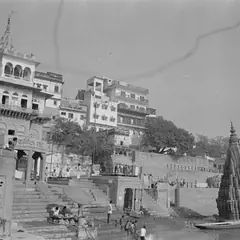
Dashashwamedh Ghat fans out from Godowlia street down to the Ganges. Its first stone steps were built shortly after 1735, when the Peshwa Baji Rao bought the plot and his banker in Kashi, Sadashiv Naik, completed the ghat for an ascetic named Advaitanand Swami. What is walked today as a single flight of steps is in fact two ghats merged: the original one, to the south, beside the Shitala temple, and the old Prayag Ghat to the north.
For centuries it was the city's water gate: in 1974 it was still the only ghat in the centre that vehicles could reach down to the waterline, and here descendants of Queen Victoria stepped down from their carriages to tour the ghats by boat. That same stage saw a bomb go off during the aarti of 2010 and, when the Ganges rises, forces the fire up onto the rooftops.
Highlights
- Ganga Aarti — seven saffron-clad priests raise multi-tiered brass lamps for about 45 minutes
- Shitala temple — a shrine of eight mother goddesses at water level, swallowed by the river in floods
- Godowlia ramp — the only street in the centre by which carriages reached the river
- Rajendra Prasad Ghat — the old Ghora Ghat, without the stone horse that gave it its name
- Dashashwamedh Plaza — a 2022 building in red Chunar stone with 182 shops and a viewing terrace over the Ganges
Dashashwamedh means «the ten horse sacrifices», and the history of Dashashwamedh Ghat begins with an argument over who offered them. The Kashi Khanda attributes them to the god Brahma; the historian K. P. Jayaswal, to the ten ashvamedhas of the Bhara Shiva Naga dynasty in the 2nd century. What is documented is the stone: shortly after 1735 the Peshwa Baji Rao bought the plot, and the letters of his banker in Kashi, Sadashiv Naik, tell that around that year he completed two ghats, this one and Manikarnika. Other sources attribute the work to his son and date it to 1748, and some websites speak of a rebuilding by Ahilyabai Holkar in 1774; the debate remains open.
In the aquatint that Thomas Daniell engraved in the 18th century, now in the Salar Jung Museum in Hyderabad, almost nothing is built behind the ghat except the Rana Mahal, the palace of the rana of Mewar. Today the steps are the busiest in Varanasi, with the parasols of the pandas, its flotilla of boats and, to the north, the bulk of the Man Mandir as a landmark for reading the line of ghats. Until 1922 it was the centre of the Burhwa Mangal, the river festival of illuminated boats, and in late 1962 Allen Ginsberg and Peter Orlovsky lived for half a year in a room overlooking this ghat.
What to see at Dashashwamedh Ghat, from south to north, is to read three centuries of a city that celebrates, suffers and bargains with a river that takes its place back every monsoon: the audio guide’s route runs from the small Shitala temple to the Ganga Aarti platforms and to the stretch that lost its stone horse.
The same banker, Sadashiv Naik, completed the neighbouring Manikarnika Ghat around 1735, downstream, and from the top of the steps the Kashi Vishwanath Temple is a few minutes’ walk away. If the aarti closes the day here, sunrise has its own ritual about two kilometres to the south, at Assi Ghat.
The ramp of the royal carriages
Dashashwamedh Ghat
Summary of this stop
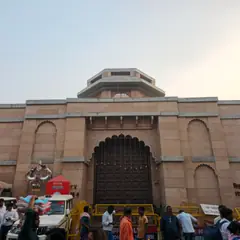
The visit begins at the end of Godowlia street, the wide road that runs straight down to the river over the old bed of the Godavari. Among rickshaws and vendors it is easy to miss what makes it unique: in 1974 it was still the only ghat in the centre that vehicles could reach down to the waterline. That is why nobles and distinguished visitors stepped down from their carriages here, among them children, grandchildren and great-grandchildren of Queen Victoria, to tour the ghats by boat.
That water gate was also the stage for small wars of etiquette. Around 1889, during a British royal visit, Raja Sir Dinkar Rao managed to have Raja Shiva Prasad’s seat removed from the darbar dais. The reply was played out precisely at Dashashwamedh, and how he turned the humiliation around is one of the episodes the narration tells on the spot.
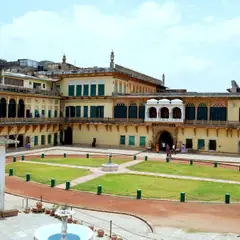
The latest layer of this entrance dates from 2022: the Dashashwamedh Plaza, more than 3,000 m² and 182 shops clad in red Chunar stone, like the neighbouring Man Mahal palace, with a viewing terrace over the Ganges. The area project moved the old fish market to Ratnakar Market.
Mother goddesses and a recent wound
Shitala temple
Summary of this stop
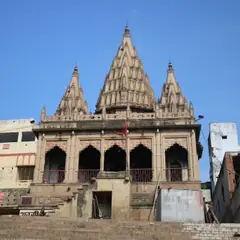
At the southern end, at water level, the small Shitala temple marks the original ghat, the one Sadashiv Naik built with the Peshwa’s funds for the ascetic Advaitanand Swami. Although it is worshipped under the name Shitala, it was originally a shrine of the Matrikas, the mother goddesses: eight icons are worshipped inside, and within its precinct stands the linga of Dashashvamedheshvara.
Local tradition reserves a singular offering for it. At Shitalashtami, the women of Varanasi spend the night cooking gulgula, puris and halwa and at dawn carry them to the Badi Sheetla for the basiaura puja, with food made the day before. According to the temple’s mahant, the goddess frees people from smallpox, measles and the fevers that come with the change of season, and on a single day a year, at the full moon of Vaishakh, devotees bathe her with their own hands with Ganges water and neem leaves.
Beside these steps, on 7 December 2010, a bomb hidden in a milk churn went off during the aarti. A two-year-old girl who was in her mother’s lap died and, days later, a 50-year-old woman, and 38 people were injured. The humble temple thus holds, at once, the foundation of the ghat and its darkest night, and the audio guide tells them with the restraint the place asks for.
The fire that climbs to the rooftops
Ganga Aarti platforms
Summary of this stop
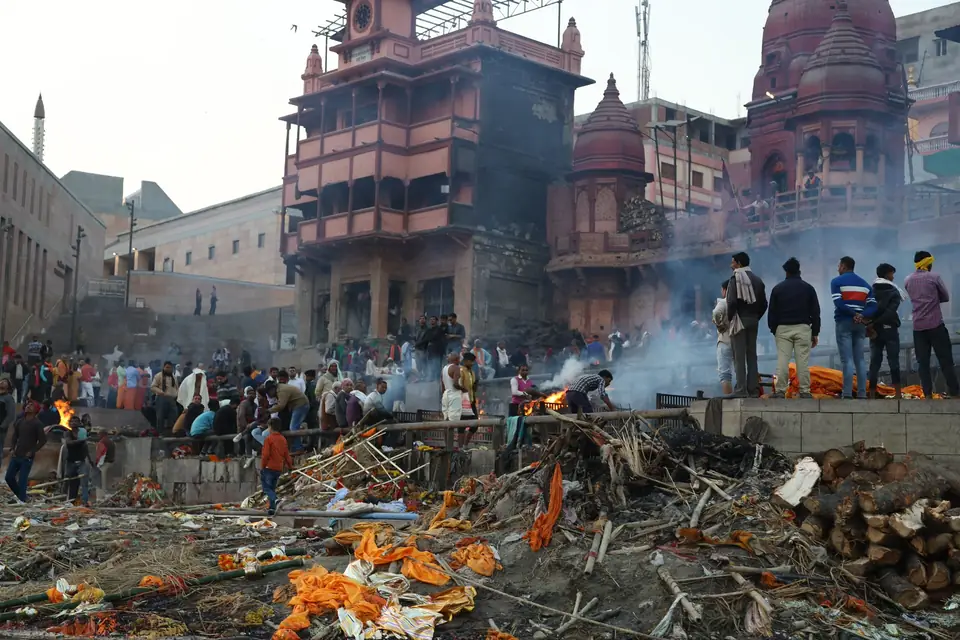
Facing the stands, the Ganga Aarti platforms line the water’s edge. Every dusk, seven young priests dressed alike, in saffron silk dhoti and kurta, raise multi-tiered brass lamps and fans of peacock feather and yak tail for about 45 minutes, while dozens of wooden boats watch the ritual from the river. The local press attributes the main aarti to the Ganga Seva Nidhi, although another organisation also performs at the ghat.
The spectacle has ancient roots. Until 1922 Dashashwamedh was the epicentre of the Burhwa Mangal, the river festival of the last Tuesday of the samvat year: for three days, boats with crystal chandeliers, musicians and dancers moored in several rows from Panchaganga to Assi. And the stage is not fixed: in July 2023, with the Ganges at 65.30 metres, the aarti moved to the roof of the Ganga Seva Nidhi office, and in August 2025, with the river at 70.91 metres, it was again held on rooftops while the Sheetla Mata temple lay under water.
These same steps hold a concert famous in the city’s tradition. One moonlit night, an amateur singer named Akkhoji was singing to himself and his voice crossed the Ganges to the Ramnagar palace, where the maharaja Ishwari Prasad Narain Singh sent to find out who it was. What Akkhoji sang before the court musicians, and what honour he received in exchange for charging nothing, is left for the narration in front of the platforms.
The legend of the ten horses
Rajendra Prasad Ghat
Summary of this stop
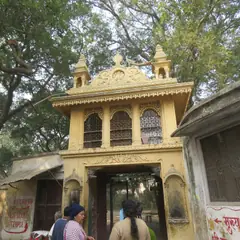
The route ends at the northern end, facing Rajendra Prasad Ghat. This stretch was the Prayag Ghat, independent until it merged with Dashashwamedh; here stands the linga of Brahmeshvara, in a low building that the river floods every year. Further north, the old Ghora Ghat, the «horse ghat», had until the end of the 18th century a stone horse that marked the ten sacrifices. Around that time it disappeared: one version says British officers took it away; another, that it was moved to save it from the floods and survives beside the Sankat Mochan temple.
The subsoil also keeps traces of fire. In 1929, an excavation beneath the Rani Putia temple, next to the ghat, brought to light numerous yajnakundas, ritual pits for the sacrificial fire.
The legend that names the place is a chain of failed spies. According to the Kashi Khanda tradition, Shiva was looking for a fault in King Divodasa, so just that he ruled Kashi without the gods daring to challenge him: he sent the sixty-four yoginis, then the Sun and finally Brahma, who with the king’s own help offered ten horse sacrifices on this bank. A popular version says that the smoke of those fires stained the sky the blue it keeps. Why none of the envoys ever went home, and why some historians place those sacrifices at the neighbouring ghat, is the closing the audio guide reserves for this last step.