Site of the Buddha's first sermon
Dhamek Stupa Audio Guide
A solid tower, with no door or chamber, marks in Sarnath's Deer Park the spot where the Buddha first taught: outside it is carved Gupta-era stone, inside it holds an older stupa that nobody sees.
- 60 min audio
- Gupta-era Buddhist stupa
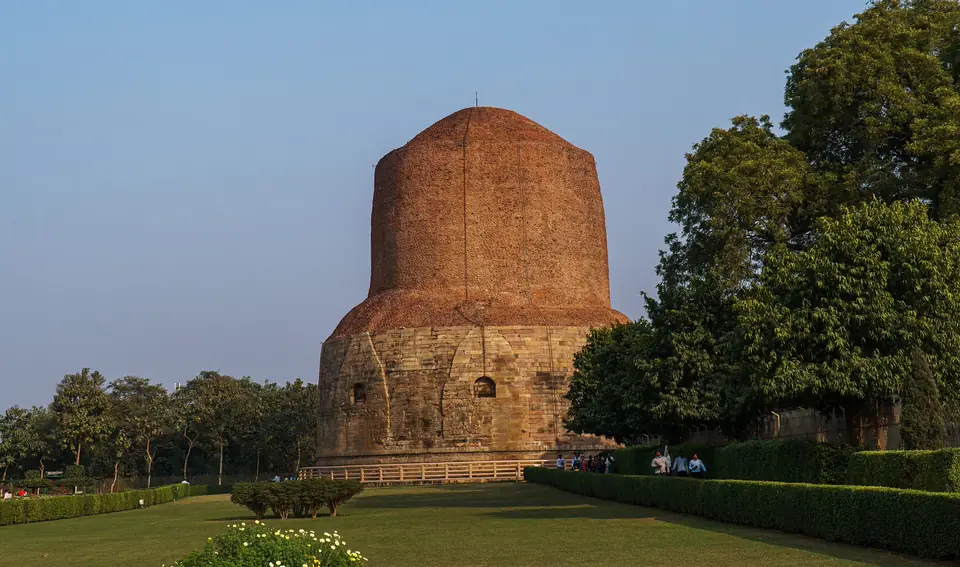
In Sarnath, near Varanasi, the Dhamek Stupa marks the place where, according to Buddhist sources, the Buddha gave his first teaching to his first five disciples and founded the sangha, the monastic community. Its present profile dates from the Gupta Empire, between the 5th and 6th centuries, when it was faced in carved stone with floral motifs in the golden age of Sarnath art. It is a solid cylinder of brick and stone, 43.6 metres high and 28 in diameter according to the most widespread record, the bulkiest structure on the site.
What is seen is only a shell. In 1835 Alexander Cunningham drilled a shaft from the top in search of a reliquary: he found no relics, but did find a slab with a Buddhist formula and, below it, an earlier stupa of Maurya bricks, possibly from Ashoka's time. After centuries of restorations, a plundering in 1794 and a long oblivion, the tower filled up again with pilgrims who walk around it.
Highlights
- Stone drum — 11.20 metres high with eight empty niches facing the eight directions
- Gupta relief band — swastikas, nandyavarta motifs and plant scrolls in Chunar stone
- Cunningham's shaft — 28 feet of drilling from the top without finding a single relic
- Base of the Dharmarajika — the brick ring left from the stupa dismantled in 1794
- Stump of the Ashoka pillar — from it came the lion capital, emblem of India
The history of the Dhamek Stupa begins with a few words. In the Mrigadava, Sarnath’s Deer Park, near Varanasi, the Buddha gave his first teaching to five ascetics, Kaundinya, Assaji, Bhaddiya, Vappa and Mahanama, and with them the sangha, the monastic community, was born. The very name of the place comes from a legend: Sarnath would be Sāranganātha, «lord of the deer», in memory of a golden deer, the Bodhisattva in a previous life, who laid his head on the executioner’s block of the king of Benares in place of a pregnant doe and got the king to turn the park into a sanctuary. The same epithet is applied to Shiva, and on a mound at Sarnath there is a modern shrine of Mahadeva.
The tower that stands today is of the Gupta era, of the 5th and 6th centuries, although the Ministry of Tourism presents it as built in the year 500 to replace a structure commissioned by Ashoka in 249 BCE, and Hindi tradition attributes its base to the Maurya emperor. Its measurements also differ depending on who gives them: 43.6 metres high and 28 in diameter in the most widespread record, 33.35 metres above the base and 42.60 with foundation on the Archaeological Survey’s plaque. An inscription of 1026 calls it Dharma Chakra Stupa, «stupa of the Wheel of the Dharma», and an 11th-century seal, «Dhamak»; exactly where the present name comes from remains a matter of debate.
What to see at the Dhamek Stupa goes far beyond the tower: around it, at ground level, remain the base of the Dharmarajika stupa, the stump of the Ashoka pillar, the old main shrine and the foundations of the monasteries. The audio guide covers that complex, a UNESCO World Heritage Site since July 2026, in five stops that open up, layer by layer, a tower that closed in on itself fifteen centuries ago.
The Ghurid campaign of 1194, to which the plundering of Sarnath is usually attributed, also razed Benares and its first Shiva temple, whose story is picked up by the Kashi Vishwanath Temple. Beside the Ganges, Manikarnika Ghat already appears in an inscription of the Gupta era, the same period as the reliefs of this stupa.
A failed snub at the foot of the drum
Dhamek Stupa
Summary of this stop
The visit starts at the foot of the stone drum, which rises 11.20 metres from the ground. In it open eight projecting niches facing the eight directions, which must have housed images of the Buddha and are empty today. Above, the cylinder keeps rising without a single door: the Dhamek is solid, with no visitable chamber, and its value lies not in what it keeps inside but in the exact spot on the ground that it marks.
According to Buddhist tradition, that first sermon began with a snub that was never carried out. The five ascetics waiting in the park saw Gautama approaching from afar and agreed among themselves not to rise to greet him, because they believed he had abandoned the effort. When they had him in front of them, one took his bowl and robe, another prepared his seat and another brought water for his feet. Even so, three times they replied that he could not have achieved anything.
What happened when they finally listened, and the nickname earned for ever by the first of the five to understand, is the story with which the narration opens the route, with the empty niches in front.
The stone skin and the hidden stupa
Gupta relief band
Summary of this stop
Around the drum, below the niches, runs a wide band of slabs carved in the Gupta era with stone from the Chunar quarries: swastikas, nandyavarta motifs, leaves and plant scrolls among which small birds and human figures peep out. It is the finest part of the Dhamek Stupa’s architecture, better preserved on some sides than on others. Higher up, the contrast is abrupt: the stone gives way to bare brick, with no facing and an irregular profile.
Through that upper part Alexander Cunningham made his way in, excavating Sarnath between December 1834 and January 1836. He drilled a shaft from the top in search of a reliquary and, at 0.91 metres, found a slab with the Buddhist formula «ye dharma hetu» in a script of the 6th–7th centuries. He kept descending among blocks joined with iron clamps until reaching virgin ground at 28 feet, about 8.5 metres, without finding a single relic.
The find was another: beneath the slab appeared an earlier stupa made of Maurya bricks, possibly from Ashoka’s time, in the 3rd century BCE. The Gupta tower is, in fact, a shell. What it means that Sarnath’s bulkiest monument is a box inside another box is revealed on listening to the audio guide while looking upwards.
Two sister stupas, two fates
Base of the Dharmarajika stupa
Summary of this stop
A short distance away, a brick ring at ground level is all that remains of the Dharmarajika stupa. Their stories crossed in the 11th century: an inscription of 1026, from the reign of Mahipala, records that two brothers, Sthirapala and Vasantapala, restored at once the Dharmarajika and the Dharmachakra, the old name of the Dhamek.
In 1794 their fortunes parted. Jagat Singh’s men dismantled the Dharmarajika to carry its bricks to the Jagatganj market in Benares, and also tore off much of the Dhamek’s stone facing; the bones and pearls of the reliquary ended up in the Ganges. The areas of the drum where the core without carved stone shows today are the mark of that episode. His role is still disputed: at the request of a descendant, the Archaeological Survey removed the word «destroyer» from the Dharmarajika plaque in 2024 and in 2026 acknowledged on the main plaque some excavations of his from 1787-88.
By then the Dhamek was already an enigma even to those who looked at it: at the end of the 18th century, the British painter William Hodges described it taking it for a ruined Hindu temple. How a single cause explains what one stupa lacks and what no longer exists of the other is told at this stop, beside the circular base.
From the stump to the emblem of India
Stump of the Ashoka pillar
Summary of this stop
West of the old main shrine the lower section of Ashoka’s Maurya pillar survives. It lacks the most famous part: the four-lion capital, emblem of India, kept in the Sarnath museum. Its fall is usually linked to the invasions of the 12th century, although who really ruined Sarnath is an open question: the archaeologist Giovanni Verardi argues that the great monasteries of the Ganges were not destroyed by Muslim armies but appropriated and transformed by Brahmins.
The capital came back to light thanks to Friedrich Oscar Oertel, a civil engineer born in Hanover with no training in archaeology who obtained permission to excavate while serving in Benares. In his single campaign, from December 1904 to April 1905, he brought out 476 sculptural and architectural pieces and 41 inscriptions, and on 15 March 1905 he announced the discovery of the lions to John Marshall in a one-line telegram.
Around it, the monastic precinct is reconstructed in the mind’s eye from a witness: the Chinese pilgrim Xuanzang, who around the year 640 noted here more than 1,500 monks and a main stupa of almost 300 feet, although it is not clear that this stupa is the Dhamek. What became of Oertel after that telegram is the capstone of this stop in the audio guide.
Ritual circuits and a recent recognition
Ruins of the old Mulagandha Kuti
Summary of this stop
From the ruins of the old Mulagandha Kuti, the square brick plan of the main shrine, the classic view of the whole tower is framed. Beside the compound the Jain temple of Shreyansnath also appears: Sarnath is sacred to the Jains, who place in nearby Singhpur the birth of Sreyansanatha, the eleventh Tirthankara.
The site came close to being lost. When the Sinhalese reformer Anagarika Dharmapala arrived on 22 January 1891, he found only ruined mounds; in May of that year he founded the Maha Bodhi Society, which in 1931 inaugurated the new Mulagandha Kuti Vihara temple at Sarnath. Today the tower is once again at the centre of ritual: on the full moon of Ashadha, the anniversary of the first sermon, the 2025 celebration began with a parikrama, a ritual circuit by monks, nuns and laypeople around the Dhamek amid chanting.
On 25 July 2026, after almost 28 years on the tentative list, Sarnath entered UNESCO’s World Heritage list as an archaeological landscape, with the Dhamek at its centre. Why, in defending its nomination, the tower’s reliefs were read as if they were a Benares silk fabric is the story with which the route closes.