Shiva's jyotirlinga
Kashi Vishwanath Temple Audio Guide
Kashi's holiest temple is not where it once stood: it is a small shrine crowned with a tonne of Sikh gold, built wall to wall with the mosque raised over the temple demolished in 1669.
- 60 min audio
- Golden Hindu temple
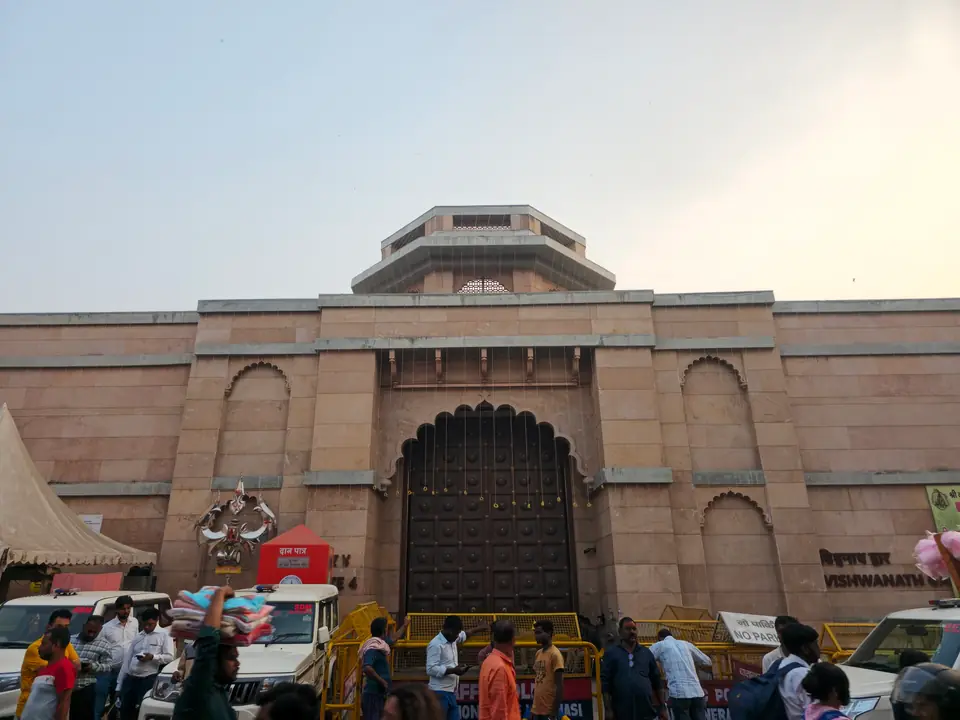
The Vishwanath temple, one of Shiva's jyotirlingas, has given Benares its meaning for centuries, and its story is a chain of demolitions and rebuildings: the first shrine fell in 1194 to the troops of Muhammad of Ghor, Aurangzeb had the one of 1585 demolished in 1669, and the present one was built by the Maratha queen Ahilyabai Holkar of Indore in 1780, on an adjoining plot, because the plans to recover the original site had failed.
The modesty of the building contrasts with the gold that covers it: the dome was plated in 1835 with a tonne donated by the Sikh maharaja Ranjit Singh, and the sanctum in 2022 with 60 kilos from an anonymous devotee in southern India. A few metres away, the Nandi bull given by the Rana of Nepal does not face the golden temple but the Gyanvapi mosque.
Highlights
- Golden dome and spire — a tonne of gold donated by Ranjit Singh in 1835
- Sanctum gold-plated in 2022 — 60 kilos from an anonymous devotee and a lingam in one corner
- Rear wall of the Gyanvapi mosque — lobed arches and toranas from the temple demolished in 1669
- Nandi of the Rana of Nepal — facing the mosque, not the present temple
- Kashi Vishwanath Dham corridor — more than 40 temples rescued and a direct exit to the Ganges
The history of the Kashi Vishwanath Temple is that of a shrine that has refused to disappear. The first Vishwanath temple, the Adi Vishveshwar, was destroyed in 1194 by the Ghurid troops of Muhammad of Ghor after his victory over Jayachandra of Kannauj, and between 1236 and 1240 the Razia mosque was raised in its place. Sikandar Lodi tore down the next shrine, and almost ninety years later, in 1585 and under the emperor Akbar, it was rebuilt; in 1632 the English merchant Peter Mundy visited it and drew its lingam. In September 1669 Aurangzeb ordered it demolished, and around 1678 the Gyanvapi mosque rose on top.
The temple visited today was built by the Maratha queen Ahilyabai Holkar of Indore, immediately south of the mosque, after the plans of Malhar Rao Holkar in 1742 and of Nana Fadnavis to recover the original site failed. The temple trust gives the date of 1780; other sources place its consecration in 1777 or speak of a renovation between 1777 and 1780. Since 1983 it has been run by an Uttar Pradesh state trust, which took it from the then Kashi Naresh, the maharaja Vibhuti Narayan Singh, and in 2023 it received an average of 45,000 pilgrims a day.
What to see at the Kashi Vishwanath Temple, and how to read it, depends on understanding that absence: the gold, the smallness of the building and the orientation of a stone bull are answers to a temple that is no longer there. The audio guide climbs from the Ganges along the new corridor and discovers, stop by stop, how that wound is still in view a few metres from the shrine.
The same queen Ahilyabai Holkar rebuilt the whole of Manikarnika Ghat, a short walk from the temple, and about 500 metres away the steps of Dashashwamedh Ghat close each day with the Ganga Aarti. The family of the Kashi Naresh, from whom the state took the management of the temple in 1983, still lives on the other bank of the Ganges, in Ramnagar Fort.
An avenue open to the Ganges
Lalita Ghat
Summary of this stop
The route starts at the Ganga Dwar, the great gate of the Kashi Vishwanath Dham corridor that joins the temple esplanade with Lalita Ghat. Until a few years ago the temple hid among houses and had barely some 3,000 square feet of precinct; the corridor, whose first stone was laid on 8 March 2019 and which Narendra Modi inaugurated on 13 December 2021, enlarged it to about 500,000 and opened it directly to the river, after the purchase of more than 300 buildings. From the water one now sees a temple that the river could not see.
The demolitions of 2018 brought a surprise: under layers of concrete and plaster from the houses that had swallowed them, more than 40 ancient temples appeared, among them the Gangeshwar Mahadev and the Manokameshwar Mahadev, now restored along the corridor. In the Benaras Gallery, a large mural pays tribute to Ahilyabai Holkar, the builder of the temple.
The work is not told the same way from every side. The authorities present it as a decongestion without disputes that rescued 40 temples; displaced residents denounce the demolition of houses, family temples and two- or three-century-old dharamshalas with stone carvings, and the figures for area and cost vary by source. What was lost and what was gained in that opening is the question with which the narration sets off.
Sikh gold on a modest shrine
Shri Kashi Vishwanath Temple
Summary of this stop
In the courtyard, under the dome, the size is what strikes first: the temple and its mandapa are small, and the mandapa is covered with a dome instead of a spire. What dazzles is the gold. In 1835 the maharaja Ranjit Singh of the Sikh Empire, at the urging of his wife the maharani Datar Kaur, donated a tonne of gold to plate the dome and the spire, of about 15.5 metres; hence the nickname «Golden Temple». In February 2022 the sanctum was in turn plated with 60 kilos donated by an anonymous devotee from southern India. Inside, the lingam, about 60 centimetres tall, rests on a silver altar and occupies not the centre of the shrine but a corner.
The architecture of the Kashi Vishwanath Temple also holds a story of divine hierarchies, debated by scholars. Tradition says that Shiva holds Kashi on the tip of his trident and never leaves it, hence one of his names, Avimukta, «the never forsaken». The oldest manuscripts of the Skanda Purana call Benares the sacred field of Avimukteshwar and do not name Vishweshwar, who would have gained prominence only between the 12th and 14th centuries with the Kashi Khanda.
That old lord of the city did not vanish: Ahilyabai Holkar rebuilt a small shrine for him in the south-east corner of the precinct, in the shade of the golden Vishwanath. According to tradition, whoever beholds his lingam is freed from the sins of three lives, and Vishwanath himself worships him every day. Why the most famous god of Benares could have arrived late to his own city is revealed by the audio guide beside that corner almost nobody looks at.
The stone Peter Mundy drew
Rear wall of the Gyanvapi mosque
Summary of this stop
Behind the temple, past security fences, the domes of the Gyanvapi mosque appear, along with its rear wall, with lobed arches, mouldings, toranas and pillars. They are remains of the temple rebuilt in 1585, which according to some sources was promoted by the scholar Narayan Bhatta with the support of Raja Todar Mal and the maharaja of Amber, and according to others by Man Singh I together with Todar Mal. The English merchant Peter Mundy visited it in 1632, called its god «Cassibessuua» and drew the lingam raised in the centre of the shrine, 37 years before the demolition.
After Aurangzeb’s order of 1669, the mosque left the temple’s plinth as a courtyard and turned its south wall into the qibla wall, the one that orients prayer. The reason for the demolition is still debated: some readings speak of religious iconoclasm, other historians link it to a punishment for local rebellions tied to the temple, and a collection of 1721 attributes it to a local skirmish. Ownership of the compound has been in litigation since 1991, and in January 2024 a report by the Archaeological Survey of India concluded that a large Hindu temple with reused pillars had existed there.
That neighbourhood has a dark episode, remembered as the Lat Bhairav riots of 1809 and considered the first recorded communal riot: on a single day one mob tried to demolish the Vishwanath temple and another set fire to the mosque, with victims among those who had taken refuge inside. How it all began, far from here, beside a pillar on the outskirts of the city, is told in front of these arches.
A bull facing the lost site
Gyan Vapi well colonnade
Summary of this stop
Between the temple and the mosque stretches the Gyan Vapi well colonnade, a low-roofed pavilion with more than 40 stone pillars built in 1828 by Baiza Bai, widow of the Maratha ruler Daulat Rao Scindia of Gwalior, inspired by the Gyan Mandapa of the Kashi Khanda and by Mughal baradari pavilions. Around 1900 the municipality covered the well with a hexagonal screen to prevent ritual suicides; today it is sealed with a thick concrete slab and a priest draws its water with a cup through a small opening. The belief that the original lingam was hidden there in 1669 is tradition without documentary proof.
East of the colonnade stands the great Nandi, Shiva’s bull, a gift from the Rana of Nepal. It does not face Ahilyabai’s temple but the mosque: the lost site. It is not the only sign of that fidelity: in September 1824 Reginald Heber found the old plinth of the destroyed temple more venerated than the new temple, full of priests and devotees. The viral photo of the «waiting Nandi» that circulates on social media, however, belongs to another temple, in Wai (Maharashtra).
The Nepali gift connects to a documented tradition in Nepal: in 1678 a minister of the king of Lalitpur consecrated a temple to Vishveshvara in Patan and carved on a slab that he had brought the god from Kashi. What exactly that inscription says about Shiva’s flight to the Himalayas closes the audio guide in front of the bull that is still waiting.