Genocide memorial
Armenian Genocide Memorial Audio Guide (Tsitsernakaberd)
On the hill of the swallows, twelve basalt slabs lean over a flame lit in 1967. It is where Armenia climbs every 24 April to remember the victims of the genocide, and every stone has behind it a story of caution, tenacity and memory.
- 90 min of audio
- 1967 Soviet memorial
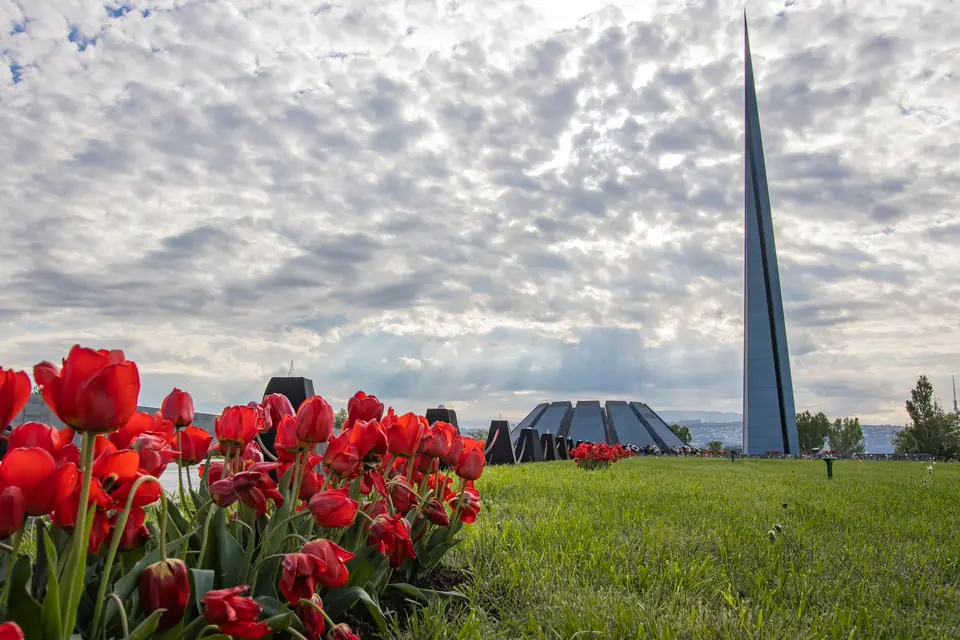
Tsitsernakaberd, the “Swallows' Fortress”, is the hill in Yerevan where the 1967 Soviet memorial to the Armenian genocide stands. It was designed by architects Arthur Tarkhanyan and Sashur Kalashyan: a circle 30 m in diameter formed by twelve basalt slabs leaning towards the eternal flame, a split column, “Armenia Reborn”, and a 100 m wall with the names of the Armenian towns of the Ottoman Empire. Since 1995 it has been completed by the Armenian Genocide Museum-Institute, dug into the hillside.
The memorial grew out of a 1964 petition to Moscow that avoided naming the genocide and spoke of “Armenian martyrs sacrificed in the First World War”, so as not to clash with Soviet-Turkish friendship. To keep the great slabs from being replaced with concrete, one of its architects had himself appointed assistant stonecutter; and every week buses of volunteers arrived, mostly descendants of victims, to work as labourers.
Highlights
- Temple of Eternity — 12 basalt slabs in a 30 m circle open over the eternal flame
- Armenia Reborn — a spire of about 44 m split in two by a vertical cleft
- Memorial wall — 100 m with the names of the Armenian towns of the Ottoman Empire
- Urns of earth — from the graves of Anatole France, Nansen, Lepsius and others who denounced the genocide
- Genocide Museum-Institute — dug into the hillside in 1995 so as not to compete with the memorial
Above the Hrazdan gorge, on the hill Armenians call Tsitsernakaberd, stands the memorial the country dedicates to the victims of the Armenian genocide. Since 1968, hundreds of thousands of people have climbed here every 24 April to leave flowers beside the eternal flame, and the night before, tens of thousands walk through Yerevan with torches up to the summit. It is a place of national mourning, but also a work of architecture with a history of its own, as revealing as it is sober.
The history of Tsitsernakaberd begins in December 1964, when Yakov Zarobyan, first secretary of the Communist Party of Armenia, asked Moscow for permission for a “monument to the Armenian martyrs sacrificed in the First World War”. The resolution came on 16 March 1965; the works, from 1966 to 1967, cost about 750,000 roubles, and the complex was inaugurated on 29 November 1967. In 1995 the Armenian Genocide Museum-Institute was added and in 1997 the Memory Alley, with some 200 fir trees planted by delegations from around the world.
What to see at Tsitsernakaberd arranges itself almost on its own, from the museum esplanade to the bottom of the circle: the roof facing Ararat, the wall of the towns, the split column, the Temple of Eternity and the flame. The audio guide, documented and checked against historical sources, accompanies that walk at an unhurried pace and with the respect the place asks for.
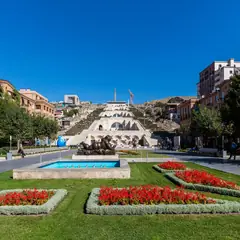
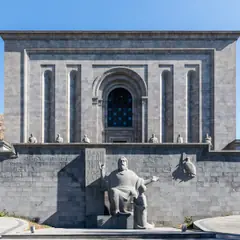
Part of the memory of 1915 is written on parchment: the manuscripts saved from the genocide in Vaspurakan, Mush or Erzurum are part of the Matenadaran collection. Across the gorge, the white staircase of the Yerevan Cascade is the city’s other great viewpoint towards Ararat.
A hill of layers: swallows, a fortress and a buried museum
Armenian Genocide Museum-Institute
Summary of this stop
The visit starts on the flat roof of the Armenian Genocide Museum-Institute, from where the view opens onto the Ararat valley. What looks like a simple esplanade is the roof of a building dug into the hillside so as not to compete with the memorial. It was designed and built in seven months and opened on 24 April 1995, with 1,000 m² of permanent exhibition on the upper floor and a 170-seat Komitas hall on the semi-underground floor.
The hill, moreover, is far older than the monument. About 700 m to the east, above the Hrazdan gorge, remain the ruins of the fortress that gives it its name, with basalt walls 2 to 6 m thick; the archaeologist Hayk Hakobyan dated it to the 12th-9th centuries BC, inhabited until at least the 17th century.
The name holds a legend. According to a documented tradition, the palace or temple of Astghik, goddess of love in the pre-Christian Armenian pantheon, stood here, and her swallows carried messages to her beloved Vahagn, the god of thunder. How a name of messenger birds came to preside over the site of national mourning is the first of the layers the narration reveals on this roof.
The wall of lost towns and of those who defended them
Memorial wall
Summary of this stop
Along the access path runs a 100 m basalt wall. On its front face, since 2002, are carved the names of the Armenian towns of the Ottoman Empire. The sculptor Van Khachatur wanted to cover it with reliefs of the road to the Deir ez-Zor desert, but the wall was inaugurated without them; it also had a more prosaic purpose: to screen off from the complex some houses that spoiled the composition. Before it rest five fighters killed in the Armenian-Azerbaijani conflict, buried in 1990-1992, and in the complex stand khachkars in memory of the Armenians killed in Sumgait, Kirovabad and Baku.
The back face tells another story. Since 1996 it has held urns with earth from the graves of foreigners who denounced the genocide, such as Anatole France, Armin Wegner, Johannes Lepsius, Fridtjof Nansen and Maria Jacobsen, alongside plaques with their names. Among them is that of Pope Benedict XV, who took in some 400 Armenian orphans at Castel Gandolfo.
That name echoed a century later: on 25 June 2016, a dozen descendants of those orphans were waiting for Pope Francis at the memorial. What happened that afternoon, and the sentence he left written in the guestbook, is told in the audio guide beside this hidden face of the stone.
Armenia Reborn, a spire split in two
Armenia Reborn column
Summary of this stop
Above the complex rises the column “Armenia Reborn”, a granite spire visible from much of Yerevan. Sources differ on its height (44 m according to most, 40 m according to the city’s tourism website), but not on its shape: two spires, one large and one small, separated by a vertical cleft, as an image of the nation’s rebirth against the mourning of the circle of slabs.
That idea is what decided the design. The first design by Arthur Tarkhanyan and Sashur Kalashyan, from 1964-1965, was a symbolic burial: a great gravestone over a 9 m pit with an immense cross inside. They dropped it because the brief required symbolising the rebirth of the Armenian people too, and on 7 June 1965 they won the competition under the motto “Armenia SSR droshak”. Figures for the number of participants vary by source, and one attributes the authorship to the sculptor Van Khachatur, named head of the architectural group that same year.
Behind the spire there is also a negotiation with Moscow and a carefully chosen name. How permission was obtained for such a memorial in the middle of the Soviet Union is part of the story of Tsitsernakaberd that the narration explains at the foot of the column.
The Temple of Eternity and its twelve slabs from Artik
Armenian Genocide Memorial
Summary of this stop
The heart of the memorial is the Temple of Eternity: a roofless circle 30 m in diameter, formed by twelve slabs of grey basalt leaning inwards, 9 m high on the inside and 7 m on the outside. You go down by tall steps and the stone funnel closes off the sky as you descend towards the flame.
The architecture of Tsitsernakaberd has its most tenacious episode here. The popular explanation identifies the twelve slabs with twelve lost provinces, but Kalashyan said they tried versions with 4, 8 and 16 pillars and settled on twelve for harmony. To keep the great slabs from being replaced with smaller pieces or concrete, the architect had himself appointed assistant stonecutter at the Artik quarry and managed to cut whole blocks there for the first course. Between 1966 and 1967, buses of volunteers from all over Armenia, mostly descendants of victims, arrived every week to work as labourers on the site, directed by the trust “Yerkimshin” with Artavazd Ordukhanyan.
These stones were touched again recently. In 2025 the first full renovation since 1967 began, because of water seepage damaging the foundations, and it has not been free of controversy, with protests and even hoaxes about a supposed demolition. The audio guide reviews that debate with care on the very steps of the circle.
The eternal flame and the flowers of 24 April
Eternal flame
Summary of this stop
At the bottom of the circle burns the eternal flame, surrounded by flowers. The inauguration was planned for 24 April 1967, but was moved to 29 November, the 47th anniversary of Soviet Armenia; that day Anton Kochinyan lit the fire with a torch before tens of thousands of people, and the procession lasted well into the night. Two years earlier, on the 1965 fiftieth anniversary, some 20,000 people had held an illegal commemoration in what is now Republic Square, the first demonstration of its kind in the whole Soviet Union.
Kalashyan proposed that the memorial should have music, and Karen Demirchyan, in charge of the project, reviewed each piece and discarded those that mentioned the word “God”. Today the place comes alive above all every 24 April, when hundreds of thousands of people leave flowers beside the fire.
Those flowers have an unexpected fate: until 2010 they were burned as rubbish and since then they are recycled, the stems as compost for the Memory Alley and the petals turned into paper. How many sheets come from each kilo of flowers, and what it means for mourning to end up transformed this way, is the close the route keeps for the edge of the flame.