Art market
Vernissage Audio Guide
Three hundred and fifty metres of paintings of Ararat, carpets, silver, old books and Soviet screws. The open-air market where Yerevan sold its art, and sometimes its own belongings, to get by.
- 45 min of audio
- Armenian art and crafts
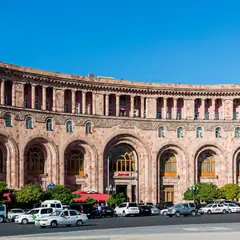
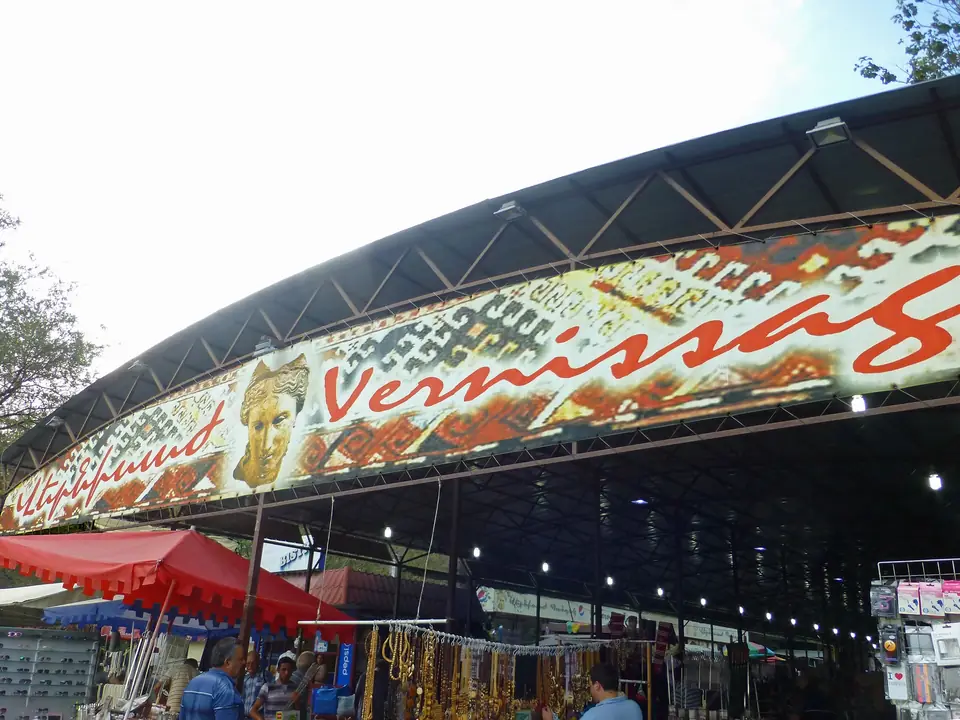
Vernissage is Yerevan's great open-air market: about 350 metres along Aram and Pavstos Buzand streets, from the Republic Square metro to the equestrian statue of Vardan Mamikonyan, covering more than three hectares. It grew out of the spontaneous painters' exhibitions of the 1980s, which moved from square to square until they reached this street, and in the 1990s it became one of the few places where artists could sell their work. Traders followed them, and with them carpets, silver, second-hand books and souvenirs of the Soviet era.
Its name is a French word meaning varnishing: on exhibition day, painters gave their canvases a last coat of varnish. Today the market also sells a political memory. The most repeated souvenir among the stalls became the pair of stone heads from Karabakh that Armenians call “the grandmother and the grandfather”, a monument no longer in Armenian hands.
Highlights
- Painting aisle — Ararat, churches, monasteries and still lifes with pomegranates
- Carpets and crafts — hand-woven kilims, silver, duduks and walnut boards
- Old-book sellers — Charents, Sevak and Shiraz lined up in rows
- Vardan Mamikonyan — a 17-metre copper general held up by a cloud of dust (Kochar, 1975)
- Kochar's “Melancholy” — the bronze before the NPAK experimental art centre
Vernissage did not begin as a market but as an unauthorised exhibition. In the 1980s, Armenian painters hung their canvases in the square beside the Artists’ Union of Armenia, today’s Charles Aznavour Square, and in the Komitas Conservatory park; then they moved to the Martiros Saryan garden, facing the Opera, and when they no longer fitted they ended up on Aram and Buzand streets. Before filling with stalls, this stretch of the Main Avenue was a park with shallow pools and fountains.
The market’s birth date, however, is disputed. The most widespread version places it in those 1980s exhibitions; other sources date the opening of the Aram and Buzand market to 1996, and in 2016 the city council credited it with some 20 years of history. Everything points to two distinct phases: first the painters and, in the mid-1990s, the market as it is known today. Nor is there agreement on opening days: some sources have it open daily, others describe it as a weekend market, and most vendors turn up on Saturday and Sunday.
The history of Vernissage is that of a city that painted, sold off its belongings to keep living and still argues over what image of itself it wants to offer the traveller. The audio guide’s documented route covers the market from end to end: from the painting aisle to the carpets, from the old-book sellers to the copper general who closes it.
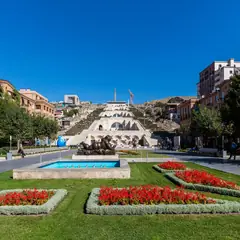
The market is a step from Republic Square, and anyone wanting to move from the stall paintings to a contemporary art collection can climb to the Cafesjian Center at the Yerevan Cascade.
Paintings of Ararat and a name from varnish
Painting aisle
Summary of this stop
Beside the Republic Square metro exit the rows of stalls begin. Looking at the market from there, the left side gathers the paintings: Ararat over and over, churches, monasteries and still lifes with pomegranates. They are the direct heirs of those artists who kept moving from square to square until they ended up on this street of about 350 metres.
The name comes from the French vernissage, derived from vernis, “varnish”: painters varnished their canvases on exhibition day. The word entered the vocabulary of Yerevan residents in the late 1970s, and ended up naming a whole market. The original custom has not disappeared: on weekends painters still exhibit in the Martiros Saryan park, around the 6-metre white marble statue that Levon Tokmajyan dedicated to the painter in 1986, and for that reason locals call that corner the “Saryan Vernissage”.
What a varnish, a square beside the Opera and a souvenir market have to do with each other is the thread the narration untangles in this first stretch, among the canvases of Ararat.
Carpets, pomegranates and the Karabakh grandmother
Rows of carpets
Summary of this stop
Across the aisle, carpets and kilims hand-woven in different regions hang and pile up, beside stalls of silver, crosses and miniature khachkars, duduks and walnut backgammon and chess boards. In the 1990s, after the painters came the traders, and Vernissage went from being an art exhibition centre to a market with stalls of every kind.
Dividing up the space has never been simple. In 2016 mayor Taron Margaryan pushed a reconstruction and regulation programme, with private participation, to organise the activity of some 2,000 operators. In 2018 veteran vendors paid 1,000 dram per square metre of stall, in cash and without a receipt, to the managing company, and on good weekends between 80 and 85 vendors were left out for lack of room. Some of them also complained that mass-produced souvenirs were eating into handicrafts; the manager replied that it could not separate one from the other because many sold both.
In 2019 the most repeated souvenir was two stone heads: the Stepanakert monument “We Are Our Mountains”, which many Armenians call “Tatik-Papik”, the grandmother and grandfather. They appeared on magnets, plates, bags, watches and even lighters, alongside dried pomegranates that vendors boasted of bringing from Karabakh. What happened afterwards to the original, and why that magnet says more than it seems, is the part the audio guide keeps for this stall.
Screws and poets of the hard years
Old-book sellers
Summary of this stop
Beyond the tourist souvenirs appears another Vernissage: metals, hardware, technical parts and objects of the Soviet era. It is the trace of the transition years. In 2013 the prose writer Levon Djavakhyan, who sold silver crosses and rings from a stall, explained that the market was born when people brought their belongings here to sell so they could live.
With the 2016 reconstruction the market was purged of part of that: selling dogs, building materials and clothing was banned, and deputy mayor David Ohanyan announced that dog sellers would go to the Zeytun animal bazaar and those of materials to the Gnuni bazaar.
At one end the old-book sellers hold on, with Charents, Sevak or Shiraz lined up in rows and art albums. In 2013 a local named Edik sold a classic by Gostan Zarian there for 1,000 dram, and a Belgian traveller was delighted to have found a rare book on carpet weaving. The haggling, “3,000, 2,000, 1,000”, until meeting halfway, rings all over the market; which titles were snapped up at these stalls is told by the narration among the piles of books.
A copper general on a cloud
Vardan Mamikonyan statue
Summary of this stop
The market ends at the Khanjyan and Vardanants roundabout, before the equestrian statue of Vardan Mamikonyan, the Armenian leader of the battle of Avarayr in 451. It is the work of Yervand Kochar with architect Stepan Kyurkchyan and was inaugurated on 20 December 1975: a beaten-copper general with sword raised on a pedestal of pink Artik tuff, 17 metres in all, who seems suspended in the air.
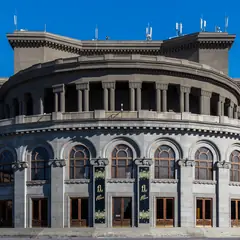
The effect has a trick. Horse and rider are caught in full charge, and their point of support is not the legs but a stylised cloud of dust. The author of that daring had spent 1941 to 1943 in prison on political charges. Across Buzand Street, another work of his, “Melancholy”, stands before a building designed as an auditorium at the end of the Cold War which, after standing empty for a time, has housed since 1995 the Armenian Center for Contemporary Experimental Art (NPAK).
The route’s close adds a municipal irony: on 11 August 2017 the city council banned a certain Oriental-style music at Vernissage so that tourists would not associate it with Armenian culture. How Kochar got out of prison and where the bronze of “Melancholy” came from is what the narration reveals in front of the general.