Monumental staircase
Yerevan Cascade Audio Guide (Kaskad)
A white travertine staircase dreamed up in the 1920s, begun by the Soviets, abandoned after the earthquake and turned into a museum by a Brooklyn-born patron. Its terraces look out to Ararat; its summit, a century later, is still unfinished.
- 60 min of audio
- Soviet architecture and contemporary art
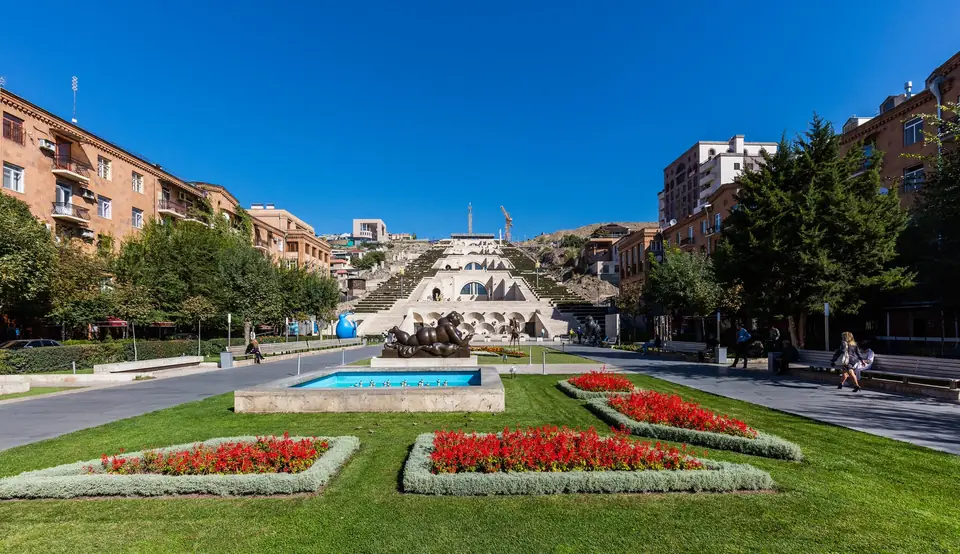
The Cascade is the great staircase linking central Yerevan with the hill to the north: five main terraces, about 302 metres long and 50 wide, with 572 steps clad in white travertine and milk-coloured tuff. The idea comes from Alexander Tamanyan's 1920s master plan, which pictured terraces, water and flowers climbing towards Kanaker. Jim Torosyan took it up again in the 1970s with a monumental outdoor staircase and a long inner shaft of escalators, and since 2009 its interior has housed the Cafesjian Center for the Arts.
What is now Yerevan's busiest spot spent over a decade as a half-built Soviet relic, halted after the 1988 earthquake and the end of the USSR. And the stairs still don't reach the top: above the fourth terrace opens a fenced pit, with foundations and rebar in plain view, where a museum was meant to rise and never did.
Highlights
- Travertine staircase — 572 steps and five terraces along some 302 metres
- Cafesjian Sculpture Garden — Botero's Cat, which arrived in 2002, seven years before the museum
- Grigor Khanjyan's murals — the triptych on Armenian history painted inside the half-finished structure
- View towards Ararat — Tamanyan Street and the Opera on the same axis, with the mountain behind on clear days
- Unfinished pit — the last 78 metres up to the Armenia Reborn obelisk, still unbuilt
From below, the Cascade looks like a single gesture: a white band some 50 metres wide climbing the slope at a 15-degree incline to a terrace 118 metres above the base. Up close it turns out to be a work assembled in pieces over a century. Alexander Tamanyan drew it into Yerevan’s 1920s master plan as a sequence of terraces, water cascades and flowerbeds that would connect the centre with the Kanaker hills; the project was judged too ambitious and went unfunded. Half a century later, chief architect Jim Torosyan rescued it with Sargis Gurzadyan and Aslan Mkhitaryan, and work began in the late 1970s, according to the Cafesjian Center, although other sources give an earlier date.
The story of the Cascade is also the story of its interruptions. The 1988 earthquake and the dissolution of the USSR in 1991 left it half-built for more than a decade, until in 2002 the city handed the complex to the foundation of Gerard Cafesjian, a Brooklyn-born patron from the diaspora. In November 2009 it reopened as the Cafesjian Center for the Arts, with ten new galleries and a sculpture garden, and today it receives over a million visitors a year. What to see at the Cascade runs from Botero’s bronzes at the foot to the khachkar, vine and pomegranate reliefs on its walls.
The audio guide’s documented route climbs from the statue of Tamanyan, crosses the sculpture garden, enters the escalator shaft to reach Khanjyan’s murals, comes out on the upper terraces facing Ararat and ends at the fence where the staircase stops abruptly.
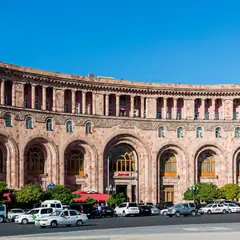
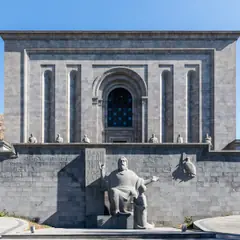
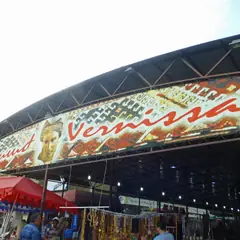
At the foot of the staircase, Tamanyan Street runs down the same axis to the Yerevan Opera Theatre, and a short walk east the Matenadaran crowns Mashtots Avenue. Anyone who prefers street art will find the painting stalls of Vernissage in the centre.
Alexander Tamanyan’s solar city
Alexander Tamanyan statue
Summary of this stop
At the foot of the staircase, with his back to the street that bears his name, the architect Alexander Tamanyan leans over a large slab, as if checking a plan. The slab rests on two stones symbolising ancient and new architecture. The monument, by sculptor Artashes Hovsepyan and architect Seda Petrosyan, went up in 1974, when the Cascade was still a project under way.
On the corner of the pedestal are engraved the plan of Yerevan that Tamanyan drew for the capital and a line by Yeghishe Charents: “Perhaps he saw a solar city.” The white staircase rising behind is, to a large extent, the last fragment of that 1920s plan: terraces, water and flowers that were meant to climb towards Kanaker and instead stayed on paper for lack of money.
Why the architect looks down rather than at the staircase he imagined, and what that line has to do with the city around the statue today, is something the narration reveals right at the pedestal.
A Botero cat above lost fish
Cafesjian Sculpture Garden
Summary of this stop
The park spreading before the Cascade is an open-air museum: hares by Barry Flanagan, figures by Lynn Chadwick and Jaume Plensa, and three monumental bronzes by Fernando Botero, “Woman Smoking a Cigarette”, “Roman Warrior” and “Cat”. The last, cast in 1998 and one of three copies, came from the Cafesjian collection and was unveiled on 26 November 2002, seven years before the museum opened.
Beneath that bustle there was something else. In the 1960s a fountain by Vardan Hyusnyan with a mosaic by Derenik Danielyan was built on this very site: colourful fish leaping from the water, made of hand-glazed tiles. It was dismantled in the 1980s, during the Cascade works. More recent is the controversy over the Japanese cherry trees: in 2023 the city began a mass felling here as part of its tree-replacement plan; the municipality spoke of old or damaged trees, while residents and environmentalists maintained that healthy, long-standing specimens were cut.
The garden is also a stage: since 2010 there have been jazz, pop and rock concerts on Fridays and Saturdays, the Karin ensemble dances traditional Armenian dances on the last Friday of the month from May to September, and in spring and summer the public sits on the steps to listen to music. What critics say about the sakura blossom, and what remains today of the fish mosaic, is part of what the audio guide tells before the Cat.
The mural painted inside a ruin
Grigor Khanjyan murals
Summary of this stop
In the centre of the base, an entrance opens onto the long inner escalator shaft that Jim Torosyan conceived alongside galleries, courtyards and gardens. Each landing shows works from the Cafesjian collection. For years that interior was a half-built Soviet void, until in 2002 it passed to the foundation of Gerard Cafesjian, born in 1925 in Bensonhurst to Armenian immigrants, vice president of West Publishing in Minnesota and, after retiring in 1996, a patron devoted to Armenia until his death in 2013.
In the Khanjyan gallery waits Grigor Khanjyan’s great triptych on the history of Armenia: the creation of the alphabet, the battle of Avarayr and the rebirth of the country. Its origin is a story disputed in some details. It began with tapestries commissioned in 1978 by Catholicos Vazgen I, which the public could not see; when murals were requested instead, the painter ended up installed, on Torosyan’s advice, in a hall of the still-unfinished Cascade. From 1992 he painted alone, often without electricity, with his eyesight failing and after losing his wife in 1997.
It is said that the day before he died, in April 2000, he finished the central part of the last panel, “Armenia Reborn”; another version holds that another painter completed that panel in 2002 following his sketches. Whose face presides over the hall and why the doubt remains open is what the narration raises in front of the mural.
572 steps that once lay in ruins
View towards Ararat
Summary of this stop
From the upper terraces, the scale of the work is measured with the body: five main terraces, 572 steps, fountains and flowerbeds on every level and Armenian-inspired reliefs on the walls. Below, Tamanyan Street, the Opera and the whole centre line up on the north-south axis; on clear days, Ararat closes the view in the distance. Aslan Mkhitaryan explained that they chose white travertine because it looked good against the green of the trees and the blue of the sky.
These terraces were not always a crowded viewpoint. After a first phase, finished around 1980, work stopped for reasons that have never been entirely clear. One explanation in circulation points to the cost of the 1980 Moscow Olympics, which would have forced budget cuts across the Soviet Union; other versions speak only of probably budgetary reasons. Then came the 1988 earthquake and the end of the USSR, and the staircase was left abandoned for years.
The 2009 reopening, after seven years of works and an investment of more than 35 million dollars according to the museum (other sources give higher figures), made it Yerevan’s busiest place. How a Swiss architect described it when Soviet papers spoke only of a “recreation zone” is the detail the audio guide saves for this viewpoint.
The pit where the staircase ends
Unfinished pit
Summary of this stop
Above the fourth terrace, the polished travertine stops short. What follows is a large fenced pit, with foundations and iron rebar in plain view, dug in 2007 for the David Hotson museum that Cafesjian wanted to crown the staircase. The design exceeded its budget several times and was cancelled, and the last stretch, 78 metres to the summit, is still unfinished. To go on you have to walk around it.
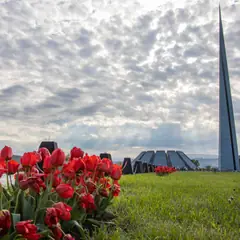
Above rises the obelisk that tops the axis, inaugurated on 6 October 1967: 65 metres, of which 50 are the shaft, one for each year of the anniversary it celebrated, that of the October Revolution according to most sources, though others tie it to 50 years of Soviet Armenia. After independence it was renamed “Armenia Reborn”. Beside it, a concrete box with a bunker-like look is the Memorial to the Victims of Soviet Repression, inaugurated in 2008 and designed by Torosyan, whose father was arrested in 1937 and never seen again; it bears a line by Charents, a victim of those same purges, and opens only for the ceremony on 14 June.
The end of the Cascade is still under discussion. In 2024 the foundation donated the upper part to the city, and in December 2025 the Cascade Cultural Hub project was signed, with a 1,000-seat concert hall and a contemporary art museum designed by Jean-Michel Wilmotte, amid criticism from residents and from the Chamber of Architects. What the latter asked for, and why Torosyan’s name returns to the debate, is the question with which the route says goodbye beside the fence.