Manuscript museum
Matenadaran Audio Guide
A secular basalt temple closing Mashtots Avenue and holding the world's largest collection of Armenian manuscripts. Behind its walls, books that survived plunder, wars and genocide.
- 75 min of audio
- Armenian manuscripts
The Matenadaran is the heir to the library of the Catholicosate of Echmiadzin, founded in 1441. Nationalised by a Bolshevik decree in 1920 and moved to Yerevan in 1939, the collection got its own building in 1959, the work of architect Mark Grigorian: a 22.4-metre cube of grey basalt whose facade copies that of the south gavit of the 12th-century Church of the Holy Apostles in Ani. That same year it became the first institute in the whole USSR devoted to studying and preserving manuscripts.
That medieval-looking building earned its architect a severe reprimand from the Communist Party in 1956, for allowing “excesses” suspected of nationalism. Fourteen years later, Leonid Brezhnev cited it as proof that sovietisation had saved ancient Armenian culture. Inside wait the largest Armenian manuscript, at over 27 kilos, and the smallest, at 19 grams.
Highlights
- Mesrop Mashtots and Koryun — the basalt group with the letters of the Armenian alphabet
- Basalt facade — a copy of the gavit of the Holy Apostles of Ani, reprimanded in 1956
- Six medieval scholars — from Toros Roslin to Movses Khorenatsi, before the facade niches
- Avarayr mosaic — the battle of 451 in tesserae by Van Khachatur
- Mush Homiliary — the largest Armenian manuscript, split in two in 1915 and reunited here
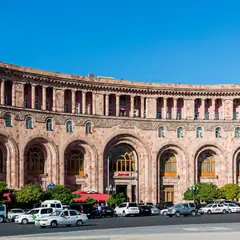
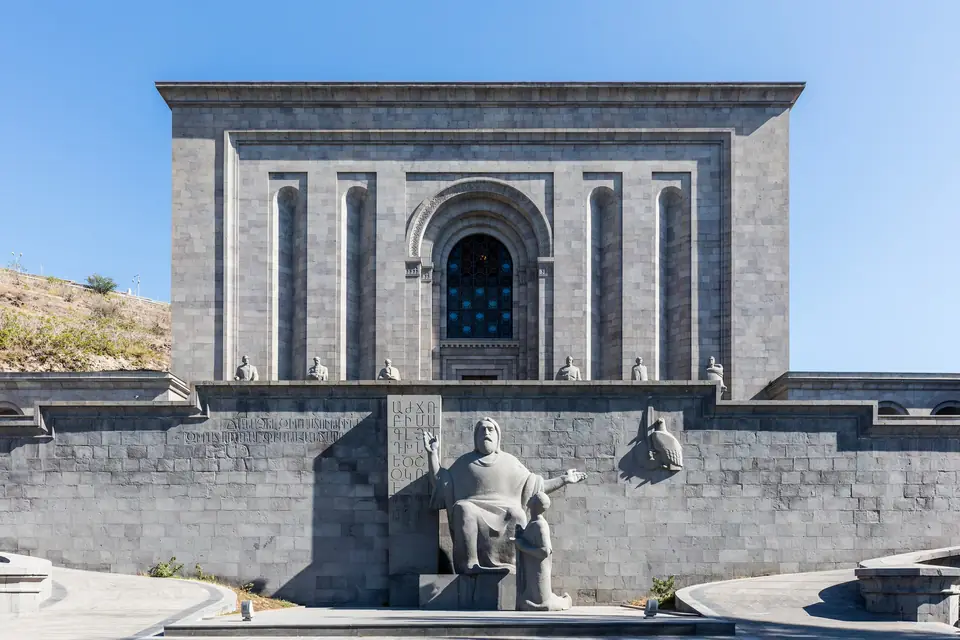
At the end of Mashtots Avenue, high on a slope, a block of grey basalt closes the perspective the way a monastery facade would. It is not a church, though it looks like one: it is the Matenadaran, the world’s largest repository of Armenian manuscripts. How many it holds depends on how you count: about 17,000 according to the 1997 UNESCO nomination, about 20,000 according to the institute itself and up to 23,000 if you add fragments and works in other languages. Its founding date also admits different readings, from the 5th century of Mesrop Mashtots to 1959, when the institute moved into the present building.
The collection’s history is a chain of rescues. It began as the library of the Catholicosate of Echmiadzin, founded in 1441; in 1915, with the front nearby, it was sent to Moscow and did not return until 1922, while some 1,600 manuscripts saved from the genocide in Vaspurakan, Mush and Erzurum arrived at Echmiadzin. A Bolshevik decree nationalised it on 17 December 1920 and in 1939 it moved to Yerevan. Mark Grigorian’s building, begun in 1945 and halted from 1947 to 1953, opened as a research institute in 1959, and in 2011 a new block by Arthur Meschian, with triple the floor area, was added behind it, freeing the historic one to serve entirely as a museum.
To understand what to see at the Matenadaran and why Armenians speak of their books as survivors, the audio guide’s documented route climbs from the statue of Mashtots, passes the facade, the basalt scholars and the lobby, and ends before the manuscripts of the main hall.
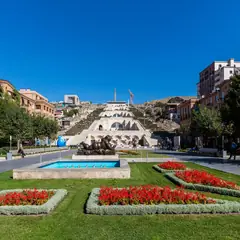
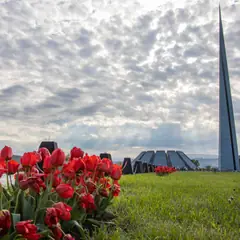
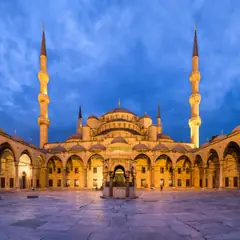
Down the same avenue the minaret of the Blue Mosque comes into view, and a short walk west rises the staircase of the Yerevan Cascade. The story of the manuscripts saved in 1915 continues on the hill of the Armenian Genocide Memorial.
The Armenian alphabet, carved in stone
Mesrop Mashtots and Koryun group
Summary of this stop
At the foot of the staircase, on the building’s axis, stands the group of Mesrop Mashtots, creator of the Armenian alphabet, with his disciple Koryun kneeling at his feet. It is the work of Ghukas Chubaryan: placed in plaster in 1962 and redone in basalt in 1967, although sources do not always agree on which date to give it. Mashtots holds the tablet with the letters of the alphabet, the key to reading everything the house behind him keeps.
On the retaining wall beside the statue, a phrase from the Book of Proverbs (1:2) is carved in Classical Armenian: “To know wisdom and instruction.” It is held to be the first sentence written in Armenian. According to the tradition recorded by Movses Khorenatsi in his History, Mesrop searched in vain for letters for his language in Edessa and Samosata, until in prayer he saw a right hand writing on rock, and the stone kept the strokes like footprints in snow.
That letters born from a rock should reappear here in stone is no coincidence, and what link the narrator of that vision has with the facade above is something the narration reveals at the foot of the staircase.
An Ani temple in the middle of the USSR
Matenadaran
Summary of this stop
From the terrace, Mashtots Avenue stretches in a straight line towards the centre: the building was conceived as its visual endpoint. The Matenadaran’s architecture is a deliberate quotation of the past. The facade, with a tall central arch decorated with octagonal metal modules, a great copper door and two narrow niches on each side, copies the east facade of the south gavit of the 12th-century Church of the Holy Apostles in Ani. Mark Grigorian, chief architect of Yerevan, received the commission in October 1939; work stopped for years for lack of skilled labour and, depending on the source, was declared finished between 1957 and 1959.
So much Armenian Middle Ages in the Soviet era did not go unnoticed. The design drew accusations of nationalism and in 1956 the Communist Party imposed a severe reprimand on Grigorian for allowing “excesses” in the building, which Armenian leader Grigory Harutyunov had backed. Critics did not agree afterwards either: Yuri Yaralov called it a “lamentable failure” for copying medieval forms almost unchanged, while Andrei Bitov considered it the most notable example of modern Armenian architecture.
In 1970, visiting Armenia, Leonid Brezhnev spoke of the Matenadaran to proclaim that sovietisation had saved ancient Armenian culture. How one and the same facade could go in fourteen years from suspect to showcase of the Kremlin is the contrast the audio guide tells in front of the arch.
Six scholars and three thousand years of stone
The six scholar statues
Summary of this stop
Before the facade niches stand six full-length basalt statues, placed between 1963 and 1967: Toros Roslin, Grigor Tatevatsi, Anania Shirakatsi, Movses Khorenatsi, Mkhitar Gosh and Frik. They embody miniature painting, philosophy, cosmology, history, law and poetry, and in 2025 they were restored after years of deterioration and cracked foundations.
Under the side arches of the entrance, the colonnades have worked since the 1970s as an open-air museum. There are medieval khachkars dated 1294, 1545, 1596 and 1604, a 17th-century gravestone from Noratus, a vishapakar from the 2nd-1st millennia BC and an Urartian door of the 8th century BC from Teishebaini: almost three millennia of carved stone in a few metres.
The statue of Toros Roslin hides an uncomfortable story. His first signed work, the Zeytun Gospels (1256), is kept in the Matenadaran, but without its canon tables: eight pages that ended up in the Getty Museum in Los Angeles and led to a five-year lawsuit. How it was resolved, and why those pages are still in California, is what the route saves for the foot of his pedestal.
Avarayr in mosaic and Lenin’s gap
Battle of Avarayr mosaic
Summary of this stop
The lobby reproduces the gavit of Sanahin Monastery, with monastic-looking vaults. In its semicircular arch, Van Khachatur composed in 1960 a mosaic of the battle of Avarayr, of the year 451, in blue, black, red, orange and yellow tesserae. A year earlier, the same artist had painted the mural triptych surrounding the main staircase, a journey through Urartu, Hellenism and the Christian Middle Ages.
Not everything that decorated the building is still in place. In the conference hall hung a 2-metre-diameter ivory medallion with Lenin’s portrait, by Sergey Merkurov, a witness to the era when the Church’s library passed into Soviet state hands.
That change of owner culminated on 3 March 1959, when the Council of Ministers of Soviet Armenia turned the Matenadaran into a research institute, the first in the whole USSR devoted to manuscripts; in 1962 it took the name of Mesrop Mashtots. How one written memory passed from the Church’s seat to a pioneering Soviet institute without ceasing to be what it was is the thread the narration follows beneath the mosaic.
The book split in two that came back
Mush Homiliary
Summary of this stop
In the main hall the two extremes of the history of the Armenian book sit side by side. The Mush Homiliary, copied in 1200-1202, is the largest Armenian manuscript: 70.5 by 55 centimetres and some 27.5 kilos, though some sources say 28. Beside it, the smallest, a liturgical calendar of 1434 measuring 4 by 3 centimetres and weighing 19 grams.
The giant codex was copied for the merchant Astvatsatur, murdered in 1203, and the monks of Arakelots of Mush ransomed it for 4,000 silver coins. It spent 811 years there, until in 1915 the book was split into two halves that survived the genocide and are now together again in the Matenadaran. The path of each half has versions that do not fit together, and the identity of those who saved them is still unknown.
Some books of this house still leave it. The Vehamor Gospel, probably of the 7th century, is the one on which Armenia’s presidents have sworn since 1991, and the Shurishkani and Shukhonts gospels travel each year to the churches of Mughni and Oshakan. Who the first president to swear on it was, and what tied him to the Matenadaran itself, is the closing note the audio guide keeps for this last display case.