Tamanian's architecture
Yerevan Opera Theatre Audio Guide
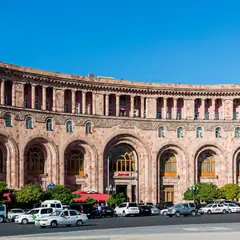
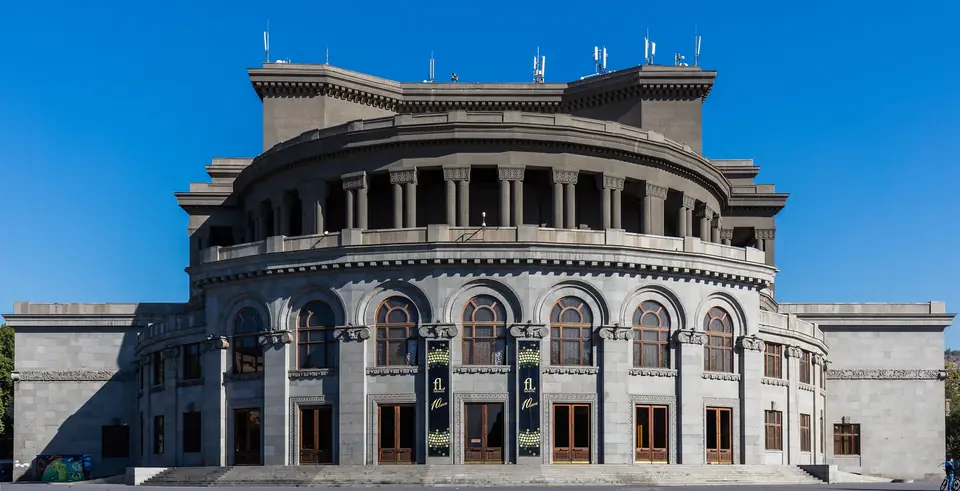
A great semicircle of pink tuff conceived as the House of the People of the new Yerevan, built over a vanished chapel and finished without its creators. At its feet spreads the esplanade where Armenia has come down since 1965 to say what it thinks.
- 30 min of audio
- Neo-Armenian architecture
The Yerevan Opera was born in 1926 as a commission to Alexander Tamanian: a Zhoghtun, a House of the People with a theatre for 1,200 spectators, a concert hall, classrooms, a library and exhibition rooms. The first stone was laid on 28 November 1930 and the theatre opened on 20 January 1933 with Almast, Alexander Spendiaryan's only opera. Today it brings together under a single semicircular body two amphitheatre halls, the Spendiaryan opera and ballet hall and the Aram Khachaturian concert hall, and its design won a prize at the 1937 Paris World's Fair.
The esplanade opening before the facade, Theatre Square until 1991 and Freedom Square since then, is much more than an atrium. There, water cannons dispersed the thousands who marked the 50th anniversary of the Armenian genocide in 1965; there, between half a million and a million people gathered in February 1988; and there began in 2018 the rally that preceded Serzh Sargsyan's resignation. In Yerevan, “let's go down to the Opera” is a synonym for “let's go protest”.
Highlights
- Semicircular facade — Tamanian's House of the People, with colonnades inspired by Tekor and Zvartnots
- Freedom Square — stage of the gatherings of 1965, 1988, 2008 and 2018
- Almast — Spendiaryan's opera, sung in Armenian, with which the theatre opened in 1933
- Two halls under one body — the Spendiaryan, with about 1,070 seats, and the Aram Khachaturian, with about 1,300
- Swan Lake — swans in summer and a skating rink in winter beside the theatre
In the heart of the Yerevan that Alexander Tamanian drew in the 1920s, a curved building of pink tuff embraces a round esplanade. Its official name is long, the Alexander Spendiaryan National Academic Theatre of Opera and Ballet, but in the city it is enough to say “the Opera”. The history of the Yerevan Opera begins in January 1926, when the Central Executive Committee of Soviet Armenia decided to build a House of the People with a theatre hall and commissioned Tamanian with the design and site management. The first stone was laid on 28 November 1930, on the tenth anniversary of Soviet Armenia.
The dates of its opening are not as crisp as the facade. On 20 January 1933 the theatre was inaugurated with Almast, although several sources place the end of the Winter Hall in 1939 and the company’s first season in Tamanian’s building on 12 January 1940; the major works, in any case, did not conclude until 1953. Between 1978 and 1980, on the initiative of Karen Demirchyan and under the direction of Gevorg Tamanian, the architect’s son, it was thoroughly rebuilt: light Aghveran marble in the lobbies, an upper amphitheatre divided into two tiers and a curtain chosen in person by Demirchyan from sketches by Grigor Khanjyan. It reopened on 28 November 1980.
What to see at the Yerevan Opera goes beyond architecture: a chapel that vanished beneath its foundations, a square that has filled with crowds at the country’s decisive moments, a composer buried in the park and a pond named after a ballet. The audio guide’s documented route covers the south facade, Freedom Square, the statue of Spendiaryan and the shore of Swan Lake.
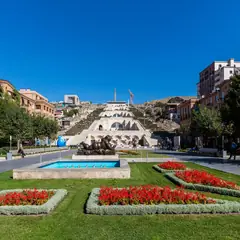
Behind the building, Tamanian Street climbs on the same axis to the staircase of the Yerevan Cascade, and a short walk south waits Republic Square, the other great stage the architect laid out in pink tuff.
A House of the People over a lost chapel
South facade of the Opera
Summary of this stop
From the south edge of the square, the building reads as what it aimed to be: a House of the People, the Zhoghtun of the new capital, with a programme including a theatre for 1,200 spectators, a concert hall, classrooms, a library with a reading room and exhibition rooms. Its colonnades copy no monument, but Tamanian conceived them from the compositions of volumes and the ornament of medieval Armenian temples such as Tekor and Zvartnots, and that is the key to the architecture of the Yerevan Opera.
Before the theatre, on this same plot, stood the Gethsemane chapel, single-nave and from the late 17th century, built over a church ruined by the 1679 earthquake and surrounded by Yerevan’s old cemetery. In 1929 it was dismantled and its stones numbered one by one to rebuild it elsewhere. That never happened: in 1932 Tamanian was removed from the management of the works and his successor, Ashot Melik-Martirosyan, decided to use those stones for the Workers’ House on Byron Street.
Of the temple and the cemetery nothing remains in sight. It is said that only one piece survived, a stone cross that would now be kept in the courtyard of the Church of Saint Anne, beside the old Katoghike, a few streets from here. What it means to build the centre of a new city over that void is the idea with which the narration opens the route in front of the facade.
The square Armenia fills to protest
Freedom Square
Summary of this stop
At the foot of the colonnade stretches the semicircular esplanade that was called Theatre Square until 1991 and Freedom Square since. On the afternoon of 24 April 1965, thousands of people gathered here for the 50th anniversary of the Armenian genocide and were dispersed with water cannons. In the last week of February 1988 the square became the gathering point of the Karabakh movement: on 25 and 26 February between half a million and a million people came together, and over the course of that year Soviet police and army closed it several times.
Those 1988 gatherings, by the testimony of those who were there, did not begin with Karabakh but with the environment: workers from a biomaterials plant in Abovyan marching to demand its closure, slogans against Nairit chemicals and for Lake Sevan, and portraits of Gorbachev held high. The activist Zori Balayan recalled that among all those slogans there was only one banner about Karabakh, and that nobody paid it any attention.
Other scenes followed: the sit-in by supporters of Levon Ter-Petrosyan, broken up by police at dawn on 1 March 2008; the square closed to rallies until 17 March 2011 and an underground car park of three floors and 500 spaces opened beneath it in 2010, which the government justified by traffic and the opposition saw as a way to prevent demonstrations. And on 13 April 2018, the rally against Serzh Sargsyan that began here before moving to France Square. How an almost ignored banner ended up moving half a country is the episode the audio guide tells before this esplanade.
Almast and the two absences at the premiere
Alexander Spendiaryan statue
Summary of this stop
In front of the theatre, two bronze and granite monuments have stood since 1957: the poet Hovhannes Tumanyan on the left and the composer Alexander Spendiaryan on the right. The latter gives the theatre its name, and his opera Almast was the one that inaugurated it on 20 January 1933, sung in Armenian in a translation by Tigran Hajumyan. The work had premiered in 1930 at the Bolshoi Theatre in Moscow, with the fourth act orchestrated by Maximilian Steinberg, because Spendiaryan died before finishing it.
The composer had died in Yerevan on 7 May 1928 and is buried in the park around the theatre. Almost a century later, on 7 May 2026, the “Funeral Song” that his pupil Levon Khoja-Eynatyan dedicated to him in 1928 sounded before his tomb for the first time in 98 years.
The other absence is the architect’s. Alexander Tamanian died in 1936 without seeing the building finished, and the work passed to his son Gevorg Tamanian. A year later, the design won at the 1937 Paris World’s Fair a grand prize that sources call the Grand Gold Medal, gold medal or Grand Prix. What it meant to open a theatre with an opera in Armenian whose two creators were no longer there is the heart of this stop.
Swans in summer, skates in winter
Swan Lake
Summary of this stop
The building seen from the square hides two theatres. Under one semicircular body two amphitheatre halls are joined: the Spendiaryan opera and ballet hall, with about 1,070 seats, and the Aram Khachaturian concert hall, home of the Philharmonic and in use since 1963, with about 1,300. Sources disagree on whether that second hall was already in Alexander Tamanian’s original design or was the work of his son Gevorg.
In the park, at the crossing of Tumanyan and Teryan streets, lies Swan Lake, a pond built in 1963 by the architect Gevorg Musheghyan as a small-scale replica of Lake Sevan. Its name pays homage to Tchaikovsky’s ballet, the first that the theatre’s company staged, in 1935. In summer white and black swans swim in it, and on its shore stands, since 2003, the monument to Arno Babajanian.
Every winter since 2005, part of the pond freezes and becomes a skating rink, the oldest open-air one in Yerevan, with the opera as a backdrop. What other unexpected scenes this quiet shore has seen is the close the route keeps for the water.