Heart of Yerevan
Republic Square Audio Guide (Hanrapetutyan Hraparak)
An oval of pink tuff that was Lenin Square for half a century and now holds an empty lawn where his statue once stood. A 17th-century town sleeps under the paving; above it, Armenia has changed masters and voices without changing stone.
- 30 min of audio
- Tamanian's urban design
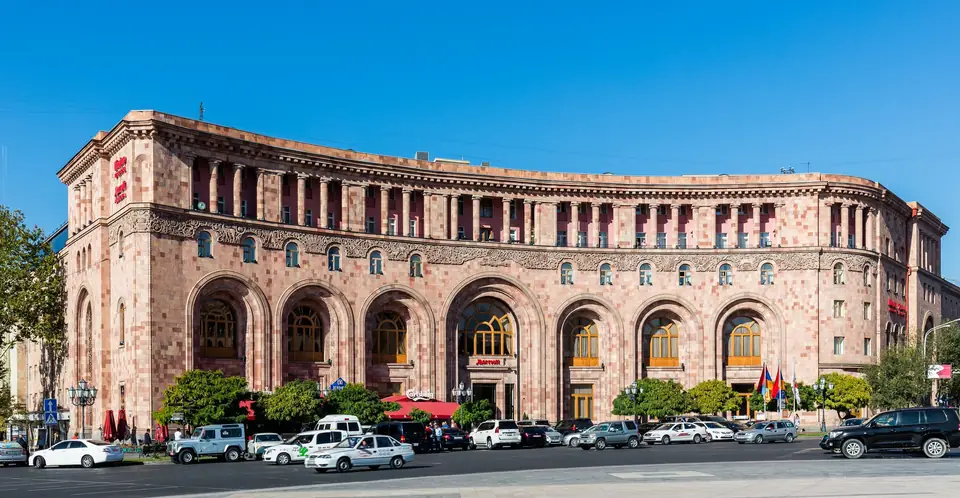
Republic Square is the heart of the Yerevan that Alexander Tamanian laid out in his 1924 master plan. Work began in 1926 with the Government House and the ensemble was not closed until 1977, when the National Gallery was finished. All its buildings are built and clad in felsitic tuff, pink in most and white in two, on a basalt plinth: hence the warm tone that makes it the most recognisable image of the Armenian capital.
The square's most eloquent piece is an absence. At the southern end, a patch of lawn occupies the spot where a seven-metre statue of Lenin stood from 1940 to 1991, and where its pedestal held out until 1996. Meanwhile, the toppled Lenin is still in Yerevan: according to several sources, his decapitated body lies in the back yard of the museums building, across the oval.
Highlights
- Government House — pink tuff on basalt and five arches with motifs from Tekor and Dvin
- Tower clock — Yerevan's favourite meeting point, brought from Moscow in 1941
- Lenin's gap — the lawn where the statue stood until 1991 and its pedestal until 1996
- Singing fountains — water, light and music since 1970, the first in the USSR
- Museums building — white facade of 1977, the last piece of Tamanian's oval
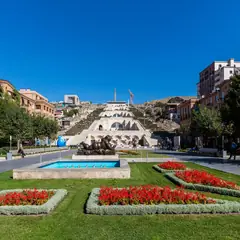
Whoever arrives at Republic Square tends to see it as a postcard: a great oval of pink stone, a clock tower, a pool and a white facade at the far end. Behind that image lie more than fifty years of building. Alexander Tamanian drew it in his 1924 master plan of Yerevan as the centre of the new capital of Soviet Armenia; the first stone was laid in 1926 with the Government House, and the last building, the National Gallery, was not finished until 1977. For much of that time it was called Lenin Square, and on 1 November 1990 the city council gave it the name it bears today.
What to see at Republic Square is not limited to its architecture. This oval has been a tribune for Soviet parades, the stage of the USSR’s first great national protest in 1965, the starting point of the 2018 Velvet Revolution and the site of encounters as unexpected as a metal concert on the eve of the genocide centenary or a prayer for peace led by a pope. Beneath its feet, moreover, lie buried the cellars of 17th-century houses.
The audio guide’s documented route covers the square in five stops: the Government House and its clock, the empty lawn where Lenin stood, the centre of the oval, the pool of the singing fountains and the facade of the museums. By the end, the history of Republic Square reads like a stage built in layers.
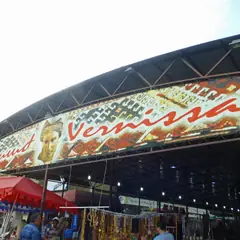
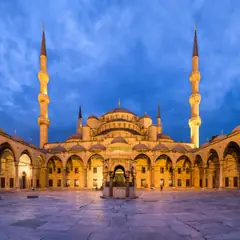
A step away begin the stalls of Vernissage, and to the north the Yerevan Opera Theatre is the other great stage Tamanian drew in pink tuff; to the west, the Blue Mosque holds what is left of Persian Yerevan.
Tekor arches for a Soviet government
Government House
Summary of this stop
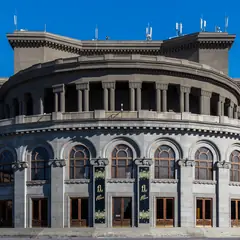
In front of the Government House you grasp the key to the whole square. It was the oval’s first building: its northwest wing was finished in 1929 for the People’s Commissariat of Soviet Armenia, and its height, scale and the rhythm of its facade set the standard for everything built around it afterwards. The architecture of Republic Square starts here: pink felsitic tuff on a dark basalt plinth, the same material repeated by the other buildings, except for two clad in white tuff.
The curved facade facing the square is articulated with five arches on bundles of monumental columns, with an open gallery above. For a building of Soviet power, Tamanian took decorative motifs from the medieval Armenian architecture of Tekor and Dvin, and the work won him the Soviet State Prize in 1942. On the north side, the clock tower, crowned by a rotunda, is the city’s favourite meeting point, which some call the Armenian “Big Ben”.
The story goes that the clock was made in Moscow and reached Yerevan in July 1941, and that its chimes play the first notes of the Armenian anthem every hour. The story of one of those bells, and where it might have come from, is the detail the narration keeps for this spot.
The pedestal that hurt more than Lenin
Lenin monument gap
Summary of this stop
At the southern end of the oval lies a patch of lawn with no monument. Here, in November 1940 (sources hesitate between the 24th and the 29th), Sergey Merkurov’s statue of Lenin was unveiled, about seven metres tall and in copper, on a granite pedestal of about 12 metres by Natalia Paremuzova and Levon Vardanov, with Armenian ornament inspired by a khachkar from Gosh.
The end came in two stages. On 28 March 1991 the city council voted to remove the statue, and in April that year, on the 13th according to nearly all sources, it was hoisted onto a truck that circled the square like a funeral cortege amid cheers. The empty pedestal held on five more years: in July 1996 President Levon Ter-Petrosyan ordered it demolished, and the battle of journalists, architects and poets to save that national work of art was fiercer than the one to remove Lenin. The poet Silva Kaputikyan called it an “act of vandalism”.
Since then the gap has had fleeting occupants: on the night of 31 December 2000, a 24-metre cross with 1,700 light bulbs for the 1,700 years of Christian Armenia, removed at the end of 2001; from 2004 to 2006, a giant advertising screen; in 2019, some karases, large clay wine jars, on the lawn. Why no monument has ever managed to stay is one of the questions this stop raises.
A town from 1679 under the parades
Stone carpet of the oval
Summary of this stop
In the centre of the oval, the paving of coloured stones is drawn to look like an Armenian carpet seen from above. Underneath lies another square. In the 2003 renovation, on lifting the asphalt, cellars of 17th-century houses appeared with halls 4.5 metres high, ruined by the 1679 earthquake; they were covered again with sand and remain buried.
Over that lost town Soviet Armenia paraded. At the celebrations of 1 May and 7 November, the leadership presided from the tribune at Lenin’s foot, and on the anniversaries of 1961, 1970 and 1980 a wooden extension was added to host leaders from the other republics. The last parade was held in 1988.
The square also belonged to the crowd. On 24 April 1965, the 50th anniversary of the Armenian genocide, some 20,000 people gathered without permission in what was then Lenin Square to demand that the USSR recognise it, in the first demonstration of its kind in the entire Soviet Union. On 17 April 2018, Nikol Pashinyan proclaimed here the start of a velvet revolution against Serzh Sargsyan, and after the latter’s resignation on 23 April the oval filled with celebration. Who walked among the demonstrators of 1965 and what role he would play later is one of the twists the audio guide tells about this stone carpet.
Fountains that sang before Moscow
Singing fountains pool
Summary of this stop
In front of the museums building stretches the great rectangular pool built in 1953. In 1970 the radio technician Abraham Abrahamyan added colour and sound fountains to it: the USSR’s first “singing” fountains, copied afterwards in Moscow, Batumi and Sochi. In 2007 the French firm Aquatique Show International renovated them for about 1.4 million euros, and in season they still run at night.
It is the liveliest face of the square, the one that gathers locals and visitors as evening falls. And it has an unexpected counterpoint: a few metres away, in the back yard of that same building, the decapitated body of Lenin’s statue is said to have lain since 1991, head separated and traces of three gunshots in the chest. Not all sources agree on its whereabouts, and one tourist guide even claims it ended up sold in New York.
How a Yerevan technician managed to make water dance to music before anyone else in the Soviet Union is the story the narration keeps for the edge of the pool.
The square that was meant to face Ararat
History Museum of Armenia
Summary of this stop
The white, symmetrical facade, with its colonnade, houses the History Museum of Armenia and the National Gallery. Finished in 1977, it was the last piece of a plan drawn in 1924. Tamanian had oriented Yerevan towards Mount Ararat and wanted the mountain to be seen from the square; later tall buildings prevented it, and this same building cut off the Northern Avenue, which in his design ran into the oval.
The mountain returned to the square symbolically on 25 June 2016. That day Pope Francis and Catholicos Karekin II jointly led an ecumenical meeting and a prayer for peace before thousands of people. Francis called the Armenian genocide an “immense and senseless slaughter” and said that keeping its memory alive is a duty for everyone.
The gesture with which both closed that meeting, tied to the vine and Noah’s Ark, the great symbols of Ararat, is the ending the route keeps for this last stop in front of the museums.