Persian Yerevan
Blue Mosque Audio Guide (Gök Jami)
An 18th-century Persian compound sunk two metres below Mashtots Avenue, with a tree-filled courtyard, a pool and a blue-tiled minaret. It was a Soviet anti-religious museum and planetarium, an Armenian poet saved it, and today it is Armenia's only active mosque.
- 30 min of audio
- 18th-century Persian architecture
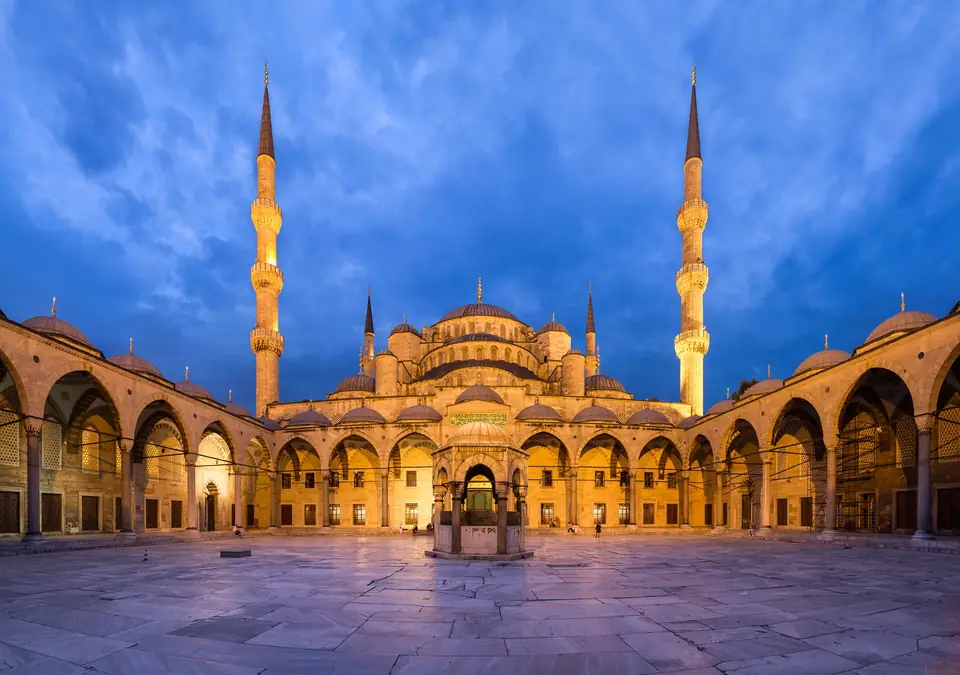
The Gök Jami, Yerevan's Blue Mosque, is the most important building left from the Iranian city before 1827. It was built by the sardar Hoseyn Ali Khan as the main Friday mosque, and his name appears in the Persian inscription of the south portal alongside the year 1179 AH (1765-1766), although the exact founding date remains disputed. Brick, glazed ceramics, a great blue dome with the mirrored “Ya Ali” calligraphy and a minaret of about 24 metres, the tallest structure in 19th-century Yerevan, define its architecture.
The contrast lies in its biography. It closed to worship in the mid-1920s, housed an Anti-Religious Museum, an Anti-Fascism one and, from 1936, the Yerevan History Museum and a planetarium under the prayer hall's dome. The poet Yeghishe Charents and other intellectuals saved it from demolition, and every year, when the courtyard mulberry blooms, the mosque marks it with a service in his memory.
Highlights
- Blue dome — glazed ceramic with the mirrored “Ya Ali” calligraphy, under which a Soviet planetarium operated
- 24-metre minaret — the tallest structure in 19th-century Yerevan
- Courtyard with pool — elms, plane trees and mulberries between arcades of 28 vaulted cells
- South portal — Hoseyn Ali Khan's Persian inscription, walled up in Soviet times
- Persian tea with poets — the tea house of Charents, Saryan and Bakunts in the 1920s
From Mashtots Avenue, in the very heart of Yerevan, only a minaret and a blue-tiled dome peek out. To get in you have to go down: the Blue Mosque, the Gök Jami, ended up more than two metres below street level when the Soviet city was laid out above it. That difference in level sums up its history. Below survives the greatest piece of Persian Yerevan, the city of bazaars, domes and minarets that the Russians found when they took it in 1827, when this was the largest of its eight working mosques.
Its origin is read in stone: a Persian inscription over the old south gate names Hoseyn Ali Khan, semi-independent sardar of Yerevan, and gives the year 1179 AH, that is 1765-1766. Other readings of the inscriptions and other authors propose somewhat earlier or later dates, and according to tradition the mosque of Def Sultan, destroyed by the great earthquake of 1679, once stood on this same site or very near it. Nor is its identity a settled matter: Armenian, Iranian and Western sources describe it as a Persian mosque, while Azerbaijan’s official discourse claims it as Azerbaijani heritage.
Between those layers fit British and Italian travellers, a planetarium, a poets’ tea house, a restoration paid for by Iran and a 99-year diplomatic transfer. The audio guide’s documented route takes in the entrance staircase, the courtyard with its pool, the foot of the minaret and the prayer hall under the great dome, and lets each episode be heard at the exact spot where it happened.
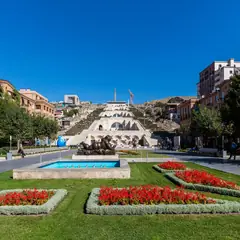
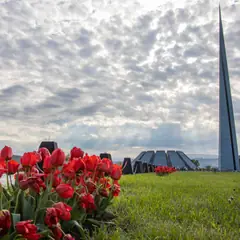
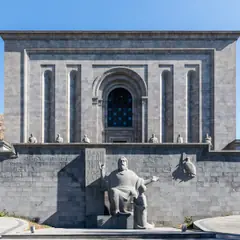
Going up Mashtots, the avenue ends at the Matenadaran and its manuscripts, and a short walk east Republic Square shows the Soviet capital built over the Persian city. Across the Hrazdan gorge, the hill of the Armenian Genocide Memorial holds the country’s most painful memory.
Two metres below Mashtots: the survivor
Blue Mosque
Summary of this stop
The staircase descending from the avenue is not the original entrance. Alexander Tamanyan’s 1924 master plan sank the mosque relative to the new street level, and the opening of Mashtots Avenue cut off the compound’s northwest corner on the diagonal. The main south gate was walled up, and the new north entrance, opened in that amputated corner, became the only one. Each step marks the border between the city planned in the 20th century and the one that was there before.
What lies at the bottom is, moreover, the last one still in use. Many of Yerevan’s 19th-century mosques fell in the 1930s and 1940s under Soviet atheist policy, in the same wave that demolished most of the city’s historic churches, such as Poghos-Petros or the Katoghike. Of the Kond mosque, in the old neighbourhood of the same name, only a part remains, and it is said to be inhabited by families descended from 1915 refugees. It is a disputed story: Baku accuses Armenians of destroying mosques to “Armenianise” the city, and the Armenian reply is that Soviet demolition hit churches and mosques alike.
Between those two readings, the Gök Jami is today Armenia’s only active mosque. Why this one in particular was saved, and what the level difference of the staircase says about the two cities superimposed here, is what the narration raises before crossing to the courtyard.
Persian tea with poets under the mulberry
Courtyard with central pool
Summary of this stop
The courtyard, about 71 by 47 metres, appears suddenly after the noise of the avenue: a pool with a fountain for ablutions in the centre, elms, plane trees and mulberries giving shade, flowerbeds and, on the east and west sides, arcades of 28 vaulted cells that were Quranic school, pilgrim lodging and, in the 1920s, workers’ housing. In the 1840s, August von Haxthausen, who visited with Khachatur Abovyan, found in a madrasa room some thirty children sitting cross-legged, learning Persian from manuscripts of a history of Nader Shah.
In the early Soviet years, this courtyard was something unexpected: a tea house frequented by Yeghishe Charents, Martiros Saryan and Aksel Bakunts, which William Saroyan, Osip Mandelstam and Andrei Bely also passed through. The writer Gurgen Mahari remembered often coming with Bakunts to drink “Persian tea” in the shade, while his friend predicted that this bazaar quarter would be unrecognisable by the fifties or sixties. The prediction came true and then some.
Charents did not only drink tea here. With other Armenian intellectuals, the poet kept the mosque from falling in the Soviet campaign against religious buildings, and in 2026 the complex’s ceremonial hall was given his name. There is an even more striking documented tradition, tied to one of the courtyard’s trees; which tree it is and what happens when it blooms is part of what is told beside the pool.
A minaret where they feared a shot
Southwest corner minaret
Summary of this stop
In the southwest corner rises the minaret, a cylindrical brick tower clad in blue tile, about 24 metres according to most sources. It was the tallest structure in 19th-century Yerevan, and from its top the muezzin called the faithful to prayer every day. Very close by, the old south portal keeps its frame of decorative ceramic and the Persian inscription with Hoseyn Ali Khan’s name, although the door was walled up in Soviet times: the founder’s signature is still there, but it no longer welcomes anyone.
The tower also holds a dark episode, recorded by the Italian traveller Luigi Villari. In 1905, shortly after one of the outbreaks of violence between Tatars and Armenians that shook Yerevan that year, Villari crossed the bazaar and came out into a courtyard that seemed to him straight from the Arabian Nights, with robed men drinking tea by the fountain. He wanted to climb the minaret for the views, and an old muezzin ended up accompanying him up the narrow stairs, not without resistance.
What happened on the balcony turns this tower, so photographed today from the avenue, into the portrait of a divided city. What the old man feared up there and why he would not let his guest walk all the way round is the moment the audio guide keeps for the foot of the minaret.
A planetarium under the blue dome
Blue dome of the prayer hall
Summary of this stop
The southern prayer hall is crowned by a great central dome of glazed ceramic, flanked by two smaller domes, with the mirrored “Ya Ali” calligraphy running around it. Under that sky of tiles another sky operated for decades: from 1936 until the end of the USSR, the compound housed the Yerevan History Museum and the Natural Sciences Museum, with a planetarium installed in the prayer hall itself (some sources place the museum’s arrival in 1937).
The return to worship came with Iran. After a preliminary agreement in February 1991 with an Iranian delegation, the mosque was restored at a cost of around 1,000 million Iranian rials, paid by the Mostazafan Foundation, under the supervision of the Iranian-Armenian engineer Varoujan Arakelian; sources date the works between 1994 and 1998, or between 1996 and 1999, and the reopening for worship in 1996. Across the courtyard, the Hafez Library holds more than 8,000 Persian volumes alongside Persian-language classrooms and an exhibition of Iranian crafts.
In October 2015 the mosque’s 250th anniversary was celebrated here, and on 10 December that year the Government of Armenia ceded its use to the Iranian embassy for 99 years as a cultural centre, keeping the building as the inalienable property of the Armenian state. How the memory of the planetarium, today’s prayer and the politics arriving from Iran live together under the same dome is the close of the route, and it is best understood listening in front of the prayer hall.