Sultanate market since 1758
Beringharjo Market Audio Guide (Pasar Beringharjo)
The market that was born in 1758 in a banyan forest next to the Kraton and that the sultan's plan turned into the worldly temptation of the royal road. Today batik, jamu roots and flowers for offerings pile up under a concrete hall raised between 1925 and 1926.
- 60 min of audio
- Batik, jamu and ritual flowers
Pasar Beringharjo is one of the four pieces of the Catur Tunggal, the urban plan of the Sultanate of Yogyakarta: the Kraton for power, the alun-alun for public life, the mosque for worship and the market for exchange. Trade has gone on here since 1758, first on mats under the banyans of the old Pasar Gedhe and since 1926 in a building of mixed Javanese and colonial style, with Art Deco touches, that the Dutch came to call the most beautiful market in Java.
The market a visitor finds at midday starts to be set up before dawn. Some 260 buruh gendong, porters who carry goods on their backs held with a shawl, move among the stalls; 210 are women, almost all middle-aged, who carry between 30 and 50 kg per trip in exchange for 35,000 to 50,000 rupiah a day. Many sleep in the arcades opposite to unload the vegetable trucks that arrive around one in the morning.
Highlights
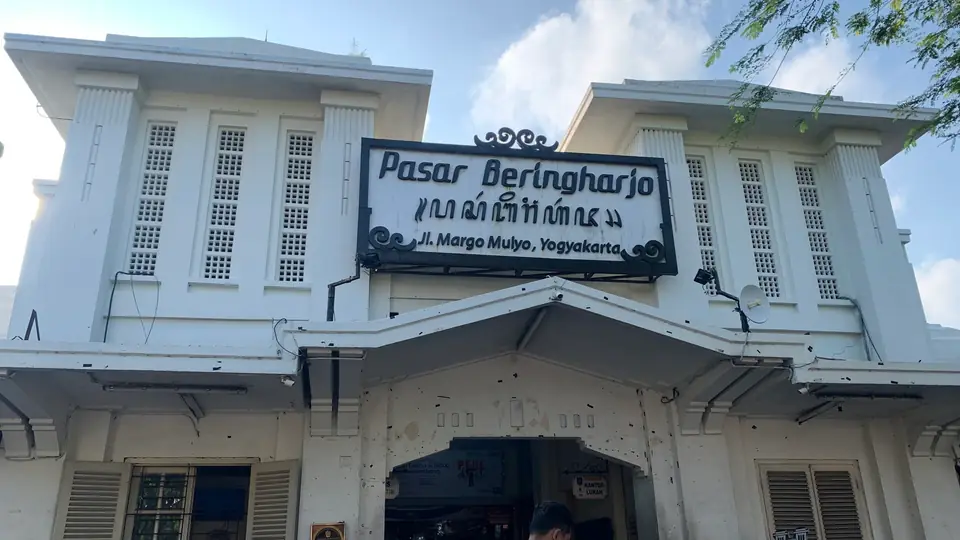
- Colonial gateway on Malioboro — the market's sign in Latin and Javanese script
- Batik halls of the west wing — fabrics, surjan, blangkon and sarongs under the 1925-1926 hall
- Jamu and spice floor — piles of turmeric, temulawak, ginger and cinnamon
- Historic kitchens — Empal Bu Warno (1960) and Gado-gado Bu Hadi (1952) between soot-black walls
- Flower sellers on the south pavement — the bundle of seven flowers for offerings
The story of Pasar Beringharjo begins with trees, not walls. The site was a banyan forest and, soon after the founding of the Kraton in 1758, the people of Yogyakarta and its surroundings began to use it for trade. That is how the Pasar Gedhe, “the big market”, was born, which for more than a century and a half worked without a building: sellers dealt on mats or in stalls set up in the shade. Most sources place that beginning in 1758, although one traces it back to the founding of the Mataram kingdom, in the 17th century.
None of it was chance. The market is one of the four pieces of the Catur Tunggal, the plan with which the sultanate ordered its capital, and in the Philosophical Axis of Yogyakarta, inscribed by UNESCO as a World Heritage site on 18 September 2023, it symbolises the worldly temptations of the road from the Tugu to the Kraton. It is often presented as the oldest market in Yogyakarta, a debatable label: Pasar Legi of Kotagede, founded in 1549, predates it by two centuries, and it is more accurate to call it the oldest around the Kraton.
What to see at Pasar Beringharjo is ordered from the gate inward and from the bottom up: the gateway on Malioboro, the batik halls of the west wing, the jamu floor and the kitchens of the east wing and, outside, the south pavement of the flower sellers. The audio guide covers it in four stops, with documented narration checked against historical sources, and leaves for each corner the part of the story that cannot be seen among the stalls.
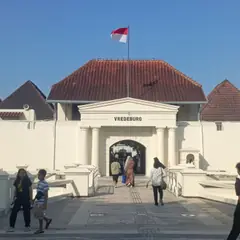
About two hundred metres to the south stands Fort Vredeburg, and to the southwest, beside the palace esplanade, the Masjid Gedhe Kauman. To the north, Malioboro climbs along the city’s axis to the Tugu.
The bilingual gate on the road to the Kraton
Pasar Beringharjo
Summary of this stop
The main entrance opens on the west side, facing Jalan Malioboro. It is a colonial-style gateway with the sign “Pasar Beringharjo” written twice, in Latin and in Javanese script. On each side there is a small room of 2.5 by 3.5 metres for administration, and from the threshold a straight corridor about 2 metres wide runs east, with the pavilions open on both sides. In the Dutch colonial era, the market was nicknamed “Passer Op van Java”, the most beautiful market in Java.
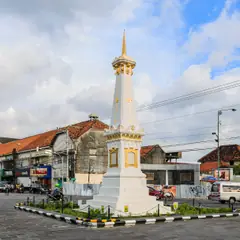
The gateway is also a point on the city’s symbolic map. On the Philosophical Axis, the stretch between the Tugu and the Kraton represents the human being’s road to the Creator, and the Kepatihan complex and Pasar Beringharjo embody the worldly temptations of that road, along with Jalan Margo Mulyo, “the road to nobility”. A bustling market placed on purpose on the route to the sacred.
At this very gate, on 11 April 2018, Mayor Haryadi Suyuti inaugurated on a trial basis the night opening until 21:00: until then the market closed around four or five in the afternoon, before maghrib. He did it not by cutting a ribbon but a garland of flowers. What else debuted that day at Beringharjo is one of the details the narration keeps for the gateway.
Mats under banyans, a concrete roof
Batik halls of the west wing
Summary of this stop
Under the hall of the west wing, the central aisle opens between batik stalls: fabrics in the north part and, along almost the whole wing, batik clothing, surjan, blangkon and sarongs. The cool half-light of this space occupies the old banyan forest where, since 1758, goods were sold on mats. Not a single tree of that forest remains.
The current building has a date and a builder. On 24 March 1925, the Kraton commissioned the pavilions from the Nederlandsch Indisch Beton Maatschappij, the Dutch East Indies Concrete Company; by the end of August 11 stalls were finished and the rest followed in phases, until the work was completed at the end of March 1926. A month later it began to be used. Sources do not agree on which sultan signed the commission, nor on whether the first permanent stalls date from 1923 or 1925.
The name came later. Sultan Hamengku Buwono VIII officially christened the market Beringharjo, according to the Sonobudoyo museum on 24 March 1929, as part of his order that all the sultanate’s institutions use Javanese; other sources move the date to 1925. “Bering” comes from beringin, the banyans, and “harjo” means prosperity. How a vanished forest lives on in a single syllable is understood on hearing it in the central aisle.
Jamu, soot and the empal that survived
Jamu floor and east wing kitchens
Summary of this stop
The second floor of the east wing smells of root. Here are concentrated the ingredients of Javanese jamu and the spices: piles of turmeric, the kunyit of kunyit asam, temulawak for the bitterest jamu, ginger and cinnamon. An ethnobotanical study by Universitas Padjadjaran, carried out in the market between February and March 2019, counted 93 species of edible plants from 37 families and 159 local varieties, brought by farmers from Yogyakarta and Central Java. One floor up, the third floor gathers antiques and second-hand clothes, with old typewriters and helmets from the 1960s.
On this same floor are the eateries, with walls blackened by the daily smoke of stoves and charcoal, and their presence here is itself a story of survival. In 1986 a great fire struck the market, which did not work again until 1991, and after the reconstruction historic stalls such as Empal Bu Warno moved here from Jalan Pabringan, south of the building. Founded in 1960 by Ibu Prawiro Suwarno, it now occupies stall Los Timur PA 1; opposite, Gado-gado Bu Hadi has been open since 1952 and is in its third generation.
The empal, fried beef, is still cooked in a luweng, a wood-fired stove lit with tallow instead of kerosene: 40 kg of raw meat shrink to 20 after hours of cooking. According to the family, the great Kraton clan, above all the relatives of Sultan Hamengku Buwono IX, bought here, and legend says more than one customer found a partner thanks to a piece of empal. The memory of a neighbour who in 1984 bought it wrapped in banana leaf is the scene the audio guide reserves for this stove.
Seven flowers with a proverb for offerings
Offering flower sellers on the south pavement
Summary of this stop
Outside the building, at the street stalls on the south pavement, flowers are sold for funerals, weddings and sajen, Javanese offerings. Mbah Mardi, who came from Klaten and was 81 in 2022, has been selling on this pavement for some 40 years, among other things the bundle of seven flowers for offerings. Because of that tradition the market was the starting point of the sajen route of the 2022 Festival Kebudayaan Yogyakarta.
Each flower is sold with its Javanese pun. The rose, mawar, recalls “mawarno-warno”, multicoloured, because life brings joys and sorrows; the kenanga reads as “keno ngene keno ngono”, you get this, you get that. The bundle gathers jasmine, kantil, red rose, white rose, tuberose, kenanga and melati gambir, and the number seven, pitu, sounds like “pitulungan”, divine help. Among its regular customers is a batik businessman with shops right opposite the market.
All around, the market is carried on backs. The buruh gendong cross between the stalls and loading areas with bundles tied in a cloth, organise in groups such as the Sayuk Rukun association, and today some porters carry up to 70 kg to the third floor; Yogyakarta’s municipal ordinance 3/2022 finally recognised them as an economic actor of the market. Who those women are and what a day that starts while Malioboro is still dark is like is what closes the tour.