Dutch colonial fort
Fort Vredeburg Audio Guide (Museum Benteng Vredeburg)
The fort the Dutch Company planted a cannon shot from the Kraton and that the sultan himself had to pay for. It was barracks, prison and battlefield, and today it is the museum of the struggle for independence, on ground that never stopped belonging to the sultanate.
- 60 min of audio
- Fort and independence museum
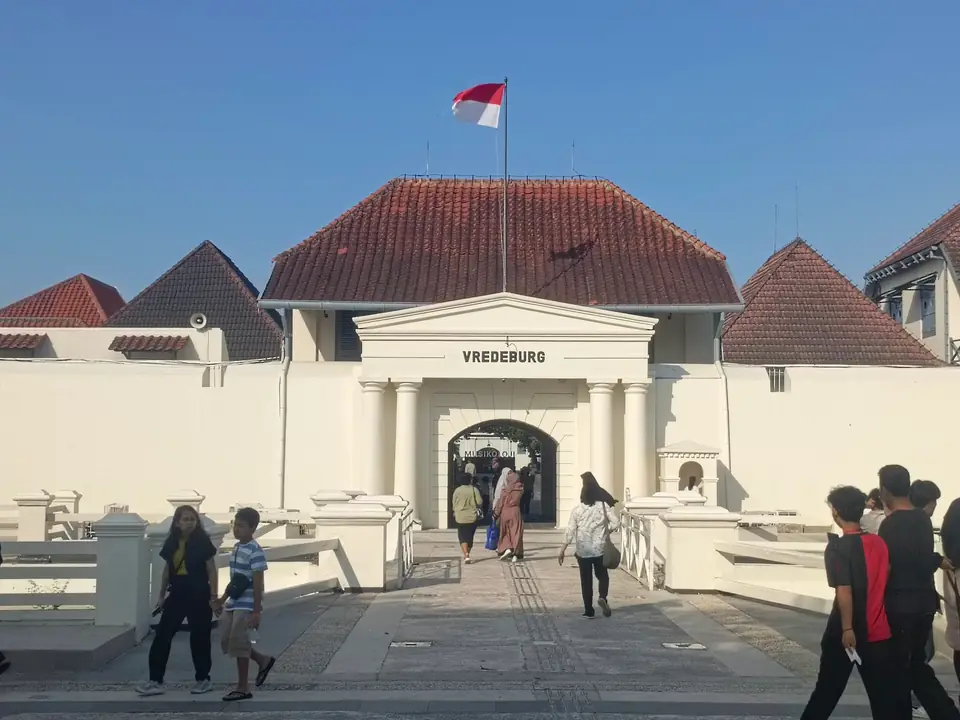
Fort Vredeburg, the Museum Benteng Vredeburg at Yogyakarta's Km 0, was born as one of the obligations of the Treaty of Giyanti (1755). In 1760 a first enclosure was raised of earth, coconut-palm posts and bamboo; the permanent version, square, with four bastions, a moat and room for 500 soldiers, took decades to finish, in 1787 or 1790 depending on the source. In 1981 it was declared a cultural property and since 1992 it has been the official museum of the struggle for independence.
Its name is almost an irony. It was built 400 metres from the palace and facing the street that leads to it, officially to protect the sultan and in practice to watch him. In June 1812 its cannons fought a duel with those of the Kraton. Even so it ended up called Vredeburg, “fort of peace”, and in all its stages, colonial, Japanese and republican, the land remained legally the sultanate's.
Highlights
- West gate — two-level gateway with a bridge over the moat, facing the Gedung Agung
- Jagang — the buried moat, excavated in 2014 and turned in 2024 into a pond with a dancing fountain
- Jayaprakosaningprang Bastion — three cannon mounts at the southwest corner
- Whitewashed barracks with arcaded galleries, built for some 500 soldiers
- Four diorama halls, from the Diponegoro War (1825) to 1974
The story of Fort Vredeburg begins with a paradox: Sultan Hamengku Buwono I had to pay for the barracks from which the Dutch were going to watch him. It was one of the obligations of the Treaty of Giyanti (1755), and the sultan tried to delay it as long as he could. What came out of that reluctant work, a square fort with four bastions and a moat a single cannon shot from the Kraton, was first called Rustenburg, “castle of rest”, and later Vredeburg, “fort of peace”. Neither name describes well what happened inside.
The construction dates remain open. Some sources attribute the first fort of 1760 to the sultan himself and place the permanent work between 1767 and 1787 under the engineer Frans Haak; the Atlas of Mutual Heritage has it begin in 1765 and end in 1790; the province’s tourism portal simply attributes it to the Dutch government. Nor is there agreement on the area: about 2,100 m², 22,480 m² for the fort or 46,574 m² for the whole museum compound, depending on who measures it.
What to see at Fort Vredeburg is divided between military architecture and memory: the west gate facing the Gedung Agung, the recovered moat, the bastions with Javanese names, the rows of whitewashed barracks and the diorama halls that tell the struggle for independence, all of which took place in Yogyakarta and its surroundings. The audio guide covers the compound in five stops, with documented narration checked against historical sources, and keeps for each corner the part of the story that the whitewashed walls do not let show.
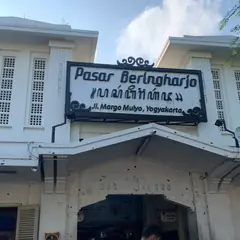
To the south, past the Km 0 junction, lies the Kraton, the palace the fort’s cannons aimed at in 1812, and about two hundred metres to the north opens Pasar Beringharjo.
A fort a cannon shot from the sultan
Museum Benteng Vredeburg
Summary of this stop
The fort’s west gateway, of two levels and with its bridge over the moat, faces the main street leading to the palace, today Jalan Margo Mulyo, and has opposite the Gedung Agung, the former residence of the Dutch Resident and today the presidential palace. The position is no accident: the fort was planted a cannon shot from the Kraton, officially to protect the sultan and in practice to watch him, intimidate him and, if need be, attack or blockade him. The house opposite was the refuge that gave meaning to the whole fortress.
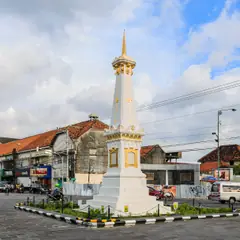
The great earthquake of 1867 brought down Fort Rustenburg, together with the Resident’s residence and the Tugu Pal Putih. After the reconstruction it was renamed Vredeburg, for the coexistence without attacks between the sultanate and the Dutch, although the Atlas of Mutual Heritage moves the renaming to the years following the Java War (1825-1830).
The street, by contrast, preferred its own name. The Javanese called Dutch buildings “loji” for their size and courtyards, and this one, the oldest in the city, is the Loji Gede, “the big loji”. Around it grew a whole family of nicknames, from the Loji Kebon opposite to the Loji Kecil and a Loji Setan, “the devil’s loji”, which today houses the regional parliament. Why it earned that name is what the narration tells before the gate.
The moat the sultan had to pay for
Bridge over the jagang
Summary of this stop
The entrance bridge crosses the jagang, the moat that surrounded the fort. That first enclosure of 1760, raised at the Dutch request, was very simple: earth walls reinforced with coconut-palm and aren-palm posts, and bamboo and timber buildings with alang-alang roofs. In 1765 W. H. van Ossenberch, successor to Nicolaas Hartingh, asked to turn it into a permanent fort under the direction of Frans Haak.
The work advanced with a slowness the sources explain by the sultan himself: he supplied the materials and labour, and he was busy building his Kraton. The result was a square fort, with four bastions, a moat and lodging for 500 soldiers, finished in 1787 or 1790 depending on the source consulted.
The moat later had a life of its own. In time it was filled with earth, dug out again in 2014 and, in the revitalisation of 2024, costing some 50 billion rupiah and reopened on 8 June, it became a pond with a dancing fountain for the night visit. Inside the compound, the cafe has recovered the name Rustenburg. How a work the sultan tried to delay dragged on for so many years is one of the stories the audio tells about the bridge.
The bastion that shelled the Kraton
Jayaprakosaningprang Bastion
Summary of this stop
The four corner bastions received Javanese names from the sultan: Jayawisesa in the northwest, Jayapurusa in the northeast, Jayaprakosaningprang in the southwest and Jayaprayitna in the southeast. At the top of the southwest one three piles survive that served to seat cannons, and the revitalisation of 2024 also opened to the public a corner bastion overlooking the Titik Nol Kilometer junction, with the Gedung Agung, the Kantor Pos and the old BNI 1946 building in view.
Those cannons were not decoration. In 1785 the crown prince Adipati Anom, the future Hamengku Buwono II, promoted the Baluwarti, the Kraton’s outer wall, in response to this fort planted north of the palace. In June 1812, after the arrival of Thomas Stamford Raffles with his army on the 17th, the fort’s artillery fought a duel with the Kraton’s.
In the midst of the bombardment the powder magazine of the Baluwarti’s northeast bastion exploded, and on 20 June British troops stormed and occupied the palace: the Geger Sepehi. How an artillery duel between two walls a few hundred metres apart ended in the taking of the Kraton is what the narration reconstructs from the bastion.
The fort’s peace, turned into a cell
Barracks and Gedung C1
Summary of this stop
Under the arcaded galleries of the barracks, former officers’ houses and barrack rooms, the fort tells its history as a place of confinement and refuge. Six days after the Java War broke out, on 25 July 1825, the Ratu Ageng fled here with her child grandson, Sultan Hamengku Buwono V; Diponegoro’s supporters besieged the Kraton and the fort until General Hendrik Merkus de Kock arrived on 25 September.
From 1942 to 1945 the compound was the barracks of the Kempeitai, the Japanese military police, an arms depot for weapons brought from Semarang and a prison for Dutch, Indo-Dutch and Indonesian politicians opposed to Japan, with powder magazines at every corner except the northeast. Under the republic, after the failed coup attempt of 3 July 1946 led by Major General Soedarsono, Mohammad Yamin and Tan Malaka were held here; the fort was then a republican barracks and that same year opened a military hospital.
In the late 1940s, at the ceremony for the 40th anniversary of Budi Utomo, Ki Hadjar Dewantara proposed turning the fortress into a cultural institution. The dream was cut short in 1965: after the G30S, the compound served as a detention place for political prisoners under the control of the Ministry of Defence, and the Gedung C1, the most imposing building of the complex and today the museum’s introduction hall, came to be a cell for special prisoners. In the city it is also said that at night these arcades have their own guard, with a Dutch lady with horse’s legs and a headless colonial patrol; the versions of the legend are left for the audio.
Six hours of 1949 that return every March
Courtyard and diorama halls
Summary of this stop
The central courtyard was the stage of the fort’s last war. On 19 December 1948 Dutch aircraft bombed the republican barracks and Colonel Van Langen’s T Brigade occupied it. On 1 March 1949 it was the centre of the Dutch defence and the main objective of the Serangan Umum, the general attack that left the city in republican hands for some six hours.
That morning returns every March. Around six o’clock sirens sound in Beringharjo, Lempuyangan or Gading, the museum opens an exhibition and the commemoration culminates in this courtyard with a colossal drama reconstructing the attack, performed since 2014 by the Komunitas Djogdjakarta 1945 from books and veterans’ testimony. In 2017, 250 people took part; in 2018 a parade of 30 groups and some 3,500 participants, with Anoa and Tarantula armoured vehicles and cavalry, went along Malioboro to the fort; and in 2022, the year a presidential decree made the date the Day of the Affirmation of the State’s Sovereignty, the battle was staged again at the museum.
Around the courtyard, four diorama halls run from the Diponegoro War to 1974, with scenes such as Soedirman’s appointment as commander-in-chief at the Gedung Agung. They were born half-finished: 93 display cases were planned and, when it officially opened on 23 November 1992, only 30 were complete. Behind it was the agreement of 9 August 1980 between Sultan Hamengku Buwono IX and Minister Daoed Joesoef, and a detail that closes the circle of the tour: the fort’s ground is still the sultanate’s, which lends it to the State.