18th-century water palace
Taman Sari Audio Guide
The water garden Hamengkubuwono I raised in 1758 next to the Kraton survives in a third of its extent among the alleys of a neighbourhood: baths reserved for the women of the court, a gate that encodes its date in birds and a circular mosque reached only underwater.
- 75 min of audio
- The sultan's water palace
Hamengkubuwono I ordered Taman Sari built in 1758, three years after the Treaty of Giyanti, over the Pacethokan spring, which had been a bathing place since the reign of Amangkurat IV. The complex covered more than 10 hectares with 57 buildings: pavilions, baths, a suspension bridge, canals, two artificial lakes with islands, a mosque and underground passages. Roughly a third survives today.
A war and an earthquake ruined it. In 1812, when British troops took the Kraton, the garden was working as an arms workshop and much of it was destroyed; the earthquake of 1867 emptied the ponds. On the dry lakebed grew the Kampung Taman, home to some 2,700 residents known for batik and painting, and reaching the ruins means crossing its alleys.
Highlights
- Gedhong Gapura Panggung — the old back gate, with two of its four nagas
- Umbul Pasiraman — three pools with mushroom-shaped fountains and the sultan's tower
- Gapura Hageng — birds sipping flowers that encode the year 1765
- Gedhong Kenongo — the ruins of an island now surrounded by houses
- Sumur Gumuling — a circular mosque with four crossing stairways, reached through a tunnel
The story of Taman Sari begins before the garden itself. The Pacethokan spring was already a bathing place in the time of Sunan Amangkurat IV (1719–1726), and in 1758, the Javanese year 1684, Hamengkubuwono I decided to raise a water palace on top of it, a step from the Kraton. The work was not considered closed until around 1765, with the completion of gates and walls, and it was finished under Hamengkubuwono II. The dates shift by source: 1758–1765 for the Kraton, 1757–1765 for the Sonobudoyo museum, and some carry the end to 1769; nor is there agreement on the number of buildings, between 57 and about 59.
Authorship is another open discussion. The Kraton website attributes the technical design to Demang Tegis, a supposed Portuguese who arrived from Gowa, in Sulawesi, and the Serat Rerenggan manuscript presents him as a castaway who turned up at Mancingan and was ennobled by Hamengkubuwono II. Against that version, P. J. Veth already stressed the clearly Javanese character of the building, and Hélène Njoto-Feillard maintains that its creators were Javanese and that Dutch descriptions mention no European involvement.
What to see at Taman Sari is divided between what is still standing and what is missing: the east gate through which one enters today, the Umbul Pasiraman pools, the Gapura Hageng relief, the ruins of Kenongo island and the circular Sumur Gumuling mosque, reached down a tunnel. What is missing, the lake, shows in every alley of the neighbourhood. The audio guide covers the complex in five stops, with documented narration checked against historical sources, and keeps for each point what the brick does not explain by itself.
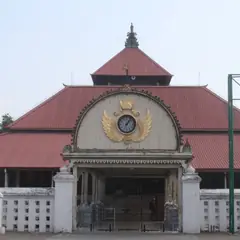
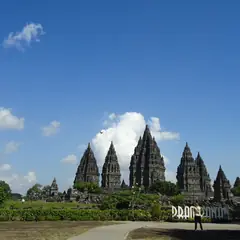
A few minutes away stands the Kraton, the palace this water garden depended on, and beside its northern esplanade rises the Masjid Gedhe Kauman, the royal mosque. For a day outside the city, the Prambanan Temple lies about 16 km to the northeast.
Entering by the sultan’s back door
Taman Sari
Summary of this stop
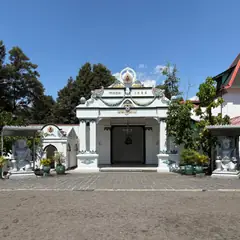
The visit opens with a twist. The current tourist entrance is the Gedhong Gapura Panggung, the east gate, dated to the Javanese year 1684, around 1758; but the pesanggrahan of Taman Sari faced west, and this was in fact its back door. Side stairs climb to a high terrace, like a stage, and of the four nagas that decorated it, two remain.
From above, only part of what once stood can be seen. The original complex gathered 57 buildings over more than 10 hectares, and roughly a third survives today. The east zone no longer exists: in 1812, when British troops took the Kraton, Taman Sari was working as an arms workshop and much of the complex was destroyed. Raffles ordered it drawn, and the reconstruction of the vanished part comes from that English military sketch of 1812.
In the octagonal courtyard to the east stand the Gedhong Sekawan, four pyramid-roofed pavilions where the sultan’s daughters rested. What garden the British drew just before it disappeared is what the narration tells at the top of the terrace.
The tower above the women’s bath
Umbul Pasiraman pools
Summary of this stop
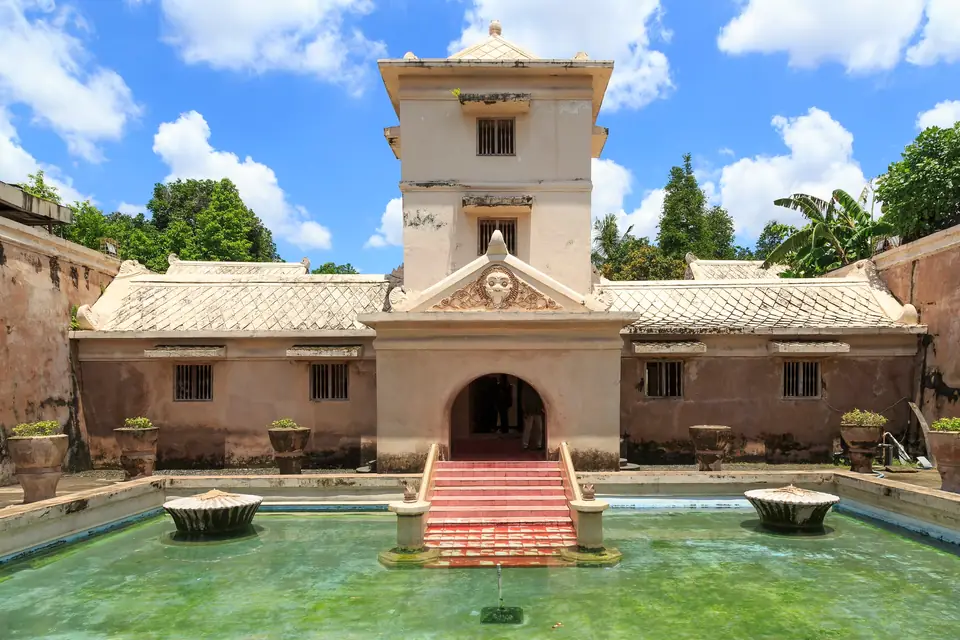
The heart of the tour is the Umbul Pasiraman, also called Umbul Binangun: three pools lined up from north to south between high walls, with mushroom-shaped fountains and large stone planters. The bath rises over a spring that was already in use before the garden, in the time of Amangkurat IV.
It was an enclosed space: only the women of the court and the sultan could enter. The central building, with dressing and resting wings, has a tower from which the sultan watched his daughters and concubines bathe, and the south pool was reserved for him and his concubines. Legend has it that from the top of the tower he threw a rose into the water and that the princess who caught it became his wife or concubine, although the flower almost always ended in the hands of the queen or her concubines; it is also said that whoever entered this area had to undress.
The current look of the pools has a date. Serious restoration of the complex began in 1977, and in 2004 a project backed by Portugal recovered the Umbul Binangun mixing the cement by hand and without heavy machinery. Two years later, the earthquake of 27 May 2006 damaged it badly again, and it had to be repaired and reinforced once more. What exactly was overlooked from the tower window is one of the details the audio guide keeps for this point.
Birds sipping a date in stone
Gapura Hageng bird relief
Summary of this stop
The Gedhong Gapura Hageng, in the west, was the old main gate. Its east face keeps a sengkalan memet, a chronogram in relief of birds sipping flowers that reads “Lajering Kembang Sinesep Peksi” and gives the Javanese year 1691, around 1765: the date the work was closed. The west face, the one that received the sultan’s visitors, has been covered by the houses of the neighbourhood.
Behind that date lies a story of bricks and accounts. Hamengkubuwono I commissioned the regent of Madiun, Raden Rangga Prawirasentika, to make them, in exchange for freeing Madiun from its tribute; on seeing the size of the complex, the regent calculated it would cost him more than the taxes and resigned. The work was then directed by Raden Tumenggung Mangundipura, who had travelled twice to Batavia to study European architecture, and it was finished by Prince Natakusuma, the future Pakualam II. Visitors are still told that those bricks were stuck together with egg white, a tale that in Yogyakarta is rebutted with irony: when Taman Sari was built, lime cement was already known.
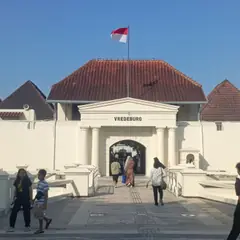
Almost eight years of work also feed a debated suspicion: some believe the sultan lengthened his garden on purpose to delay the construction of Fort Vredeburg, which the Dutch demanded of him. Whether that was strategy or simple ambition is the question the narration leaves open before the stone birds.
Houses where Kenongo island floated
Gedhong Kenongo ruins
Summary of this stop
To the west of the complex stretched the artificial Segaran lake, with the island of Pulo Kenongo and its Gedhong Kenongo, a two-storey building with very thick walls. The royal family crossed the lake by boat. Among the episodes that survive is the visit of Jan Greeve, an envoy of the VOC: he arrived with gifts, the sultan took him for a ride in a golden boat over the waters of Taman Sari, the elderly monarch vanished into a secret chamber and then invited everyone to dance in one of the pavilions.
Today the Gedhong Kenongo is a ruin surrounded by houses instead of water. The earthquake of 1867, under Hamengkubuwono VI, brought down several buildings and emptied the ponds; the palace was abandoned and people began to build among the ruins and on the dry beds. Research on the remains began in 1942 and was interrupted by the Japanese occupation; in those years many neighbours took refuge inside the ruins, and Hamengkubuwono IX allowed them to stay.
That is how the Kampung Taman was born, with some 2,700 residents known for batik and painting, whose alleys occupy the old gardens and lakes: the garden is today Kampung Ngadisuryan and the eastern lake, Kampung Segaran. The neighbourhood even keeps an unexpected episode: on 12 October 2014, Mark Zuckerberg turned up unannounced in the so-called kampung cyber, and three years later the residents named after him the street he had walked. South of Kenongo lay Pulo Panembung, the island where the sultan meditated, and the meaning of its name and of its hanging well is what the narration reveals in front of the ruins.
A mosque under the vanished lake
Sumur Gumuling
Summary of this stop
The end of the tour goes underground. To reach the island without a boat, a tunnel under Lake Segaran, the urung-urung, was built in 1761; with the lake drained, it has remained buried and is still passable, and on the surface the small Tajug structures that served as its vents poke out.
On the other side waits Sumur Gumuling, a circular building that was an island in the lake and was entered only through the tunnel. It worked as a mosque: a mihrab niche opens in its wall, there is a small basin for ablutions and, in the centre, four stairways cross over a platform from which a fifth rises to the upper floor.
Legend says the passage continued to the shore of the Southern Sea and that along it the sultan went to meet Nyi Roro Kidul, the queen of those waters; others say it was she who came up to greet him, that it served as an escape route if the palace was attacked, or that it was a trap the guards flooded to drown pursuers. The passage collapsed and was restored in 1972: today it measures 39 metres, runs more to the west than to the south and ends in a brick wall. Where it truly led is the unknown with which the audio guide closes the visit.