Royal mosque of the sultanate
Masjid Gedhe Kauman Audio Guide
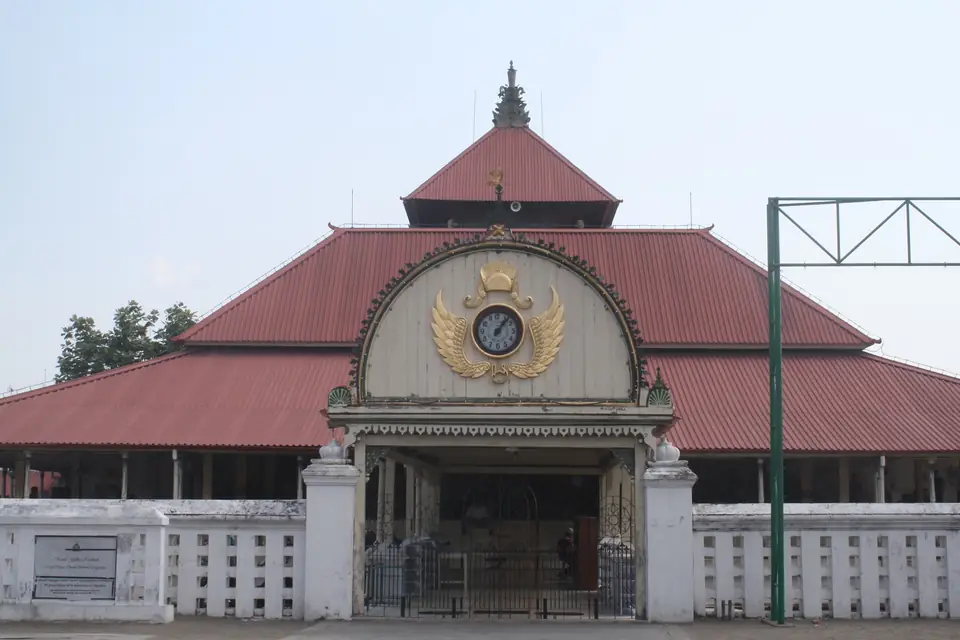
The mosque of the sultan of Yogyakarta has no dome or minaret: it is covered by a three-tier Javanese roof beside the palace's great esplanade. Its porch was a court, it collapsed in the earthquake of 1867, and one of its khatib, born in the neighbourhood, questioned which way prayers were directed.
- 30 min of audio
- Javanese royal mosque
The Masjid Gedhe Kauman, the Great Mosque of Yogyakarta, was founded in 1773 on the initiative of Sultan Hamengku Buwono I and the court penghulu Kiai Fakih Ibrahim Diponingrat, to a design by Kiai Wiryokusumo, eighteen years after the Treaty of Giyanti that created the sultanate. It inherits the model of the Demak mosque: four master pillars, 48 pillars in all and a three-tier, 16-sided roof crowned by the mustaka that only the sultan's mosques carry.
Behind its calm lies a mosque that sank, bent and argued with itself. Around 1897-1898, the khatib Ahmad Dahlan held that the hall faced due west, “towards Africa”, and not Mecca; some young men secretly drew three white lines at 23 degrees, in 1899 a crowd demolished his prayer house and in 1912 the Muhammadiyah organisation was born in the Kauman neighbourhood.
Highlights
- Gapuro, the gate of forgiveness — Javanese and European forms, rebuilt in 1869 after the quake
- Pagongan Lor and Kidul — closed pavilions that open only for the Sekaten gamelan
- Serambi — a porch that was an Islamic court and doubled in size after the 1867 earthquake
- Three-tier, 16-sided roof — no dome or minaret, crowned by the sultan's mustaka
- Prayer hall — four saka guru, a wooden mimbar and the maksura where the sultan prayed
The story of the Masjid Gedhe Kauman begins with a date calculated in three calendars: Sunday Ahad Wage, 29 May 1773, 6 Rabiulakhir 1187 of the hijra and the year Alip 1699 of the Javanese calendar, according to most sources (the newspaper Kompas moves it to 27 May). Hamengku Buwono I raised it on the west side of the Alun-Alun Utara, the Kraton’s northern esplanade, southwest of the Beringharjo market. It is no chance location: it repeats the triad of Javanese capitals since Majapahit, with the palace as the centre of government, the market as the economic centre and the mosque as the religious centre.
The architecture of the Masjid Gedhe Kauman follows the model of the Demak mosque, with no dome or minaret. Four master timber pillars, the saka guru, hold up a tajug lambang teplok roof of three tiers and 16 sides, which reads as the three stages of Sufism: syari’at, thareqat and ma’rifat. It is crowned by a mustaka, the finial reserved for the sultan’s mosques, which stylises a mace for the oneness of God, a kluwih leaf for excellence and a gambir flower for the perfume that spreads. To that core were added over time a porch, two pavilions for the gamelan, a gate rebuilt after an earthquake and a marble floor from Italy.
What to see at the Masjid Gedhe Kauman is ordered from the esplanade towards the prayer wall: the east gate, the courtyard of the gamelan pavilions, the great serambi and the main hall. The audio guide covers the mosque in four stops, with documented narration checked against historical sources, and keeps for each point the story the building does not tell at first sight.
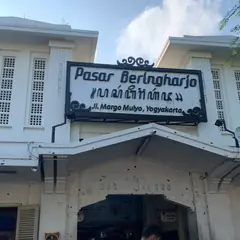
The mosque looks onto the northern esplanade of the Kraton, where the gunungan of the Garebeg set out from, and some 600 metres to the northeast Pasar Beringharjo remains the sultanate’s great market.
The gate of forgiveness the earthquake brought down
Masjid Gedhe Kauman
Summary of this stop
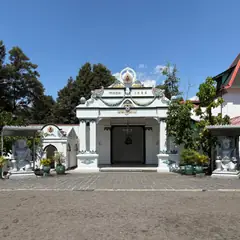
Facing the Alun-Alun Utara opens the Gapuro, the main gate on the east. It was raised in 1840 in the Semar Tinandhu form and its name comes from ghofuro, the “forgiveness of sins”: one enters the sultan’s mosque literally through the gate of forgiveness. The one that stands today is not the original. The great earthquake of 1867 brought it down and it was rebuilt in 1869, dated by the chronogram Murti Trus Giri Narpati, 1798 of the Javanese calendar, in a hybrid language that mixes traditional Javanese architecture with classical European.
To the right and left of the gate, two small sentry boxes, the Pajagan, built in 1917, keep another memory. During the war of independence they were the barracks of the Asykar Perang Sabil militia, which supported the republican army against Dutch military aggression. Its fallen were buried in the old cemetery on the west side, behind the mosque itself.
From this threshold the whole city can also be read: the palace a few steps away, the Beringharjo market to the northeast and the mosque closing the triangle. Why a gate with a religious name ended up guarded by militiamen is the thread with which the narration opens the tour.
Two pavilions for a split gamelan
Pagongan Lor and Pagongan Kidul
Summary of this stop
In the front courtyard, to the north and south, stand two tall pavilions, the Pagongan Lor and the Pagongan Kidul. They were built in 1775 and stay closed almost all year: they open only during the Sekaten, when the court’s sacred gamelan sound in them again. Their story is that of a split inheritance. Kyai Guntur Madu and Kyai Guntur Sari were forged in 1644 under Sultan Agung; after the Treaty of Giyanti of 1755, which divided the kingdom and gave rise to the sultanate, Guntur Sari went to Surakarta and Hamengku Buwono I had a copy made, Kyai Nagawilaga. Today the copy sounds in the Pagongan Lor and the elder, Guntur Madu, in the Pagongan Kidul, to the sultan’s right.
The Sekaten closes with the Grebeg Maulud. In that of 28 September 2023, the Kraton brought out seven gunungan, mountains of glutinous rice, rengginang, wajik and vegetables: five ended in this courtyard, where after the prayer people dismantled them in an instant, and the other two went to the Kepatihan and the Puro Pakualaman. That same week, according to a popular belief that still survives, whoever chews sirih leaves while the gamelan sound stays young, and eating nasi gurih with endog abang, eggs with red-dyed shells, brings God’s blessing.
There is an even stranger ritual, documented in the court tradition. Only in the Dal year of the Javanese cycle, once every eight years, the sultan does not leave the mosque by the door: on the night of 4 September 2025, Hamengku Buwono X walked to the pintu butulan, the walled-up side door on the south side, knocked it down by pushing with his hands and returned to the Kraton over the rubble. It is the Jejak Banon, “treading the bricks”, which according to tradition recalls Prince Mangkubumi’s flight from his enemies on leaving Friday prayer. What happens to those bricks once the wall falls is one of the scenes the audio guide tells in this courtyard.
The porch that was a court and sank
Serambi of the Masjid Gedhe
Summary of this stop
The serambi, the great open porch in limasan form, was not in the initial plan. Only two years after the foundation, in 1775, the influx of worshippers made it necessary to add it, dated by the chronogram Tunggal Windu Pandhita Ratu, 1701 of the Javanese calendar. In the early days of the sultanate it worked as a court of Islamic law, the Al Mahkamah Al Kabirah, above all for civil suits and divorces, under the authority of the court penghulu and the body of religious servants Abdi Dalem Pamethakan. A narrow water moat, the blumbang, surrounds it on three sides: it was used to wash the feet before entering.
In the earthquake of 1867 the gate and the serambi collapsed and killed the Kiai Penghulu. Hamengku Buwono VI diverted the material intended for the Kraton’s Pagelaran to rebuild it, and in 1868 the porch ended up with twice its original area: its current size is the scar of that catastrophe. That same year Ahmad Dahlan was born in Kauman, son of an imam and preacher of the mosque, who would later serve in it under the name Raden Ngabei Ngabdul Darwis and the post of Khatib Amin: Friday sermon in turns with eight other khatib, guard duty on this porch and a seat in the Kraton’s religious court, the Raad Agama. Under the timber ceiling, the decorated tile floor, the tegel kembang, dates from 1933, and a tombstone keeps the foundation chronogram Gapura Trus Winayang Jalma.
The serambi is still full. Every Thursday of Ramadan the mosque serves a free iftar of goat gulai, a yellow turmeric broth over rice in banana leaf: on 19 February 2026, 1,500 portions were handed out. Nobody knows when the custom began, and in Kauman three different versions of its origin circulate, none certain. What they are, and what neighbourhood breakfast ends the fast here on the morning of Eid, is what the narration unpacks under the porch.
Ahmad Dahlan and the lines at 23 degrees
Prayer hall and mihrab
Summary of this stop
From the western edge of the serambi opens the main prayer hall, square and held up by the four saka guru. Its floor is Italian marble, laid in 1936; three years earlier, in 1933, the rotten wooden shingle of the roof had been replaced with corrugated sheet, on the initiative of Hamengku Buwono VIII (sources distribute those works between 1933 and 1936 somewhat differently). At the back, on the west wall, remain the mihrab, the three-step wooden mimbar and the maksura, the railed enclosure of the first row where the sultan prayed. Attached to the building is the pawestren, the women’s prayer hall.
That west wall was the centre of a dispute. Around 1897-1898, Ahmad Dahlan held that the Masjid Gedhe, like almost all the mosques of Yogyakarta, faced due west, “towards Africa”, when it should turn some 23 degrees to the northwest to face the Kaaba. Young men from his prayer house secretly drew three white lines at 23 degrees inside the mosque, and on the night of 15 Ramadan 1899 a crowd arriving from the Pengulon demolished his prayer house, the Langgar Kidul. The question remains open in the reading of the building: an architectural study interprets that exact westward orientation as faithful to the Kraton’s Javanese cosmology, not as an error.
From that clash came Muhammadiyah, born in the Kauman neighbourhood on 18 November 1912, from the school Dahlan had opened in 1911 in a room of his house measuring 6 by 2.5 metres, with three tables, a blackboard and eight pupils. From the traditionalist side, that of Nahdlatul Ulama, there is also a disputed version about the mosque’s inherited great drum. What is said about that drum and why its silence became a banner is the episode with which the audio guide closes the tour.