UNESCO heritage
Tugu Yogyakarta Audio Guide (Tugu Pal Putih)
A white post among motorbikes that is, in fact, the scaled-down version of a fallen pillar and the northern tip of the line the sultan gazed along when meditating. Its Javanese inscriptions say who paid for the work and who only applauded it.
- 20 min of audio
- Landmark of the cosmological axis
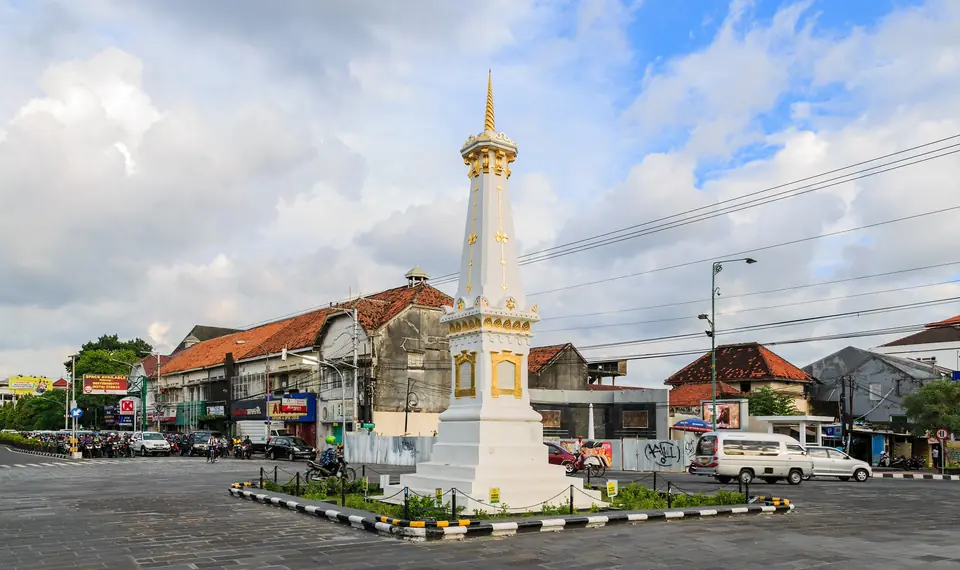
The Tugu Yogyakarta, the Tugu Pal Putih of the Javanese, is the white pillar that crowns the northern end of the cosmological axis laid out by Sultan Hamengku Buwono I. The original, from 1755, was a cylinder topped by a ball, about 25 metres tall, an image of the union between the sovereign and his people. The earthquake of 1867 split it in three, and the one Hamengku Buwono VII inaugurated in 1889 has a square plan, ends in a point and is ten metres shorter.
Its four faces bear inscriptions in Javanese script that share out the credit precisely: the sultan signs, his patih Danureja V pays, a Dutch engineer builds and the colonial resident merely celebrates the sovereign's will. For the city it is also a talisman: it is said that whoever is photographed in front of it will return to Yogyakarta and that hugging it helps finish a degree sooner.
Highlights
- White shaft of 1889 — 15 metres where the 25 of the Tugu Golong-Gilig once rose
- Spiral finial with ornaments repainted in 2012 with 22-carat gold
- Four inscriptions in Javanese script that say who paid and who only applauded
- Low green fence with the Javanese alphabet Ha Na Ca Ra Ka
- Miniature of the original pillar and the straight line to the Kraton on the UNESCO cosmological axis
In the middle of the great junction in the north of Yogyakarta, where Jalan Jenderal Sudirman, A.M. Sangaji, Diponegoro and Margo Utomo meet, a white pillar rises amid the traffic that the city has made its emblem. The story of the Tugu Yogyakarta begins in 1755, when Sultan Hamengku Buwono I planted here the Tugu Golong-Gilig: a cylindrical shaft, the gilig, topped by a ball, the golong, some 25 metres tall, as an image of the union between sovereign and people, the Manunggaling Kawula Gusti. Some sources give 1757 or even 1775, but most, with the Sonobudoyo museum, settle on 1755.
What can be seen today is not that monument. The earthquake of 1867 brought it down and Sultan Hamengku Buwono VII inaugurated on 3 October 1889 a new pillar, square in plan, topped with a point and lower: about 15 metres according to most sources, 12 above ground according to others. The colonial government called it De Witte Paal, the white post, hence the Javanese name Tugu Pal Putih. Many local sources read the change of shape as a Dutch manoeuvre to erase the symbol of unity between king and people, although no document proves it, and the architecture of the Tugu Yogyakarta still fuels debate: where some see Masonic hexagrams, others read Javanese symbolism.
What to see at the Tugu Yogyakarta goes well beyond the roundabout photo: a golden finial, four inscriptions in Javanese script, ornaments of hexagrams, lotus leaves, water drops and rhombuses, and in one corner the miniature of the lost pillar. It is also the northern end of the cosmological axis UNESCO inscribed in 2023, the model for replicas such as the one at Ambarketawang, raised around 1940-1941 for the enthronement of Hamengku Buwono IX, and the spot where the fans of PSIM, the city’s football club, celebrate their victories: on 17 February 2025, with promotion to the top division after 18 years, thousands of supporters filled the junction with convoys and fireworks.
Since the pandemic a fence has surrounded the monument, so the visit is made from the pavements of the junction. The audio guide circles it in three stops, with documented narration checked against historical sources, and keeps for each corner the part of the story that the stone does not tell at first sight.
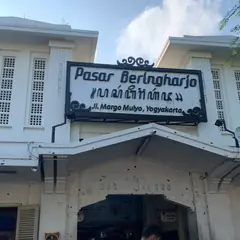
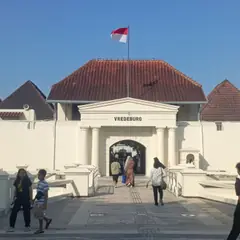
Following the axis south along Malioboro leads to Pasar Beringharjo and to Fort Vredeburg, already at the gates of the sultan’s palace.
Fifteen metres where there were twenty-five
Tugu Yogyakarta
Summary of this stop
From the southwest corner of the junction, the Tugu shows its 1889 form: a white shaft of square plan crowned by a spiral, the untiran, that sharpens upward and ends in a small ball. In the restoration of 2012, part of the ornaments, including that little ball at the tip, were repainted yellow with a paint containing 22-carat gold, and a small garden was created around it. All of that replaces a cylinder with a solid ball of some 25 metres: the current pillar is ten shorter, although the figures shift by source.
The cause of the change was the earthquake of 10 June 1867, in the time of Hamengku Buwono VI, which split the Tugu Golong-Gilig into three pieces. The remains lay abandoned, unrebuilt, for some 22 years. Java keeps the memory of that collapse in a chronogram, a candra sengkala: “Obah Trus Pitung Bumi”, the seven worlds do not stop trembling, a phrase that encodes the year 1796 of the Javanese calendar.
This same white had its bewildering episode. On Sunday 5 July 2015, around midday, a foreign woman arrived from the south and, instead of taking a photo, began throwing red paint at the pillar; the south and east faces were stained. Neighbours held her and handed her to the police, and according to local reports she carried only an artist’s card from the Czech Republic and explained in tears that she was looking for a painter from the city. Firefighters, municipal police and neighbours washed the monument, but the paint had already seeped into the pores of the stone. How the year hidden in those four Javanese words is deciphered is what the narration reveals right there, in front of the pillar.
The inscriptions that say who paid
North and east inscriptions of the pillar
Summary of this stop
Each face of the Tugu bears a plaque in aksara jawa, the Javanese script, and together they share out the credit for the work of 1889 with an almost notarial precision. The west face declares it the work of Sultan Hamengku Buwono VII. The north presents it as funded by the patih Danureja V, the sultanate’s prime minister, and built by Y. P. F. van Brussel, opzichter of the Waterstaat, the public works and water service. The east names the Dutch resident Y. Mullemester, and the south gives the date, 7 Sapar Alip 1819, with the motto “Wiwara harja manggala praja”, under a shield with a Dutch-style crown, ears of rice and cotton and the initials HB VII.
The detail is in the verb. The east inscription presents the resident only as the one who celebrates the sultan’s will, because the colonial government put up no money: the cost was borne by the patih. The colony, however, did name the pillar. Not all sources tell the same: some stress Dutch involvement and place Danureja V as a mere supervisor, and even the engineer’s initials change from one text to another.
Since 29 September 2023, a green pare anom fence of roughly one metre, removable and adorned with the letters of the Javanese alphabet Ha Na Ca Ra Ka, has replaced the tall Traffic Department fence and marks how close those taking photos may come. It has its reason: in the city of students it is said that hugging the pillar helps finish a degree sooner, and the most recent version of the myth claims that merely touching its Javanese letters is enough. In Yogyakarta it is repeated that new myths always spring from the Tugu, and why a signature of 1889 exposes the Dutch is understood on hearing it beside those plaques.
The miniature of the pillar the sultan gazed at
Miniature of the Tugu Golong-Gilig
Summary of this stop
At the southeast corner of the junction, a miniature inaugurated in 2015 brings back the lost form: the cylinder and ball of the Tugu Golong-Gilig. Beside it, the Modiste Pini house keeps the look of the old photos, and the corner fills with young people every night. That ball was not an ornament: it served as a sighting point for the sultan when he meditated seated in the Bangsal Manguntur Tangkil, the pavilion of the Siti Hinggil Lor of the Kraton, to the south and on the same straight line.
Looking south begins Jalan Margo Utomo, and with it the city’s philosophical axis. Read from the Tugu, the layout is the human being’s road to the Creator, the paraning dumadi, and each stretch bears the name of a stage: Margo Utomo, road of virtue; Malioboro, the torch; Margo Mulyo, road of glory, and Pangurakan, driving out evil passions, up to the Kraton. The white of the pillar symbolises the purity of the heart. The famous line between Merapi, the Kraton and the Southern Sea is in fact an imaginary axis; the straight one, joining the Tugu, the Kraton and the Panggung Krapyak, is the core of the property UNESCO inscribed in 2023 as The Cosmological Axis of Yogyakarta and its Historic Landmarks.
Beside the miniature, a scale model explains that axis in copper plates, from Merapi to the sea. In the early hours of Tuesday 24 March 2020, when the coronavirus had just emptied the streets, someone tore off and took the plates on the south and east sides of the miniature of the Panggung Krapyak, the southern end of the axis. The province’s Culture Office asked for the cameras to be reviewed and lamented the lack of handarbeni, the feeling that something belongs to one. What the sultan sought with his gaze from the other end of that straight line is the revelation with which the audio guide closes the tour.