Sultan's palace since 1756
Yogyakarta Kraton Audio Guide (Karaton Ngayogyakarta Hadiningrat)
Seven sand courtyards linked from north to south along the city's sacred axis, with a throne that faces the Tugu. It has been the court of the sultans of Yogyakarta since 1756: it survived the British sack of 1812 and the 2006 earthquake, and the gamelan still sounds in the mornings.
- 90 min of audio
- Living Javanese court
The Yogyakarta Kraton, the Karaton Ngayogyakarta Hadiningrat, was born of the Treaty of Giyanti of 1755, which gave Hamengkubuwono I his own sultanate. The founder was also the palace's chief architect and finished the work on 7 October 1756, the 13th of Sura 1682 in the Javanese calendar. Its core is a succession of courtyards separated by gates, from the Alun-Alun Utara to the Alun-Alun Selatan, aligned on the Panggung Krapyak–Kraton–Tugu axis that UNESCO inscribed in September 2023.
It is a palace in use, not a museum. Hamengkubuwono X works in the Gedhong Jene, the yellow house of his predecessors, and the Kraton keeps some 21 gamelan sets: every Friday the Abdi Dalem Kanca Gendhing, the court servants, clean and check one of them in turn. One of the oldest, Kanjeng Kiai Surak, accompanied Mangkubumi, the future Hamengkubuwono I, in his war against the VOC to raise the spirits of his troops.
Highlights
- Siti Hinggil — the throne facing the Tugu and Soekarno's 1949 investiture
- Bangsal Pagelaran — the pavilion the gunungan leave from at the year's three Garebeg
- Bangsal Ponconiti — the former capital-punishment court of the Keben courtyard
- Srimanganti Courtyard — the surrender of 1812 and morning gamelan and dance shows
- Bangsal Kencana and Gedhong Jene — the golden pavilion and the sultans' yellow house
The story of the Yogyakarta Kraton begins with a move dated in code. When Hamengkubuwono I left the Ambar Ketawang pavilion, in Gamping, to settle in his new palace, the transfer, the boyongan, was recorded with a chronogram in words: Dwi Naga Rasa Tunggal, two, dragon, feeling, one. Read backwards it gives 1682 in the Javanese calendar, 1756 in ours, and the Regol Kemagangan repeats it in stone with two carved serpents. Two versions circulate about the chosen site: one places it at the old Garjitawati pavilion, where the funeral processions of the kings of Mataram rested on their way to Imogiri; the other, at the Umbul Pacethokan spring, in the middle of a banyan forest between two rivers.
The architecture of the Yogyakarta Kraton reads from north to south: seven plataran, courtyards of sand brought from the south coast, separated by regol, gates, and dotted with open marble-floored pavilions that stand above the sand. Some are as old as the sultanate. The Bangsal Kamandungan, for example, was brought by Hamengkubuwono I from the village of Karangnongko, in the old Sukowati, where it had served as his residence during the war against the VOC. What can be seen today, however, is mostly the result of the restoration by Hamengkubuwono VIII in the 1920s and 1930s.
What to see at the Kraton follows that axis: the Pagelaran facing the great northern esplanade, the Siti Hinggil terrace with the throne, the Keben courtyard, the Srimanganti courtyard and, at the back, the Kedhaton with the Bangsal Kencana. The Pagelaran and Siti Hinggil sector is separated from the rest of the compound and has its own entrance, a division often linked to the family dispute opened in 2015, when Hamengkubuwono X, with no sons, named his eldest daughter heir.
The audio guide covers the palace in five stops, with documented narration checked against historical sources, and keeps for each courtyard the episode that sand and timber do not tell at first sight: from a sack and an earthquake to the rituals the court still holds.
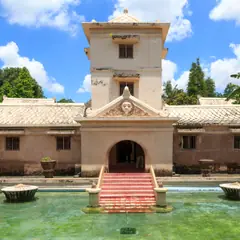
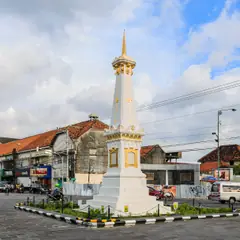
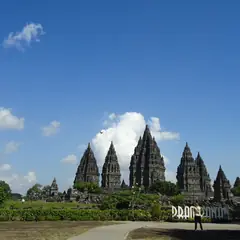
To the southwest of the palace lies Taman Sari, the sultans’ water palace, and the sacred axis ends in the north at the Tugu, the pillar the throne faces. Outside the city, some 15 km to the northeast, the Prambanan Temple adds the Hindu Java of the 9th century.
The pavilion the rice mountains leave from
Pagelaran Keraton Yogyakarta
Summary of this stop
The tour starts under the Bangsal Pagelaran, an enormous pillared pavilion open to the Alun-Alun Utara. Here the court servants appeared before the sultan at the great ceremonies, and today it hosts cultural events. It is the public face of a palace raised by a warrior prince: Mangkubumi, who after the Treaty of Giyanti of 1755 became Hamengkubuwono I and directed the work in person until it was finished in October 1756.
From his troops was born the Bregada, the palace guard. The agreement of 2 October 1813 with Stamford Raffles reduced it to a ceremonial role, the Japanese occupation dissolved it in 1942 and Hamengkubuwono IX restored it in 1970. Today it is ten companies that march in the year’s three Garebeg, those of Mulud, Sawal and Besar, escorting the gunungan: mountains of rice and fruits of the land that symbolise the sultan’s gift and that leave this pavilion for the Masjid Gedhe. After the blessing, the crowd rushes to snatch them in the rayahan, in search of a piece of blessing.
The calendar also holds oddities. On 5 September 2025 the Garebeg Mulud fell on a Friday in a Dal year, something that happens once every eight years, and the Gunungan Brama paraded, which is not shared out and returns to the palace. In that procession there were still elephants, which the palace withdrew from the Garebeg Sawal of 2026 onwards. What the sultan did on returning to the mosque gate that day is the scene with which the narration closes this first stop.
A throne that faces the Tugu
Bangsal Manguntur Tangkil of Siti Hinggil
Summary of this stop
South of the Pagelaran rises the Siti Hinggil, a terrace with a large open tratag and, in the centre, the Bangsal Manguntur Tangkil, the throne pavilion where the sultans are enthroned. The throne faces north, towards the Tugu, and in that orientation lies the key to the whole palace: the Kraton is the centre of an axis that joins the Panggung Krapyak, in the south, with the Tugu, in the north, the line UNESCO inscribed as heritage in September 2023.
The terrace is also a stage of the history of the republic. Yogyakarta was the capital of the Republic from 4 January 1946, and in this pavilion Soekarno was invested as president of the United States of Indonesia on 17 December 1949. Two days later, on 19 December, Gadjah Mada University was inaugurated in the Siti Hinggil complex.
At the foot of the stairway, in the Pacikeran, stands one of the strangest episodes in the palace’s memory. Around 1948, during the plague that between the 1920s and 1940s claimed 4,535 lives in Yogyakarta, Hamengkubuwono IX allowed, at the people’s request, the Kanjeng Kyai Tunggul Wulung, the sultanate’s sacred banner, to be taken out at night, a blue so dark it verges on black; according to the abdi dalem tradition, its cloth comes from the cloth that covers the Kaaba. A witness who was five years old then also remembered an albino buffalo sacrificed at this very spot. Why a sultan refused to repeat the ritual during COVID-19 is part of what is told on the terrace.
From the death court to the New Year silence
Bangsal Ponconiti
Summary of this stop
The Kamandungan Lor courtyard, known as Keben for the keben trees that shade it, has the Bangsal Ponconiti at its centre. Until around 1812, this pavilion was the court where the sultan himself judged the cases punishable by death; today it is used in the Garebeg and Sekaten ceremonies. Beside it stands the Bale Antiwahana canopy, where people stepped down from carriages.
From here the scale of the compound can be understood. The outer wall, the Baluwarti, was finished in 1782 and measures 1,200 metres from east to west and 940 from north to south. It had a moat, the jagang, and five arched gates, the plengkung, with drawbridges; on 13 November 1809 Hamengkubuwono II added bastions at the corners, the Pojok Beteng.
Under the same roof where sentences were handed down, the Mubeng Beteng begins every year, a tradition that goes back to Hamengkubuwono II. On the night of 1 Sura, the Javanese New Year, the abdi dalem sing tembang macapat in the Keben and the procession leaves the Ponconiti to circle the wall for some 4 kilometres, barefoot and in tapa bisu, the ascetic silence: without speaking, eating, drinking or smoking. It was born as a ceremony reserved for the palace servants and today thousands of people follow it; how it went from one to the other is explained by the narration in the courtyard.
The courtyard where the sultan surrendered
Bangsal Srimanganti and Bangsal Trajumas
Summary of this stop
The Srimanganti courtyard has two pavilions facing each other. To the west, the Bangsal Srimanganti, the “place where the king is awaited”, where ambassadors and guests waited before being received by the sultan. To the east, the Bangsal Trajumas, from the time of Hamengkubuwono I, which collapsed in the earthquake of 27 May 2006 and crushed part of the sacred objects, the pusaka, kept under its roof. It was the palace’s most serious damage, and the pavilion stood again in early 2010; today it keeps pusaka such as palanquins.
This courtyard is also the final stage of the Geger Sepehi. On 20 June 1812, British troops and sepoys under Robert Rollo Gillespie blew up the powder magazine at the northeast corner of the wall, took the compound in a few hours and Hamengkubuwono II surrendered when the assailants entered here. How many defenders there were is still debated: Major William Thorn spoke of 17,000 Javanese soldiers, a figure that probably exaggerated, and recent studies put them at 6,000 or fewer, against some 1,000 or 1,200 attackers plus the Mangkunegaran Legion.
The palace’s answer to those wounds sounds every morning. From Tuesday to Sunday, from 9:00 to 11:00, the Bangsal Srimanganti hosts gamelan and dance shows, wayang golek, wayang kulit, macapat, wayang wong and open rehearsals of classical dance. More reserved is the Bedhaya Semang, a sacred dance attributed to Hamengkubuwono II that, according to tradition, is danced by nine women of whom only eight are seen. Who the ninth is is one of the secrets the audio guide keeps for this courtyard.
The restored heart of a plundered palace
Bangsal Kencana
Summary of this stop
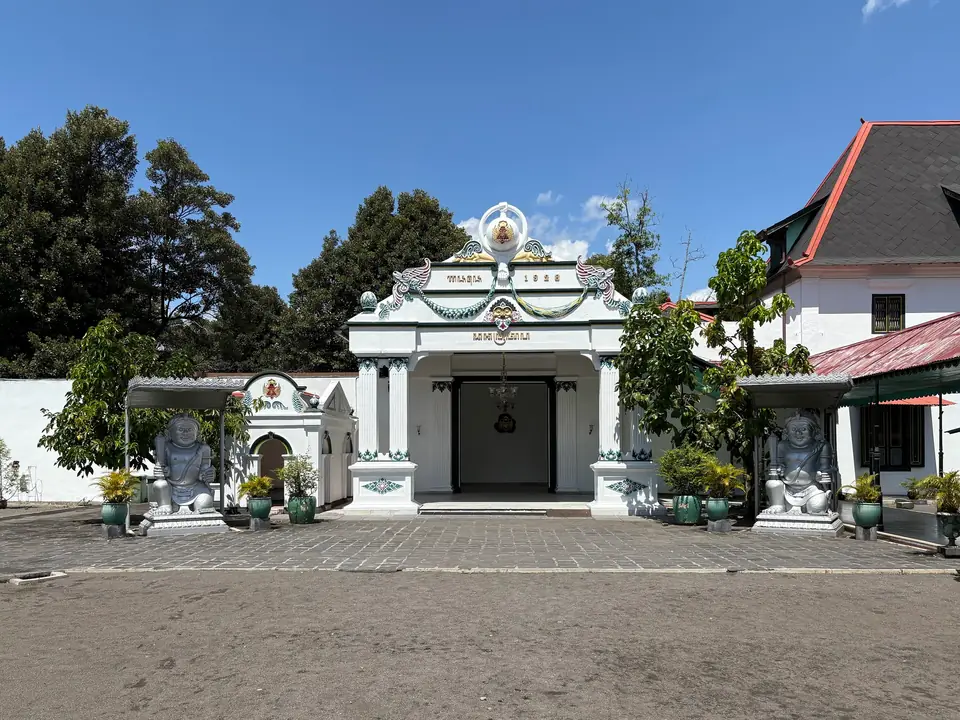
Beyond the Regol Danapratapa, flanked by two giant stone guardians, Cingkarabala and Balaupata, and with the royal emblem Praja Cihna on the screen wall, the Kedhaton opens, the heart of the palace, shaded by sawo kecik trees. Here stands the Bangsal Kencana, the golden pavilion, the Kraton’s main hall, facing east and reserved for the most important ceremonies. In front, the Gedhong Gangsa keep gamelans; beside it, the Gedhong Jene, with yellow doors and columns, was the sultans’ official residence until Hamengkubuwono IX, and Hamengkubuwono X uses it as a private office while he lives in the Keraton Kilen, the western palace. To the northeast looms the Gedhong Purwaretna, the compound’s only two-storey building, raised by Hamengkubuwono V as an office.
This courtyard is also the ledger of the sack of 1812. The loot exceeded 850,000 Spanish dollars and the assailants carried off babad chronicles, archives, gamelans and manuscripts, leaving a single Quran in the palace. Hamengkubuwono II was exiled to Penang. In 2019, 75 of those manuscripts came back, in digital format only, and by 2023 the British Library had handed over copies of 120, while the sultanate maintains that British archives hold 7,500 physical manuscripts and the descendants of Hamengkubuwono II claim the originals.
A good part of what surrounds the visitor in the Kedhaton is the work of Hamengkubuwono VIII, who reigned between 1921 and 1939 and in 1923 ordered the Plengkung Madyasura demolished, closed since the assault, to reopen the wall on the east. How a palace emptied in a few hours came to work again as a court is the story with which the audio guide closes the tour.