9th-century Hindu temple
Prambanan Temple Audio Guide (Candi Prambanan)
The House of Shiva, inaugurated in 856: a 47-metre tower, a carved Ramayana that is read while walking and more than two hundred small shrines still waiting, stone by stone, to be raised again beside the river that marks the fault of the 2006 earthquake.
- 120 min of audio
- Mandala of 240 temples
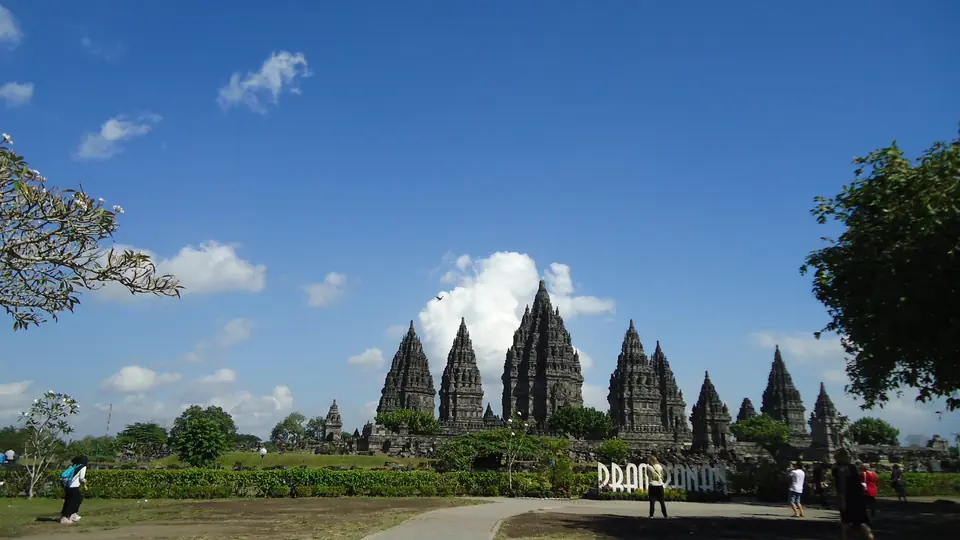
The Prambanan Temple, Java's Candi Prambanan, was originally called Shiva-grha, the House of Shiva. The Shivagrha inscription dates its inauguration to 12 November 856, and its plan is a concentric mandala of 240 temples: 16 in the inner courtyard, with the towers of the Trimurti at the front, and 224 perwara shrines in four square rows around it. The Shiva tower reaches 47 metres, and those of Brahma and Vishnu, 33.
What stands today is a reconstruction made with the original blocks. After losing its court in the 10th century and falling in an earthquake of the 16th, its stones ended up in colonial gardens and house foundations. The anastylosis began in 1918 and the Shiva temple was not finished until 1953. Of the 224 perwara, in February 2023 only 6 were rebuilt.
Highlights
- Candi Siwa — the 47-metre tower of the House of Shiva, inaugurated in 856
- Ramayana gallery — reliefs read by turning clockwise
- Durga of the north chamber — the Roro Jonggrang of the legend of the thousand temples
- Candi Brahma and Candi Wisnu — 33-metre towers rebuilt block by block
- Field of the perwara — 224 small shrines, of which only a handful have been raised again
The story of the Prambanan Temple starts with an exact date: 12 November 856, the day on which, according to the Shivagrha inscription, the House of Shiva was consecrated. The inscription was issued by Dyah Lokapala, also called Rakai Kayuwangi, although the start of the work is attributed to his predecessor, Rakai Pikatan, whose name appears painted in red on a balustrade finial. Who the true founder was remains under discussion, and also whether Prambanan was born as a Hindu answer to the Buddhist temples of Borobudur or simply as the reflection of a shift in royal patronage towards Shaivism.
After some 80 years of use and expansion, the temple was left without its court when Mpu Sindok moved the capital to East Java in the 930s, and a great earthquake of the 16th century finished bringing it down. The ruins remained known to Javanese villagers and, after the partition of the Mataram sultanate in 1755, served, beside the Opak river, as a boundary marker between Yogyakarta and Surakarta. That line is still today the border between the Special Region of Yogyakarta and Central Java, so the complex belongs to Sleman, but its administrative access lies in Klaten.
The compound is not only a monument. Since 26 July 1961, the Sendratari Ramayana, a ballet-drama without dialogue, has been performed in front of the towers; today it is hosted by the Trimurti stage, on the west bank of the Opak, open-air only from May to October. After the reconstruction of the 1990s, the Javanese and Balinese Hindu communities once again celebrated Galungan and the Tawur Kesanga before Nyepi here, and on 12 November 2019, on the exact anniversary of the inauguration, the first consecration Abhiseka in 1,163 years was held. On clear days, Merapi looms behind the towers, some 25 kilometres to the north.
What to see at the Prambanan Temple is ordered from the inside out: the ritual gate of the central courtyard, the Ramayana gallery, the chamber of Durga, the Brahma tower and, finally, the field of small shrines still awaiting reconstruction. The audio guide covers the complex in five stops, with documented narration checked against historical sources that tells what the stone leaves unsaid: abandonment, plunder, the fault and the ash.
Back in Yogyakarta, some 15 km away, the Kraton and the water palace of Taman Sari tell of the Muslim court of the sultans, raised centuries later.
A gate missing from the House of Shiva
East gate of the central compound
Summary of this stop
The tour begins before the east gate of the inner courtyard, the ritual entrance. The paduraksa gates of the south, west and north are rebuilt; this one, the main one, is still not raised. Behind that gap rises the Shiva tower, with its main stairway on the east side, flanked by two small shrines of the guardians Mahakala and Nandhisvara.
From here the geometry of the complex can be understood. The complex originally had 240 temples arranged as a concentric mandala: in the inner courtyard, the three of the Trimurti, three vahana temples, two apit, four kelir and four patok; around them, 224 perwara in four square rows of 44, 52, 60 and 68, each about 14 metres tall on a base of 6 × 6 metres. On one of the balustrade finials of the Shiva temple the word “pikatan” is still painted in red, the name of the one who, according to the most widespread attribution, began the work.
The absent gate announces what came after: the court that left for East Java, the earthquake of the 16th century and a compound strewn with stones for centuries. Why that absence is the best key to reading the whole temple is what the narration explains at this threshold.
The Ramayana read while walking
Candi Siwa
Summary of this stop
On the inner face of the gallery balustrades the carved tale unfolds. The Ramayana begins in the Shiva temple and continues in the Brahma one, while the Vishnu temple narrates the life of Krishna. To follow the story in order one must enter from the east and turn clockwise, the pradakshina, with the shrine always on the right: the abduction of Sita by Ravana, the bird Jatayu and Hanuman’s army follow one another panel by panel. On the outer plinth, the niches of the motif known as the “Prambanan” panel repeat a lion between two kalpataru, the wishing trees, with pairs of kinnaras, birds, deer, monkeys or elephants.
Beneath the visitor’s feet, the temple kept another secret. During the restoration there appeared, right below the statue of Shiva, a 5.75-metre well with a stone chest, the pripih, placed over charcoal, earth and bones of sacrificed animals. Inside were gold sheets with the names of Varuna, god of the sea, and Parvata, god of the mountains, 20 coins, jewels and twelve gold leaves cut in the shape of a turtle, naga, lotus, altar and egg.
Walking the gallery turns the visit into a ritual of reading. Which episodes of the Ramayana deserve a pause and what meaning there was in burying that chest beneath the god are the keys the audio guide unpacks along the wall.
The stone maiden who is a goddess
Durga of the north chamber
Summary of this stop
In the north chamber of the Shiva temple waits the most famous figure of Prambanan. According to Javanese tradition, she is Roro Jonggrang, or Rara Jonggrang, “the slender maiden”: the daughter of the giant Prabu Boko, whom Prince Bandung Bondowoso killed in combat before demanding her hand. She set him two impossible conditions, the last, a thousand temples in a single night. When the spirits working for him had reached the 999th, the princess had the villagers of Prambanan burn straw and pound the rice mortars as at dawn, the roosters crowed and the work was left half done. The curse that followed explains, in the legend, the statue in the chamber.
The stone tells something else. The figure is a Durga Mahisasuramardini, the goddess who slays the buffalo demon, standing on it. She is one of four that guard the House of Shiva: in the central chamber stands a 3-metre Shiva Mahadeva, and in the smaller ones, Agastya to the south and Ganesha to the west. The legend, probably composed in the time of the Mataram sultanate, has no archaeological support, and some read it as a hazy memory of the 9th-century struggles at court. Moreover, Candi Sewu, the Buddhist complex 800 metres to the north and pointed out by tradition as the unfinished thousandth temple, was called Manjusrigrha according to an inscription of 792 and predates the Shiva temple by more than 70 years.
Around the statue circulate opposing popular beliefs: some say that engaged couples who visit the temple together end up breaking up, and Javanese visitors pray before her to have children. The exact phrase that petrified the princess, and the trap of the well that preceded it, are what the narration reserves for the moment of looking her in the face.
The rebuilt tower the fault shook again
Candi Brahma
Summary of this stop
Before Candi Brahma, the reconstruction becomes visible. Anastylosis, the method of replacing the original blocks, began in 1918 under Dutch colonial rule and was taken seriously in 1930; interrupted by the war, it resumed in 1949, and the Shiva temple was finished in 1953, inaugurated by President Sukarno. Brahma was rebuilt between 1978 and 1987 and Vishnu between 1982 and 1991, and in 1993 Suharto inaugurated the complete central courtyard. In front of the Trimurti, the central vahana temple holds the bull Nandi along with Surya in a seven-horse chariot and Chandra in a ten-horse one.
On 27 May 2006 the earth moved again. The epicentre was on the Opak fault, which follows the river valley beside the temple, and the quake threw stones, carved panels and vajra-shaped finials to the ground. Candi Brahma, the Nandi and an apit temple were badly damaged, the south and west fences fell and there were no casualties because visitors had not yet arrived. The Nandi was not fully restored until 6 January 2009.
Eight years later came the ash, but not from Merapi, whose 2010 eruption the wind had diverted towards Borobudur. On 13 February 2014 Kelud erupted, some 200 kilometres away, and the next day the temple woke up white, closed to the public. Crews cleaned it first by hand, with palm-rib brooms, shovels and buckets, and the task began precisely with Brahma. Why the Shiva tower had to wait is the last piece of this story, heard before the tower.
More than two hundred shrines yet to be raised
Field of the perwara
Summary of this stop
The tour ends on the south side of the middle courtyard, among the four rows of perwara. Today they are mostly bases and numbered ashlars on the ground, with a few rebuilt shrines, such as the one at the northeast corner, with a double portico, raised in the 1930s. That ground was won from the river: during construction, a hydraulic work diverted the Opak into a straight north-south channel beside the western wall, and the old meander, too close to the main temple, was filled in and levelled. Whether the diversion sought space or protection against Merapi’s lahars, and whether it was the river or the wall that moved, is still debated; nor is there agreement on the meaning of the rows, which one theory assigns to the four castes and others see as places of worship or offerings by regional nobles.
The emptying has names. Cornelis Antonie Lons, a VOC employee, left in 1733 the first European report of the temple, and Colin Mackenzie, Raffles’s surveyor, came across it in 1811. In the following decades, Dutch residents took statues and reliefs as garden ornaments, villagers used the ashlars for house foundations and Isaäc Groneman dismantled on a large scale and piled the stones without order along the Opak.
Today a strict rule decides what rises again: a shrine is rebuilt only if it keeps at least 75% of its original stone, at a pace of 8 to 12 months per piece. On 8 July 2026, Prabowo Subianto and Narendra Modi launched at Prambanan a cooperation programme between Indonesia and India, through 2036, for the more than 200 remaining perwara, with LiDAR scanning and anastylosis; of the 240 buildings, 22 were restored. How the exact place of each loose stone is sought is the story with which the audio guide closes the tour.