Andean Baroque
Cusco Cathedral Audio Guide (Basílica Catedral de la Virgen de la Asunción del Cusco)
A cathedral designed to impose Spanish power on the palace of an Inca, and which ended up belonging to Cusco: an earthquake cut its towers short, centuries of candles blackened its Christ and its Last Supper serves guinea pig.
- 60 min of audio
- Cusco School art
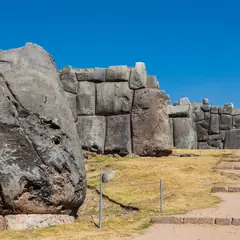
In 1552, at the initiative of Bishop Juan Solano, the town council bought the site of the old Kiswarkancha, the palace of the Inca Viracocha, because the land assigned to the church was too narrow. Work began in 1560 with stone from nearby quarries and with blocks of red granite torn from the fortress of Sacsayhuamán; it stopped during the visit of Viceroy Francisco de Toledo and was completed by Miguel Gutiérrez Sencio, in charge from 1615. Inside, three aisles of equal height rest on fourteen cruciform pillars and twenty-four Gothic ribbed vaults in andesite.
The earthquake of 31 March 1650 brought the vaults down and left the towers without their third storey, hence their stout silhouette. That day gave birth to the procession of the Lord of the Earthquakes, a black Christ of plant fibre and maguey that the people proclaimed patron after the plague of 1720, displacing Santiago. In 2005, when it was restored, 61 letters from the faithful were found inside its body, the oldest from 1762.
Highlights
- Renaissance façade with two squat towers, cut short after the 1650 earthquake
- Lord of the Earthquakes, the black Christ patron of Cusco, with 61 letters from the faithful found inside
- Ex-voto canvas of 3.34 x 4.62 m painting the city in the middle of the 1650 quake
- Marcos Zapata's Last Supper (1753), with guinea pig and Andean produce on the table
- Church of El Triunfo, the city's first cathedral, built on the Inca Suntur Wasi
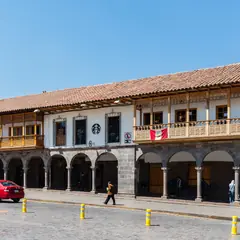
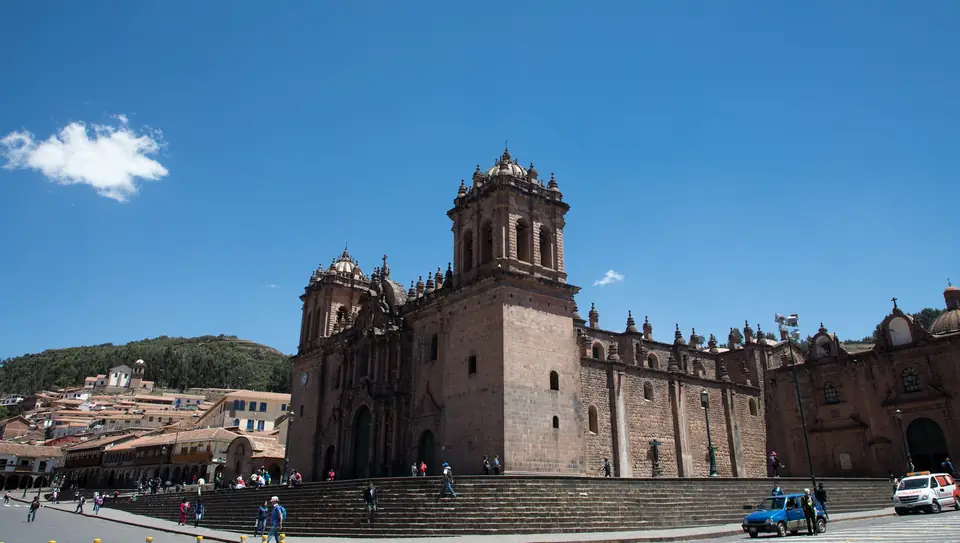
The Basilica Cathedral of the Virgin of the Assumption presides over Cusco’s Plaza de Armas from the site where the Kiswarkancha, the palace of the Inca Viracocha, once stood. On 17 May 1552 the town council decided to buy it from Alonso de Mesa, and in 1560 its walls of andesite and red granite brought from Sacsayhuamán began to rise. Construction is considered finished in 1654, with an opening mass on 15 August of that year, although the same documentation also stretches it to 1664; the consecration came on 19 August 1668. Its story, however, is not told by dates alone: it is explained by an earthquake, a Christ that the people chose as patron and some Andean painters who brought their own table into their canvases. On 15 November 2026 Pope Leo XIV prayed the Angelus in the square, before the cathedral and facing the image of the Lord of the Earthquakes, to which he gave a shroud.
The audio guide’s route goes from the façade to the interior in five stops, on a visit of about 60 minutes, with the history of each corner documented and checked against historical sources.
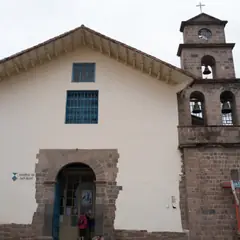
The church presides over the Plaza de Armas of Cusco, the old Inca Huacaypata, and the Andean Baroque of its canvases has its counterpoint, uphill, in the carved pulpit of the San Blas neighbourhood.
A façade with a scar: the short towers of 1650
Cusco Cathedral
Summary of this stop
From the atrium, the Renaissance stone façade opens three doors, one for each aisle. On either side, two towers that seem too low for a church of this size. It is no design whim: the earthquake of 31 March 1650 brought down the ribbed vault and forced the upper part of the façade to be rebuilt, and in that reconstruction the third storey of the towers was dropped. That wound is the source of the massive look that defines the cathedral today.
In the north tower, on the side of El Triunfo, hangs the María Angola, the great bell. Its name is attributed to an Angolan enslaved woman who is said to have thrown gold into the crucible during the casting, although no document proves it, and the figures for its weight and range vary depending on who tells them. What is documented is its role: on Holy Monday 2022, after two years without a procession because of the pandemic, it once again announced the departure of the Lord of the Earthquakes into the square.
These same doors are, every year, the goal of a very Cusco tradition: at the Corpus entrance, fifteen images of saints and virgins arrive on litters from their parishes among bands and dances such as the Cápac Colla, and their bearers compete to enter first. Who wins by tradition and who waits inside as “the guests” is one of the stories the narration keeps for the atrium.
The first cathedral over an Inca refuge
Church of El Triunfo
Summary of this stop
Attached to the north side rises the Church of El Triunfo, with three arches of which only the central one serves as a door. It was Cusco’s provisional cathedral from 1538 (some sources say 1539) until 1654, and it occupies the place of the Suntur Wasi, the Inca building where the Spanish barricaded themselves during Manco Inca’s siege of 1536. Between the arches, two plaques dated 1664 tell of the apparitions of the Virgin and of Santiago during that siege. The present church, designed by Miguel de los Ángeles Menchaca, was finished in 1732.
According to a documented tradition, its high altar preserves the so-called Cross of the Conquest, the one that Friar Vicente de Valverde brought from Spain and planted in the Suntur Wasi to celebrate Cusco’s first mass. It remains, it is said, at the very spot where it was placed.
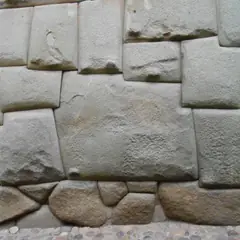
This stop reveals the logic of the whole complex: each piece rests on something Inca. Viracocha’s palace bought as a plot, the refuge of the besieged turned into a church and the ashlars of Sacsayhuamán reused in the walls. How those layers fit into what is seen today from the square is what the audio guide tells in front of the façade of El Triunfo.
Cusco painted while it shakes
1650 earthquake canvas
Summary of this stop
Inside the cathedral hangs an enormous ex-voto, 3.34 by 4.62 metres, commissioned around 1651. It shows Cusco at the instant of the 1650 earthquake, seen from San Blas: the Plaza de Armas, the Plaza Regocijo and the Plaza San Francisco, the procession of the Christ before the cathedral and, at lower right, the portrait of the donor, Alonso Monroy y Cortés. It is, in large part, the square the visitor has just crossed, frozen on its worst day.
That 31 March gave birth to the procession of the Lord of the Earthquakes, which since 1741 has set out every Holy Monday and opens Cusco’s Holy Week, on a route from the cathedral to Santa Teresa and La Merced. After the plague of 1720, which ceased once the Christ was taken out in procession, the people proclaimed him Sworn Patron of Cusco and displaced the apostle Santiago, the patron the Spanish had imposed in 1646.
The painting works as a map of fear and devotion at once. Which details of the quake it hides and how that tremor changed the patron of an entire city is discovered before the canvas, with the narration.
The Taytacha blackened by centuries of candles
Altar of the Lord of the Earthquakes
Summary of this stop
On its altarpiece, flanked by the Sorrowful Virgin and Saint John the Evangelist and with silverwork renewed in 1989, stands the Taytacha of the Earthquakes. Its dark skin is not the original colour: it is soot from centuries of candles and lamps and pigment from the red ñucchu flowers thrown at it in procession. The 1985 restoration revealed a body of plant fibre, a head of maguey and hands and feet of balsa wood, all Andean materials. Its origin is debated: popular tradition speaks of a Christ ordered in Seville by a king and replaced by a copy secretly carved in Cusco, while technical studies point to a work made in the region around 1570.
The image also holds an intimate archive. In the 2005 restoration, 61 letters from the faithful appeared inside it, slipped in through the wound in the chest; the oldest is from 1762. The Church had known of them since 1977 and had left them in place. The bond with the people once became explosive: before 1875, when Bishop Ochoa ordered it repainted, several hundred Indigenous people broke the painter’s ladders and stoned the episcopal palace, and the bishop fled through the doors linking it to the seminary. To all this is added the 1.3 kg gold crown given by Viceroy Francisco de Borja y Aragón, which vanished in 1985 without any locks being forced.
Twice a year, before Holy Week and at the patronal festival in October, the Brotherhood of the Lord of the Earthquakes lowers the Christ from its throne amid Quechua songs of the Chayñas, in the so-called Bajada de Trono. What that moment is like, when the image comes down to the level of the faithful, is told by the audio guide beside the altar.
A guinea pig on the Last Supper table
Marcos Zapata's Last Supper
Summary of this stop
The route ends before the great oil painting that Marcos Zapata made in 1753: Jesus and the twelve apostles seated at a table with potato, stuffed rocoto, maize, cups usually identified as chicha and, in the centre, a cooked animal that the most widespread reading recognises as a guinea pig, although a viscacha or a chinchilla has also been proposed. It is the most cited example of how the Cusco School adapted European iconography to the Andean table.
In the same cathedral, the Zodiac series signed in 1681 by Diego Quispe Tito, a Quechua painter from a noble Inca family, copies Flemish engravings and ties each sign to a parable of Christ, with a clear aim: to displace the worship of the stars. His landscapes full of birds are the painter’s recognisable signature.
And in the Last Supper an enigma remains open. Legend has it that Judas, in the foreground with the money bag under the table, has the face of Francisco Pizarro; another reading notes that he is the only one who looks straight at the viewer and the only one painted with mestizo skin. Which version of the Conquest each gaze chooses is what the narration leaves for the end, in front of the painting.