Inca temple-fortress
Sacsayhuamán Audio Guide (Parque Arqueológico de Saqsaywaman)
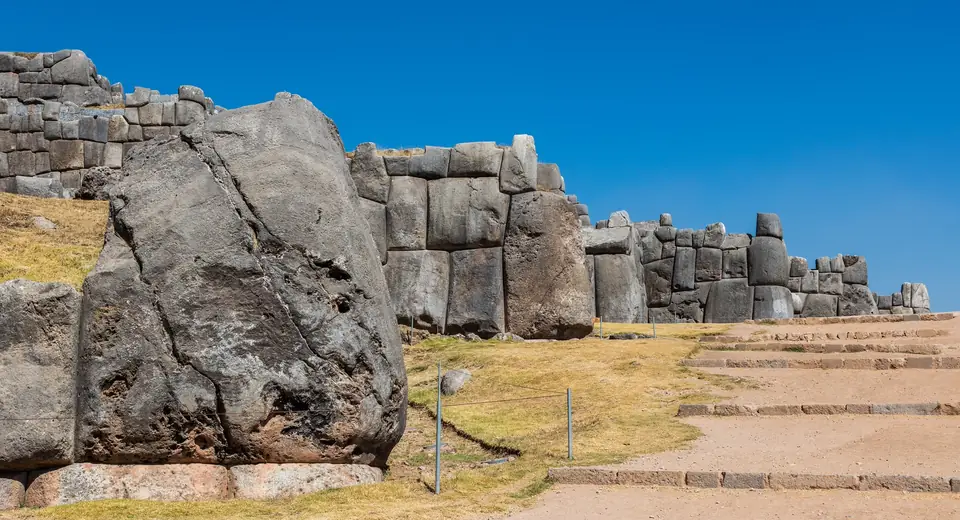
Above Cusco, the stone head of the puma: three zigzag walls with blocks so enormous that the Spanish, who dismantled the fortress to build the colonial city, could not carry them away.
- 90 min of audio
- Inca megalithic architecture
The story of Sacsayhuamán begins in the 15th century with Pachacútec, who conceived Cusco as a city shaped like a puma: the tail at the confluence of its two rivers, the body in the great square and the head on this northern plateau. Túpac Yupanqui, Huayna Cápac and Huáscar continued a work that, according to Pedro Cieza de León, mobilised 20,000 workers in shifts. The result is three stepped zigzag walls, with a wall of some 400 metres and some of the largest stones of pre-Hispanic America.
The Indigenous people called it the House of the Sun; the Spanish, the Fortress. Both were true in 1536, when Manco Inca occupied it to launch from here a ten-month siege of Cusco. Afterwards the hill became a quarry: around 1609 there was no Spanish house in the city without stone from Sacsayhuamán, and what still stands today is, above all, what weighed too much to move.
Highlights
- Three zigzag walls: the lower wall is some 400 m long and its largest limestone block is estimated at between 128 and almost 200 tonnes
- Foundations of Muyuqmarka, the round three-ring tower with water channels from which Cahuide leapt in 1536
- View over Cusco from the head of the puma that Pachacútec imagined for his city
- Great esplanade of the Inti Raymi, staged here every 24 June since 1944
- The Rodadero, the Inca's Throne and the cracks of the Chincana, the legend of a tunnel to the Temple of the Sun
On the hill that overlooks Cusco from the north rises the most colossal complex of Inca architecture. Its construction began in the 15th century under Pachacútec and continued with Túpac Yupanqui, Huayna Cápac and Huáscar. Pedro Cieza de León wrote down how it was raised: 20,000 workers in shifts supplied by the provinces, 4,000 of them quarrying and extracting the stone, 6,000 dragging it with great ropes of leather and cabuya fibre, and the rest digging foundations and preparing timber, with each lineage camped apart beside the work.
The figures of Sacsayhuamán are still disputed: the length of the works, the distance to the quarries, the weight of the largest block or the part of the complex still standing vary by source. Nor is there agreement on its main function. The chroniclers called it a fortress and as such it served in 1536, but the Indigenous people called it the House of the Sun, and its great ceremonial square and its worship chambers support the reading of a temple. Even the name has several translations: the popular “satisfied falcon”, the “royal eagle, the greatest” of González Holguín’s 1608 vocabulary, or a possible “mottled head” tied to the image of the puma.
Today the archaeological park covers 96 sites over some 2,997 hectares, and between January and August 2023 it received about 995,000 travellers, double Machu Picchu in the same period. The audio guide covers the summit of the vanished towers, the foot of the giant blocks, the Inti Raymi esplanade and the polished rocks of the Rodadero, with narration documented and checked against historical sources that keeps its most surprising episodes for the place itself.
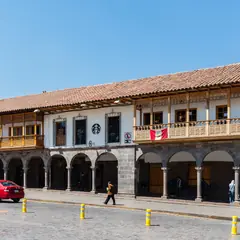
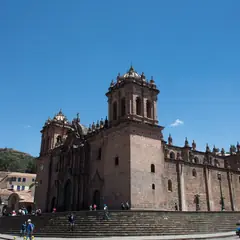
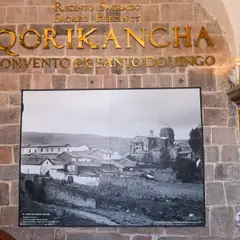
From the heights the city it once crowned is overlooked: the Plaza de Armas of Cusco, where the Spanish were trapped in the siege of 1536, and Qorikancha, the other great Inca sanctuary of Cusco. Far from the city, above the Urubamba canyon, Machu Picchu completes Pachacútec’s great work in stone.
The puma’s head looking over Cusco
View over Cusco
Summary of this stop
The route starts at the edge of the hill, with the city spread out below. From here the design attributed to Pachacútec makes sense: a Cusco shaped like a “lion city”, a puma with its tail at the confluence of its two rivers and its body in the great square and the houses around it. The head was missing, and the fortress raised on this plateau came to be it.
The name of the place changed depending on who looked at it. Around 1553, Cieza de León recounts, the Indigenous people of Cusco called it the House of the Sun, while the Spanish had already renamed it the Fortress. And that Spanish gaze ended up emptying it: after the siege of 1536 they dismantled the complex block by block to raise government buildings, churches and the houses of wealthy residents.
The rooftops seen below hold part of the hill. The Inca Garcilaso de la Vega claimed in 1609 that there was no Spanish house in the city without stone from Sacsayhuamán, a claim the narration sets against what still stands above, at the very place from which it is viewed.
Muyuqmarka, the tower of the last leap
Muyuqmarka foundations
Summary of this stop
On the summit remain the circular foundations of Muyuqmarka, the round tower that crowned the complex. It had three concentric walls joined by radial walls, three channels that carried water to a central reservoir and a pattern of 34 radial lines crossing at the centre. The Spanish dismantled it along with the two towers that flanked it, and today only the stone rings on the ground trace its plan. Even its shape is a matter of debate: some chroniclers describe it as square and others as circular.
These foundations were the setting of the siege of 1536. On 5 May, Manco Inca’s troops occupied Sacsayhuamán, which the Spanish had left empty to dig in within the city, and the next day they came down from here to assault Cusco, the start of a ten-month siege. In the counterattack, Juan Pizarro, earlier wounded in the jaw, charged without a helmet because the bandages did not allow it; a stone thrown from one of the turrets hit him on the head, and the chronicles differ on how many days he took to die.
The best-remembered episode is that of the tower’s defender, known as Cahuide, although his exact name is unknown and the sources give him several others. With the tower taken on several sides, he hurled his club at Hernando Pizarro and threw himself from the top of Muyuqmarka rather than be taken prisoner. The stop reconstructs that battle on the very stones that witnessed it.
The blocks nobody could carry away
Megaliths of the lower wall
Summary of this stop
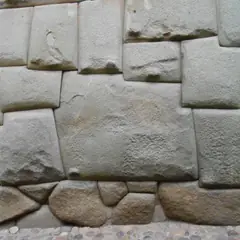
At the foot of the lower wall the scale changes completely. The three terraces advance in sawtooth fashion before the esplanade; the longest wall measures some 400 metres and reaches about 6 in height. At the base appear limestone blocks several metres across, with rounded corners and mortar-free joints. The largest is estimated at between 128 and almost 200 tonnes, although other estimates put it well below. If they are still here, it is because they were too large to take to the colonial city.
Above, the masonry betrays what was lost. The upper courses, of rougher and worse-fitted stone, are modern finishing additions against erosion: they are missing in photographs from the early 20th century and some bear present-day dates carved into them. The contrast between the Inca masonry below and these additions marks the gap left by the fine stone dismantled in the colonial period.
Against the stones that did arrive, tradition recalls the one that never did. The tale of the Tired Stone says that, in the time of Calla Cunchuy, the last of the fortress’s Inca architects, more than 20,000 men were dragging an enormous rock when it came loose on a slope and crushed thousands of them. It was left abandoned near Cusco and, they say, still weeps blood. What happens with those tears when it rains is told by the narration at the foot of the wall.
The esplanade where the Inti Raymi returns
Great esplanade
Summary of this stop
In front of the bastions opens a great esplanade able to hold thousands of people, a place for strolling and sport for the people of Cusco. On 24 June 1944 the contemporary version of the Inti Raymi was staged here for the first time, with President Manuel Prado Ugarteche as guest of honour and a script by Faustino Espinoza Navarro, who also played Pachacútec.
The date has its own story. The festival is not held on the solstice of the 21st but on the 24th, because the government of Augusto B. Leguía had decreed that day as “Day of the Indian” and, being San Juan, it was a non-working day. Since then the esplanade has filled again every June.
It is not the only rite that returns to this plain. Every third Sunday of September, hundreds of students of the Glorioso Colegio Nacional de Ciencias del Cusco stage the Warachikuy, the Inca rite of passage into adulthood, with tests of courage, war dances and combats. It has been performed since 1968, outdoors and free, and in 2025 the Ministry of Culture declared it of Cultural Interest. The stop explains what those schoolboys turned warriors are playing for.
Rodadero and Chincana, the hollow hill
Rodadero and Inca's Throne
Summary of this stop
Facing the walls rises the Rodadero, a polished, curved rock outcrop, beside a large rock carved on several levels like a stepped seat, the so-called Inca’s Throne. Its smooth channels have been polished still further for centuries by the people sliding down them, and popular tradition says that Inca children were already doing so in the 16th century.
In the same sector open cracks and entrances to passages dug into the rock: the Chincana. A Jesuit account from around 1600 speaks of an underground passage that left Qorikancha and reached Sacsayhuamán, and the Inca Garcilaso recalled that beneath the fortress’s towers there were tunnels linking them, in which he played as a child. It is a disputed story that archaeology has yet to close.
In 2025 a team of Peruvian archaeologists traced with seismic prospecting and georadar a possible tunnel of some 1,750 metres from the esplanade to Santo Domingo, with several branches. According to the team, one of the passages has already been entered, but the main gallery has not yet been walked. The route ends here, on a hill that may be hollow, with the narration of what is believed to have passed through that tunnel.