Inca Temple of the Sun
Qorikancha Audio Guide (Convento de Santo Domingo)
The most sacred sanctuary of the Inca empire had its walls lined with gold. The gold vanished in a few weeks; the stone that held it still stands beneath the Dominican convent built on top of it.
- 60 min of audio
- Inca architecture
In the 15th century, Pachacútec rebuilt Cusco and the old House of the Sun, formerly called Intikancha or Intiwasi, and filled it with oracles, buildings and sheets of fine gold. The four walls of the Sun's chamber, where the church of Santo Domingo now stands, were covered from top to bottom in gold, and from this point 42 sacred lines, the ceques, set out, linking 328 shrines. In 1534 the site passed to the Dominicans, and the church seen today is the one rebuilt after the 1650 earthquake.
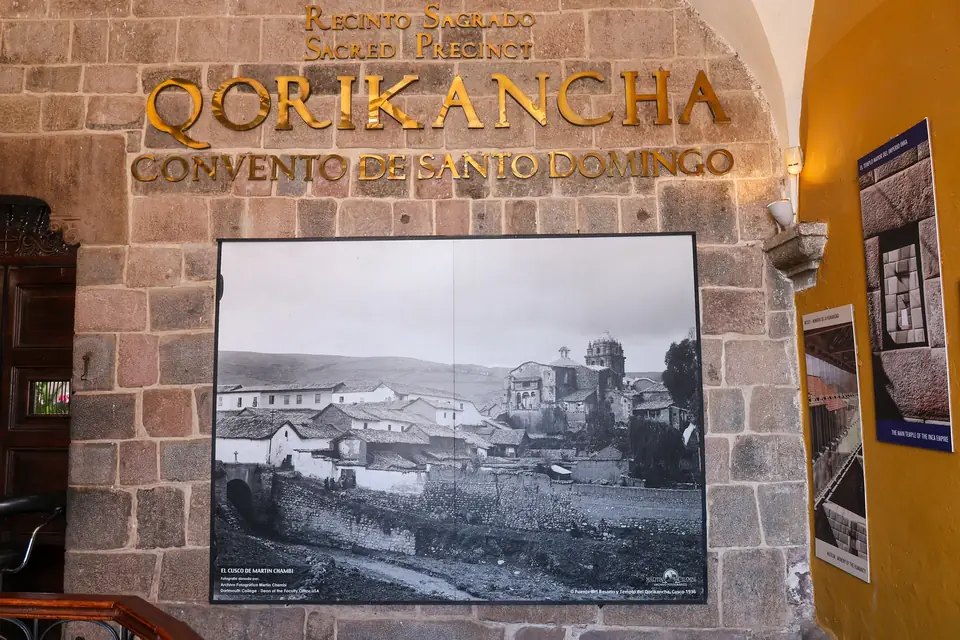
The contrast is in the walls: bare stone where the sheets once were, and a white plaster frieze in the place of the gold one that crowned the cloister. It was another earthquake, that of 1950, that brought down the tower of Santo Domingo and exposed Inca walls that the colonial work had hidden; the later reconstruction, supervised by UNESCO, chose to leave them uncovered.
Highlights
- Curved Inca wall of some 6 metres beneath the Baroque apse of Santo Domingo
- Chambers of the Moon, the stars, lightning and the rainbow, with niches and trapezoidal doorways
- Dominican cloister of arches built over the courtyard of the old Inca temple
- Terraced esplanade of the Intipampa, first stage of the Inti Raymi every 24 June
- Stretch of almost 60 metres of the original Inca wall on Calle Ahuacpinta
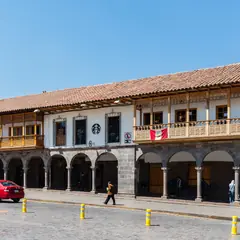
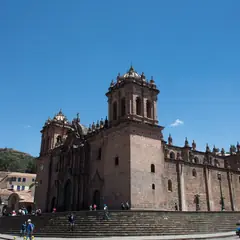
A few streets from the Plaza de Armas, a dark Inca stone wall curves beneath the head of a Baroque church. This is Qorikancha, the Temple of the Sun, the main sanctuary of the Inca empire, and on top of it sits the Dominican convent of Santo Domingo. The usual reading of the name is Quechua, quri “gold” and kancha “enclosure”, although the linguist Rodolfo Cerrón-Palomino proposes that it comes from a Puquina phrase meaning “enclosure of thunder”. There is no agreement on its origin either: Garcilaso attributes the work to Pachacútec, but makes clear that the temple had been founded since the first Inca and that he only finished and enriched it; other sources speak of a construction around 1200 or of the enlargement of an earlier Killke shrine.
What the chronicles do document is its wealth. In 1533, when the Spanish demanded gold for the life of Atahualpa, most of the ransom came from here. Then came the distribution of plots, the Dominicans, two great earthquakes and a reconstruction that, instead of covering the Inca stone, decided to show it. The story of Qorikancha is that of a gold that left in a few weeks and an architecture that still holds up everything placed on top of it.
The audio guide’s route, a narration documented and checked against historical sources, moves in four stops from the terraced esplanade to the Inca chambers of the cloister, and keeps for each place the episodes that make sense in front of its walls.
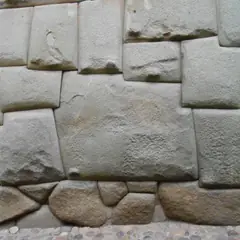
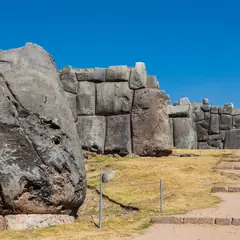
The same mortar-free stonework reappears in the wall of the Twelve-Angled Stone and in the walls of Sacsayhuamán, the other great Inca complex of the city; a short walk to the west lies the San Pedro Market.
A garden of gold over the terraces of the Intipampa
Intipampa esplanade
Summary of this stop
The route starts on the green esplanade that descends in terraces between the temple and Avenida El Sol, facing the curved wall. The chronicler Pedro Cieza de León described a garden here in which the soil was clods of fine gold, planted with maize stalks of gold, with stem, leaves and cobs, and populated by more than 20 golden llamas with their young and the shepherds who tended them, with slings and crooks of the same metal. The Qorikancha wall crowned a system of terraces that went down to the river, and before the present triangular atrium existed it turned at a right angle toward Calle Ahuacpinta, where an original stretch of almost 60 metres is still preserved.
The esplanade is not just memory. Every 24 June, the Inti Raymi begins here in the morning with the scene of the “Greeting to the Sun god”, before continuing in the Plaza de Armas and ending at Sacsayhuamán. Beneath that slope lies the site museum as well.
Inca myth adds another layer: according to tradition, Manco Cápac chose this spot, at the confluence of the Huatanay and Tullumayo rivers, to build a small house, the Inti Cancha. Centuries later, Pachacútec is said to have redesigned Cusco in the shape of a puma, and the temple ended up in a very specific place on the animal’s body. Which part of the puma it occupies and why that confluence, invisible today, mattered so much is the first thing the narration tells on the ground.
The atrium where seven hundred sheets were piled up
Santo Domingo plaza
Summary of this stop
Before the door of Santo Domingo, the atrium gathers the whole story of the plunder in a few metres. According to a documented tradition, around March or April 1533, with Atahualpa still imprisoned in Cajamarca, the first three Spaniards sent by Pizarro reached Cusco: two sailors and a notary. They entered a temple reserved for priests and mamacunas, who passed through barefoot, and as the Indians refused to help them, they tore off the gold sheets themselves with copper crowbars. They piled them outside, before furious priests, until they had gathered some seven hundred.
Then came the distribution. Juan Pizarro, the conqueror’s brother, received the temple site in October 1534 and handed it over to the Dominicans, although another source dates the transfer to 1538, to Friar Juan de Olías and twelve companions who had come from Mexico. The church was not consecrated until 1633.
The earthquake of 1650 badly damaged that first convent, while the Inca Qorikancha remained intact. The reconstruction lasted until 1680, and the church seen today from the atrium is that 17th-century work. What each sheet weighed and exactly what they looked like, down to the holes of their nails, is left for the narration in front of this door.
The golden Sun gambled away in a single night
Santo Domingo cloister
Summary of this stop
In the centre of the Dominican cloister, with its galleries of round arches and its canvases of the life of Saint Dominic, the gold is recognised by its absence. The top of the temple’s cloister was finished with a gold frieze more than a vara wide; the Spanish removed it and put in its place a white plaster frieze of the same width, which Garcilaso still managed to see. In the Sun’s chamber, the four walls were lined with gold sheets, and on the eastern wall there was a figure of the Sun made from a sheet twice as thick, so large that it ran from wall to wall.
Its fate is a matter of debate. Garcilaso says that in the division of the spoils the figure fell to Mancio Sierra de Leguízamo, a great gambler, who supposedly lost it in a single night, hence the saying “He gambles the sun before dawn”. That version is considered doubtful: other sources speak of the Punchao, an idol of human form that the Indians hid and that, in time, ended up sent to the king of Spain.
This courtyard was also the end of the Inca Inti Raymi. According to documented tradition, after greeting the solstice sun in the plaza of Haucaypata, the Sapa Inca and the curacas came here, and the Inca sat in the hall of the Sun beside the mummies of his ancestors. The sacrificial fire was not lit just any way, and how the Sun itself made it burn is one of the moments the narration keeps for this cloister.
The Inca walls the earthquake uncovered
Inca chambers of the temple
Summary of this stop
Between the colonial arches the Inca chambers appear, freed from the cloister’s building work: inclined ashlar walls, niches, trapezoidal doorways and aligned double-jamb doors, typical of the buildings of highest rank. Around the temple’s cloister there were five separate chambers: that of the Moon, lined with silver sheets; that of Venus and the stars, with a ceiling studded with stars; that of lightning, thunder and flash; that of the rainbow, painted on gold sheets; and the priests’ hall. From this ritual centre set out the 42 ceques linking 328 huacas: canals, fountains, caves, rocks and springs.
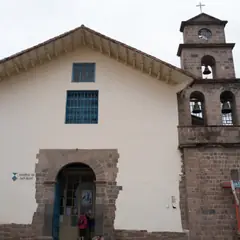
That they can be seen today is due to a catastrophe. In the earthquake of 21 May 1950, Santo Domingo was the most damaged church in Cusco: the arches of the tower collapsed, the apse wall cracked and the balcony overlooking the city fell. At the same time, Inca walls that the colonial work had concealed came into view.
Reconstruction began in 1956 under UNESCO supervision and gave priority to leaving the Inca stone exposed. The architect Óscar Ladrón de Guevara directed the main works, finished in 1976, and the tower was rebuilt around a reinforced-concrete core that cannot be seen. Beneath this floor, moreover, questions about tunnels and royal tombs remain open that nobody has resolved, and the narration goes through them with the caution they require.