Historic market
San Pedro Market Audio Guide (Mercado Central de San Pedro)
The corrugated-iron hall with which Cusco took its food off the squares in 1925: a century later, the city still breakfasts on juices, eats broth and buys luck for its homes under the same stepped roof.
- 45 min of audio
- Century-old market
Until the second decade of the 20th century, Cusco bought its provisions outdoors, in the Plaza de Armas and the Plaza San Francisco. For reasons of public health, Mayor Manuel Silvestre Frisancho moved the selling to the Qasqaparo flat, opposite the church of San Pedro, and on 7 June 1925 he inaugurated a covered market that the people baptised the “Frisancho Market”. Its hall of cement, reinforced concrete with rails, timber and corrugated iron covered the largest roofed area built in the city until then, in a design foreign to Cusco's building tradition.
Many guides repeat that the structure is the work of Gustave Eiffel, but Eiffel died in Paris in December 1923, a year and a half before the opening, and the Ministry of Culture's 2024 declaration does not name him. Among its 1,180 stalls live side by side the juice aisle, the canteens of chicken broth and roast suckling pig, and the shamanic stalls where dried llama foetuses are sold, offerings to the Pachamama that end up beneath the foundations of new houses.
Highlights
- Hall opened in 1925 with a corrugated-iron roof in three stepped tiers and timber structures
- Symmetrical façades with ornamental pillars and railings, the entrances marked by hip ridges
- Southeast wing of 1955, with long benches where chicken broth, roast suckling pig and chuño soup are served
- Shamanic stalls with herbs, Ekeko figures and offerings for the Pachamama
- Monument of the Cultural Heritage of the Nation since 2024, opposite the station of the Machu Picchu train
The story of the San Pedro Market begins with a public-health quarrel. At the end of the 1910s, the food stalls still occupied the Plaza de Armas and the Plaza San Francisco, and in 1917 the newspaper El Comercio del Cusco even opened a public survey for residents to say where the new market should be built. The mayor and deputy Manuel Silvestre Frisancho settled the matter by moving the selling to the Qasqaparo flat, land belonging to the convent of Santa Clara opposite the church of San Pedro.
The building was inaugurated on 7 June 1925. The people called it the “Frisancho Market”, but that same year it officially took the name Mercado Central de San Pedro, with Emilio Astete as its first administrator. It was a work of great scale for the Cusco of the 1920s: paving with stone from the Rumiqolqa quarries, laid until 16 January 1925, fittings with Carrara marble pieces and a corrugated-iron roof that put an end to the era of open-air markets. In 1955, after the 1950 earthquake and with a growing population, the south block was demolished to build a new wing that repeated the original design.
Its building history still has loose ends. Sources do not agree on whether the trusses are iron or timber, on when the work was considered finished, or on who designed it: against the popular attribution to Eiffel, a local operator points to a project by the Peruvian engineer Teodoro Elmore. Since 22 November 2024, the “Mercado Central San Pedro, Antiguo Mercado Frisancho”, with its 7,134.01 m², has been an integral monument of the Cultural Heritage of the Nation.
The audio guide goes through the small square of the main façade, the central hall, the canteens of the 1955 wing and the shamanic stalls, with narration documented and checked against historical sources that keeps its most curious episodes for the market itself.
Long before the open-air markets that this building came to replace, the Inca city’s main fairs were held in the Plaza de Armas of Cusco; a few streets to the east stands Qorikancha, the old Temple of the Sun.
From Inca road to train platform
Plazoleta San Pedro
Summary of this stop
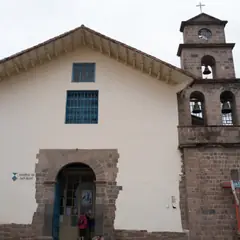
The route starts outside, in the Plazoleta San Pedro. Facing the main façade rise the towers of the church of San Pedro and San Pedro station of the railway to Santa Ana and Machu Picchu, a branch ordered by a law of 1907. That plot on Calle Cascaparo was not always a station: between the 16th and 19th centuries it was the site of the Hospital de Naturales of Cusco.
Toward the centre runs Calle Santa Clara, full of commercial bustle, which follows the line of the old Inca road that set out from the Huacaypata toward the Contisuyo, the southwest region of Tawantinsuyo. On the pavements around, the vendors offer their products outside the building, some with barrows of prickly pears.
The market is here because of a hygiene decision that banished the stalls from the Plaza de Armas. What was special about this ground, which had been road and hospital before being market, is what is told at the foot of the façade.
The hall that broke with the stone city
Main hall under the roof
Summary of this stop
Inside, the eye rises. The gable roof resolves into three stepped levels, higher in the centre and lower toward the sides, held up by rows of cement-clad columns that grow in height and thickness toward the central axis. Above them peeks the framework of trusses and rafters that holds the corrugated iron. In 1925 these volumes broke the height standards of a city of stone.
The work combined cement, reinforced concrete with rails and corrugated-iron roofs, and according to the Ministry of Culture’s resolution it used timber in its structures instead of the iron usual in this kind of architecture. That detail sits badly with the legend attributing the design to Gustave Eiffel, who died before the opening, although other sources describe riveted iron trusses and the debate remains open.
That the building has reached today is not due to its architecture alone. Over several municipal administrations it was planned to replace it with a modern two-level market, and time and again the project stayed on paper. What the traders demanded in 2011 and why that request clashed with the law is part of the story of this stop.
Broth, roast pork and a chuño soup
Canteens of the 1955 wing
Summary of this stop
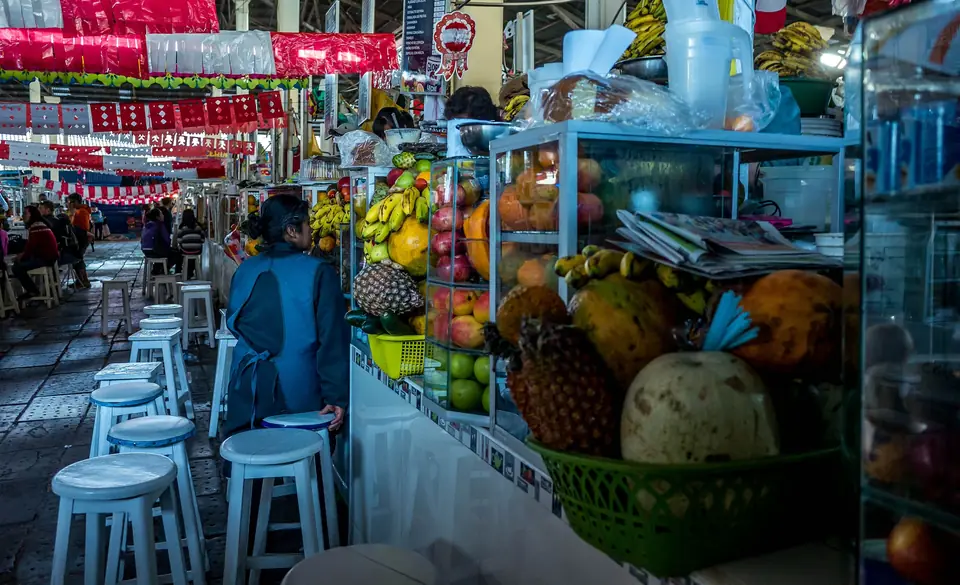
The southeast wing is that of the 1955 extension, built for a city that was growing after the 1950 earthquake. Tables and long benches line up there where chicken broth, roast suckling pig and other Cusco dishes are served, while in the juice aisle chirimoya, passion fruit, goldenberry and papaya are blended on the spot.
This is Cusco’s daily dining room inside a market of 1,180 stalls arranged in blocks according to the goods, from bread and meats to fruit, vegetables and clothing. Over the years, the food market has also become a tourist market, without ceasing to feed the city.
In April 2006, the “Peru” episode of No Reservations brought Anthony Bourdain to these aisles, among dozens of broth stalls. Which dish he chose at these benches, and why his choice says so much about the market, is revealed when listening to the narration right there.
Offerings for the Pachamama
Shamanic stalls
Summary of this stop
At the back, next to the stalls of meats and offal, begin those of herbs and shamanic goods: coca in bulk, San Pedro cactus, incense, old coins, Ekeko figures and offerings for the Pachamama. Among them hang llama and alpaca foetuses, whole and dried. According to a documented local custom, they are not a macabre souvenir: they are buried when a new house is built or walled into the corners of buildings and businesses to attract good luck.
The border between tradition and illegal trade has also passed through these aisles. On 9 October 2021, an operation by Serfor with the Police and the Public Prosecutor’s Office seized in the market 19 Titicaca frogs, destined for smoothies with supposed aphrodisiac properties, which ended up released into a tributary of the lake.
At its centenary, in 2025, the market brought together more than 1,000 traders and the Regional Government of Cusco recognised it as an emblem of traditional Cusco commerce. How a century-old market, already a monument and with any intervention subject to authorisation by the Ministry of Culture, goes on belonging to those who work in it is the idea with which the route closes.