Inca citadel
Machu Picchu Audio Guide (Santuario Histórico de Machu Picchu)
A granite citadel hung at 2,430 metres between two peaks, with more of its work buried than in view. It was never lost, and perhaps it was not even called this.
- 180 min of audio
- Inca architecture and engineering
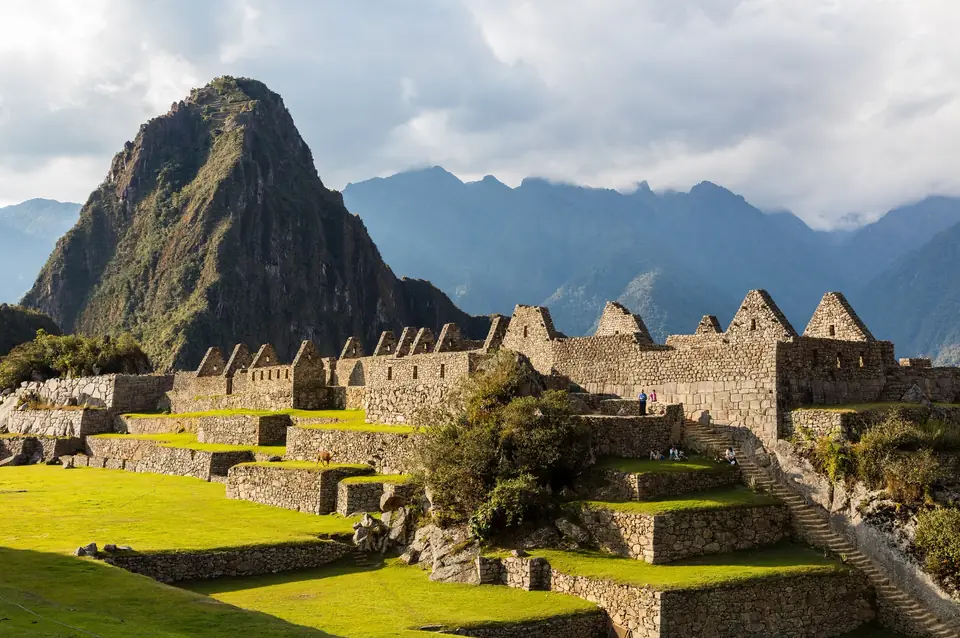
The story of Machu Picchu begins with Pachacútec, who conquered the Picchu valley on his campaign towards Vilcabamba and, according to the chronology of the Spanish chronicles, around 1450 ordered a group of luxurious civil and religious buildings raised on the ridge. Its architecture is understood by following the water: a channel brings the spring from the hillside to a stairway of 16 fountains, and beside the first, the one with the cleanest water, stand the royal residence and, opposite, the Temple of the Sun. In 1983 UNESCO inscribed it as a mixed cultural and natural heritage site.
The most astonishing part cannot be seen. Between 50 and 60% of the Inca building effort lies underground, in foundations, fills and drainage: beneath the main plaza runs a layer of granite rubble, and some 700 terraces filter almost 2,000 mm of rain a year. That is why the city still stands, and why it is more fragile than it looks.
Highlights
- Some 700 terraces and more than half of the Inca work underground, in granite foundations and drainage
- Stairway of 16 fountains still fed by an Inca channel of about 760 m
- Tower of the Temple of the Sun, with its masonry-lined cave and the marks of ornaments torn away
- Temple of the Three Windows, where Agustín Lizárraga signed in charcoal in 1902, nine years before Bingham
- Intihuatana stone, whose tip was broken off in 2000 by a crane from a commercial shoot
Above the Urubamba canyon, between two peaks and at 2,430 metres, stretches the royal estate of Pachacútec. The date of its founding is less firm than it seems: the chronology based on the Spanish chronicles places it around 1450, but in 2021 AMS dating of 26 people buried in four of its cemeteries pushed the use of the site back to around 1420, at least twenty years earlier, and on to around 1530. If those dates are confirmed, Pachacútec would have begun his conquests decades before the texts say.
Nor is the name settled. The historian Donato Amado Gonzales and the archaeologist Brian Bauer concluded in 2021 that the Incas called the city Huayna Picchu, like the pointed peak that appears behind every photo; another study in 2012 proposed Patallaqta, and the name Machu Picchu was fixed only with the publications of Hiram Bingham. The label of “lost city discovered in 1911” is the third piece that creaks: there were visitors before him and families living there when he arrived. Bingham is credited, above all, with making the site known to the world.
That fame had a cost. The materials his team excavated in 1912 spent almost a hundred years at Yale University, with piece counts that vary widely depending on how fragments are tallied, until a 2010 agreement returned them to Peru; on 22 June 2011 they reached Cusco and were assigned to the Casa Concha. Today the citadel, chosen in 2007 as one of the new seven wonders, admits up to 4,500 visitors a day, and up to 5,600 in high season. There is even a notion, with no direct proof, that Indiana Jones’s hat comes by way of the photos of that Yale professor.
The Machu Picchu audio guide covers in about three hours the terraces, the fountains, the Tower, the Sacred Plaza, the Intihuatana and the Condor Group, with narration documented and checked against historical sources that saves for each corner the episode that changes its meaning.
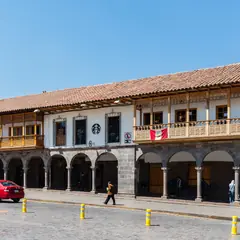
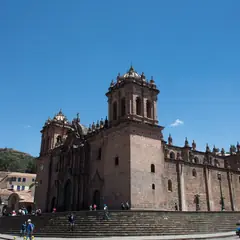
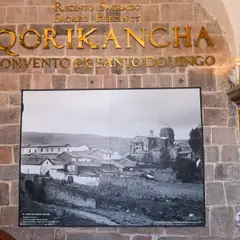
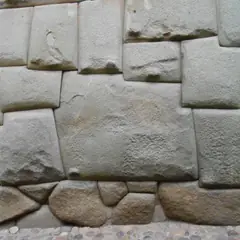
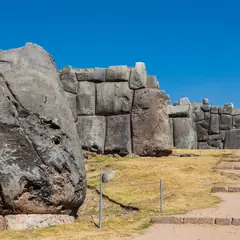
In the city of Cusco, the same Inca stone fitted without mortar is seen in the Twelve-Angled Stone, and the walls of Qorikancha, the Temple of the Sun, and the ramparts of Sacsayhuamán complete the portrait of Pachacútec’s capital.
Terraces still farmed in 1911
Farming terraces
Summary of this stop
The route starts on the great stone steps of the southern slope. At a glance they are green terraces; inside, layers of stone, rubble and earth designed to drain. Here lies the key to Machu Picchu’s engineering: between half and three fifths of the Inca work was buried, and some 700 terraces spread and filter almost 2,000 mm of rain a year so that the mountain does not carry the city away.
Those terraces were not abandoned when Bingham arrived on 24 July 1911. Up there he found the Recharte and Álvarez families farming them and drinking from an Inca channel still in use, and it was a boy, Pablo Recharte, who led him through the undergrowth to the urban zone.
That morning’s climb has something of a comedy about it. It dawned cold and drizzly, and the tenant farmer Melchor Arteaga agreed to go with him only in exchange for a sol, three or four times the local day’s wage. To cross the Urubamba there was a bridge of thin logs tied with vines, which Bingham himself confessed to crossing on all fours. What happened to that bridge a few days later is told by the narration on these same terraces.
The emperor’s water and the wounded Tower
Stairway of the fountains
Summary of this stop
On the great stairway of the fountains you hear the city before you see it. A channel of some 760 metres, with an average slope of 3%, brings water from a spring on Machu Picchu mountain and lets it fall through 16 stone-carved fountains that still work. The order is no accident: the royal residence, the finest dwelling in the city, with monolithic lintels, was built beside Fountain 1, the one with the cleanest water, and the Temple of the Sun was raised opposite it.
The Tower is a curved enclosure of fine ashlar set on a great carved rock. It served for the June solstice ceremonies, although its role as an observatory is disputed: some studies credit it with precise solar alignments, while recent 3D analyses see it more as a ritual enclosure than an astronomical instrument. Beneath it opens a masonry-lined cave, with niches and steps carved in the living rock, known as the Royal Mausoleum.
The building is wounded. One of its windows preserves the marks of inlaid ornaments that someone tore out, and the enclosure shows signs of a great fire. In this same sector, in January 2020, one of six tourists who hid to spend the night in the citadel confessed to having taken a stone from a wall, which fell from about six metres. What those window marks reveal is developed by the narration in front of the Tower.
A name in charcoal in the Three Windows
Temple of the Three Windows
Summary of this stop
In the Sacred Plaza, beside the Main Temple, rises a wall of large polygonal blocks of white granite pierced by three wide trapezoidal windows. In one of them, on 14 July 1902, the Cusco tenant farmer Agustín Lizárraga wrote in charcoal “A. Lizárraga 1902”. He had arrived with Gabino Sánchez, Enrique Palma and Justo Ochoa, nine years before Bingham, who in 1911 noted in his diary that Lizárraga was “the discoverer of Machu Picchu”. The inscription ended up erased.
It was not the only earlier trace. In 1568 the curaca of Picchu was a baptised Indigenous man, Juan Mácora, and the place paid tribute to the Spanish encomienda of Ollantaytambo, where the tribute was taken once a year: the Spanish knew the site even if they did not climb to it regularly. Mining maps of 1870-1874 already located the hills, and an atlas of 1904 recorded the ruins under the name Huayna Picchu.
The greater irony is another. Bingham was looking for Vilcabamba, the last refuge of the rebel Incas, and believed until his death that he had found it here. That same year he passed through Espíritu Pampa, in the jungle, some 130 km west of Cusco, saw about twenty buildings and dismissed it as not grand enough. What came out of that undergrowth afterwards changes the meaning of the word “discovery”, and the narration reveals it in front of these windows.
The tip a crane tore off
Intihuatana stone
Summary of this stop
At the top of the terraced hill waits the Intihuatana stone, a carved rock with a column tilted about 13 degrees. It is one of the most sacred pieces of the city and also one of the most misunderstood: the popular idea of a sundial or calendar gnomon is rejected by most specialists, who read it as a ritual stone aligned with the sun and the sacred mountains. Nor is it accepted that its base reproduces a map of the empire.
Its wound came neither from the conquest nor from earthquakes. On 8 September 2000, during the filming of a Cusqueña beer commercial, a crane fell on the stone and tore about 8 cm from its tip. In 2005 the Mixed Court of Urubamba sentenced a worker from the J. Walter Thompson agency to six years in prison.
The pressure has not eased since. Inscribed by UNESCO in 1983 and chosen in 2007 as one of the new seven wonders, the sanctuary went from limiting the citadel to 2,500 visitors a day in 2011 to a cap of 4,500 in 2024. There was even an official statement from the Ministry of Culture, in 2014, against a fad as unexpected as photographing oneself naked among the ruins. The narration links the mutilated tip to what it means to walk this hill today.
The bones that undid the Virgins of the Sun
Condor Group
Summary of this stop
The route ends at the Condor Group, a courtyard with a great carved stone in which many see a condor, caves for ritual use and traces of guinea pig rearing, with Huayna Picchu in the background. It is the place to ask who really lived at Machu Picchu.
For decades the answer was romantic: the city of the Virgins of the Sun. The osteologist George Eaton studied the skeletons excavated by Bingham’s team and concluded that almost all were women, and Bingham wrote that the last inhabitants had been women consecrated to the Sun, taking refuge there after the conquest. In 2000 the anthropologist John Verano reviewed the bones with criteria Eaton did not know and found half men and half women: the smaller Andean bodies, compared with the reference standards, had made many male skeletons pass as female.
Recent science draws a different population. The DNA of 34 servants, the yanacona, published in 2023, reveals origins from across the empire, from the coast to the highlands and the Amazon, and about a third had significant Amazonian ancestry. How Eaton explained the remains of babies and children he also found, and what the DNA of those buried in a single cave reveals, is the ending the narration reserves for this courtyard.