Artisans' neighbourhood
San Blas Neighbourhood Audio Guide
A hillside of white houses and blue doors over Inca stone, with an adobe church that keeps a cedar pulpit topped by a skull and workshops where the saints are still born with llama necks.
- 60 min of audio
- Cusco Baroque and living crafts
Before it was San Blas, this slope was T'oqokachi, the Inca neighbourhood whose Quechua name means “hollow with salt”. Around 1560 the magistrate Juan Polo de Ondegardo, on the orders of Viceroy Andrés Hurtado de Mendoza, founded here one of the first five parishes for Indians in Cusco, in the space called Arrayan-pata, today's Plazoleta de San Blas. The church, rectangular with adobe walls, was partly reinforced with stone after the 1650 earthquake, and according to tradition it rose over a shrine to Illapa, the god of lightning.
Inside, the Churrigueresque cedar pulpit, from around 1690 and paid for by Bishop Manuel de Mollinedo y Angulo, is attributed to the Inca nobleman Juan Tomás Tuyru Túpac, although its authorship is not documented. It is crowned by a small skull that, according to legend, belongs to its own sculptor. Outside, in the small square, the image-maker Hilario Mendívil invented his long-necked virgins by watching the llamas and alpacas that were bartered in the neighbourhood, and his family still carves them in the same house.
Highlights
- Churrigueresque cedar pulpit from around 1690, with Bishop Mollinedo's coat of arms and a legendary skull on top
- Late 16th-century murals of the four evangelists, hidden behind the chancel canvases until 2022
- Towerless adobe church with a three-tier bell gable, restored in 2020-2023 with 9 altarpieces and 80 canvases recovered
- Hilario Mendívil Museum, free to enter, with long-necked saints inspired by the barter llamas
- Cuesta de San Blas and a viewpoint over the rooftops of the historic centre and the cathedral
San Blas is the neighbourhood of Cusco that has never stopped working with its hands. Its story begins in Inca times, when this slope was T’oqokachi, the “hollow with salt”, and continues around 1560, when the magistrate Juan Polo de Ondegardo, on the orders of Viceroy Andrés Hurtado de Mendoza, founded here one of the first five parishes for Indians in the city. The exact date of the church, mind you, shifts depending on the source: some speak of 1536, 1544, 1562 or 1564, and the oft-repeated claim that it is Cusco’s oldest parish has no documentary backing.
San Blas’s architecture sums up in three layers: courses of Inca stone at the base of the walls, whitewashed houses with blue doors and balconies above and, in between, an adobe church that survived the earthquake of 31 March 1650. After that shock, Bishop Manuel de Mollinedo y Angulo, who governed the diocese between 1673 and 1699, drove the artistic reconstruction of the city, and his coat of arms was carved into this parish’s pulpit. In the 20th century the image-makers arrived: Hilario Mendívil and his long-necked saints, and Antonio Olave Palomino, creator of the glass-eyed Niños Manuelitos, who worked in his workshop in the neighbourhood with his wife Avelina Rupa and his children and was declared a Living Human Treasure of the Nation in 2009.
The neighbourhood has its local stories too. Near the small square, according to the popular version, the street of the lovers’ secret meetings ended up being called Siete Diablitos, and a devout neighbour, Blas de Bobadilla, had seven little angels painted on his house to counter it; at that crossing, Mayor Daniel Estrada Pérez placed a stone angel with the number seven in its hand. The same mayor was behind the paccha, the water mirror of the small square, whose renovation with heavy machinery in May 2026 set off protests from traders and residents. The audio guide goes through the neighbourhood uphill, from the cobbled street to the Mendívil workshop, with narration documented and checked against historical sources.
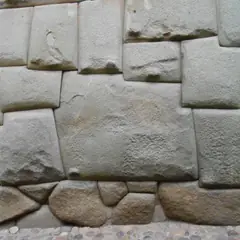
The neighbourhood is reached from the centre along Hatun Rumiyoq street, beside the Twelve-Angled Stone, and its image-makers’ art converses with the canvases of the Cusco School kept in Cusco Cathedral.
The slope that treads on an Inca neighbourhood
Cuesta de San Blas
Summary of this stop
The route begins by climbing the Cuesta de San Blas, the steep cobbled street that starts at Choquechaca, as an extension of Hatun Rumiyoc, between colonial mansions turned into workshops and galleries. It is the natural entrance to the neighbourhood and also the one that best explains its shape: a narrow hillside where each house leans on the one before.
At the base of many walls, courses of Inca stone peek out, and above them the whitewashed homes with their blue-painted doors and balconies. That layering is not decorative: here stood T’oqokachi, the Inca neighbourhood whose Quechua name means “hollow with salt”, and the colonial village was built literally on top of it. What that name has to do with the relief of the slope is something understood when listening to the narration at the foot of the slope.
An adobe church over the god of lightning
San Blas church
Summary of this stop
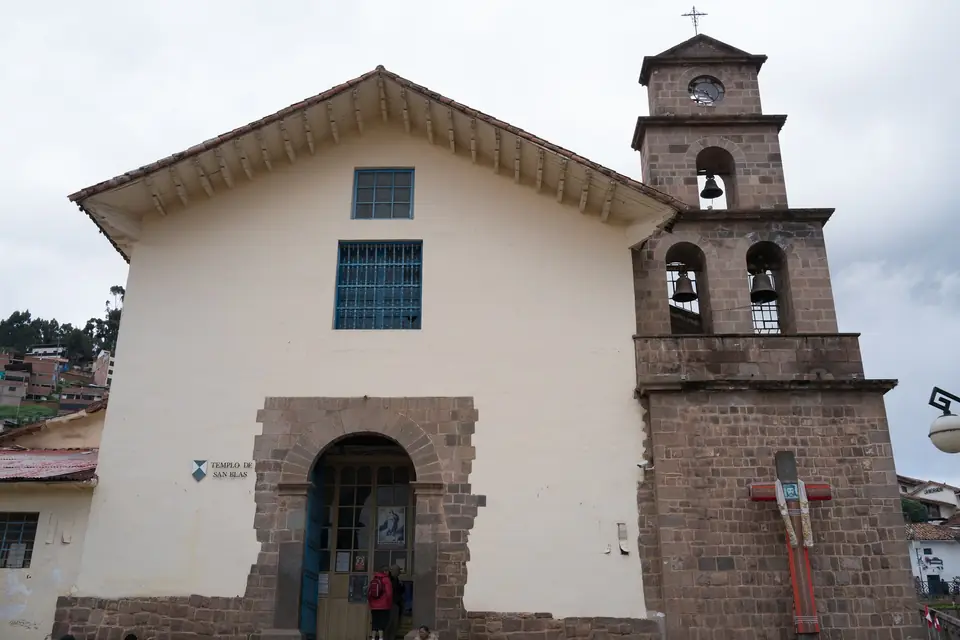
At the top appears the church of San Blas, simple on the outside: whitewashed adobe walls, a rectangular plan and, instead of a tower, a bell gable with a base and three tiers of belfry. The main door faces west and a side door opens to the south, toward the small square.
Around 1560 Juan Polo de Ondegardo erected here, on the orders of Viceroy Andrés Hurtado de Mendoza, one of the first five parishes for Indians in Cusco, in the space then called Arrayan-pata and now the Plazoleta de San Blas. According to tradition, the church was raised over an Inca shrine dedicated to Illapa, the god of lightning, thunder and flash.
The adobe walls did not come through the 1650 earthquake unscathed and were partly reinforced with stone. That mix of materials, visible from the street, tells how a parish intended for the neighbourhood’s Indians was remade after each tremor, and what it meant to choose this particular spot for it is the question with which the narration opens the visit to the church.
A cedar pulpit and a skull
Cedar pulpit
Summary of this stop
The interior’s most famous piece is the Churrigueresque cedar pulpit, from around 1690, paid for by Bishop Manuel de Mollinedo y Angulo, whose coat of arms is carved on it. Its iconographic programme celebrates the triumph of the Catholic Church over the enemies of the faith and is related to the pulpits of the cathedral, Belén, San Pedro and, above all, that of Checacupe. According to a widespread but disputed reading, the figures bearing the weight of the base would be heretics of the time, Luther and Calvin among them, along with monsters embodying the deadly sins.
Its carving is attributed to Juan Tomás Tuyru Túpac, a member of the old Inca nobility, with documented works of architecture, joinery, gilding and sculpture, who in 1668 carved the Virgin of La Almudena for Mollinedo himself. The attribution of the pulpit, however, rests on scant evidence, and some assign it to the sculptor Esteban Horcasitas; nor is there agreement on the figure that crowns it or on whether it came from a single trunk.
At the top, a small skull feeds the neighbourhood’s most told legend: that of an Indigenous sculptor sick with leprosy who promised to carve the pulpit for free if he recovered, was cured, wanted to be paid and died falling from his own work. None of that has documentary backing, but how the story ends and what is told of that skull is kept for the moment of having it in front of the visitor.
Evangelists hidden behind the gilded canvases
Chancel murals
Summary of this stop
In the upper part of the chancel the church’s original decoration is preserved, and for centuries nobody saw it. In 2022, when canvases and gilded frames were taken down, two sectors of mural painting from the late 16th century appeared, with the four evangelists holding medallions with the monograms of Jesus and the Virgin Mary. The 1984 intervention had not detected them.
The find was part of the Ministry of Culture’s comprehensive restoration, begun in 2020 and handed over on 3 December 2023 with an investment of more than 5.8 million soles. That work recovered 9 wooden altarpieces, the pulpit, 202 m² of mural painting in 12 sectors, 80 canvases and 51 polychrome sculptures, among them the gilded altarpieces and works of the Cusco School, such as the series on the life of Saint Blaise and the Raising of Lazarus. How the reading of the church changed with those murals in view is explained before the chancel.
Llama-necked saints beside the paccha
Hilario Mendívil Museum
Summary of this stop
The route ends in the small square, beside the paccha, the water mirror with a stepped cascade that fills its centre. At number 634 stands the family house of Hilario Mendívil (1927-1977), now the Hilario Mendívil Museum, free to enter, with virgins, saints and arquebusiers with elongated necks and pieces for sale in the family’s style. Mendívil created those figures inspired by the llamas, alpacas and vicuñas bartered in the old neighbourhood.
The workshop is still alive: in December 2025 the Ministry of Culture honoured his daughter, Juana María Mendívil Dueñas, as a Meritorious Personality of Culture, and the family sets up every year the traditional Christmas nativity scene in Cusco’s Plaza de Armas.
And the parish’s saint does not stay still either. Every Corpus Christi, the image of San Blas goes down on a litter to the cathedral along with fourteen other images from the neighbourhoods, and the order of arrival is not decided by distance: the bearers compete to enter first. In 2023 Santiago Apóstol, on horseback, beat him to it, and San Blas reached the Plaza de Armas dressed in Andean attire. What the devotees ask the saint’s right hand to say is the last wink the audio guide keeps.