Inca stonework
Twelve-Angled Stone Audio Guide (Piedra de los Doce Ángulos)
Six tonnes of diorite fitted without mortar, held only by its twelve edges, in the wall of an Inca palace that has spent centuries carrying bishops, marquises and earthquakes, and now needs protecting from its own visitors.
- 20 min of audio
- Wall of Inca Roca's palace
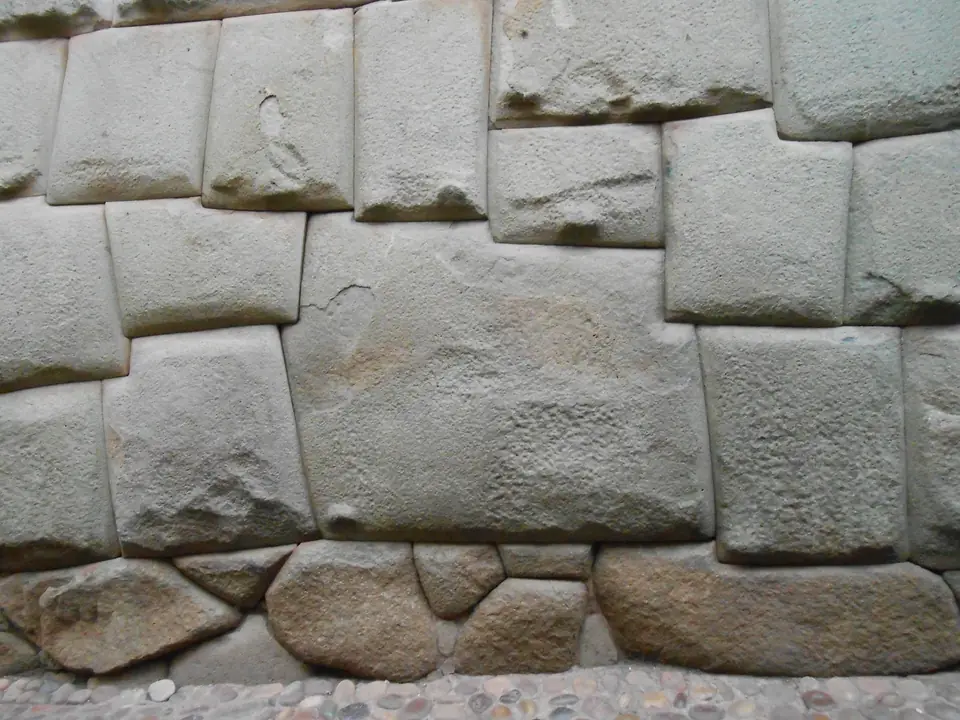
On the narrow Hatun Rumiyoq street, one block from Cusco's Plaza de Armas, the outer wall of the palace of Inca Roca, a ruler whose reign is placed roughly between 1350 and 1380, still stands beneath the present Archbishop's Palace. In the middle of that stretch of polygonal masonry rests a diorite block about 2 metres long and around 6 tonnes, carved with twelve edges that fit the neighbouring stones without a drop of cement. The street has been a Historic Monument of Peru since 1972 and part of UNESCO's World Heritage “City of Cusco” since 1983.
Over the Inca stone, layers of history pile up: the house of Cusco's first bishop, that of a 17th-century marquis, the Archbishop's Palace and, since 1966, the Museum of Religious Art. Neither the earthquakes of 1650 and 1950 managed to bring the wall down; a hammer, however, left it in 2025 with damage that the Ministry of Culture calls irreversible.
Highlights
- Diorite block of about 6 tonnes and 2 metres long, with twelve edges fitted without mortar
- Outer wall of Inca Roca's palace, base of the Archbishop's Palace and the Museum of Religious Art
- Chips from the February 2025 hammer attack, damage described as irreversible
- Neighbouring stones of five, six and seven angles and the puma silhouette seen by popular tradition
- Hatun Rumiyoq street, 141 pedestrian metres of Inca stonework toward San Blas
The story of the Twelve-Angled Stone begins long before anyone counted its edges. The site now occupied by Cusco’s Archbishop’s Palace corresponds to the palace of Inca Roca, the ruler whose reign is placed roughly between 1350 and 1380, and three of its four outer walls are still Inca stonework: a sign that a building of the first rank in pre-Hispanic Cusco stood here. The wall facing Hatun Rumiyoq street, in Quechua “street with the big rock”, is the one that holds the city’s most photographed stone.
That pedestrian street, 141 metres long and barely 3 wide, is part of the processional axis linking the small square of San Blas with that of La Almudena, laid out over the Inca roads that left the Huacaypata toward the Antisuyo. It was declared a Historic Monument of Peru on 28 December 1972, fell within UNESCO’s World Heritage “City of Cusco” in 1983 and was inscribed again in 2014 as part of the Qhapaq Ñan.
The stone’s fame is not down to a record: there are Inca blocks with more vertices, such as one of 13 angles in Inkawasi (Huancavelica) and another of 20 in Qollmay, in the province of Anta. What sets it apart is its place, in the very centre of Cusco, and the quality of its finish. The audio guide goes along the wall in three stops, with narration documented and checked against historical sources that reads the building from bottom to top, from Inca stonework to colonial house, down to the damage that nobody will be able to undo.
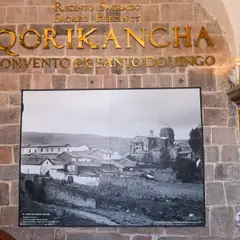
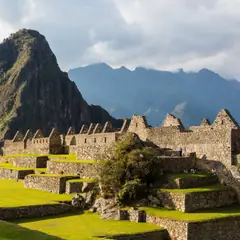
Hatun Rumiyoq street continues uphill to the San Blas neighbourhood, and the same art of fitting stone without mortar reaches its fullest expression in the walls of Qorikancha. Outside the city, the same polygonal masonry reappears, in white granite, in the Temple of the Three Windows at Machu Picchu.
A Baroque doorway over Inca Roca’s house
Museum of Religious Art
Summary of this stop
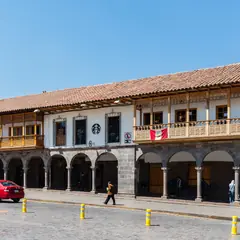
The route starts at the corner of the Archbishop’s Palace, where a Baroque doorway gives entrance to the Museum of Religious Art and a balcony with a two-light door looks out over Hatun Rumiyoq. This is the colonial layer resting on the Inca one. After the conquest, Inca Roca’s palace was the home of Cusco’s first bishop, Friar Vicente de Valverde, who lived there with his sister María Valverde, wife of the Almagrist conquistador Rodrigo de Orgóñez.
In the mid-17th century the house passed to Pablo Costilla y Gallinato, second Marquis of San Juan de Buenavista; the Rocafuerte family later gave it much of its colonial appearance, and in the 20th century Cusco’s first archbishop, Felipe Hermosa y Sarmiento, acquired it as the Archbishop’s Palace. In 1966 Monsignor Ricardo Durand Flórez turned it into the Museum of Religious Art, with José Orihuela Yábar’s collection of Cusco colonial painting, which remains open behind the stone’s wall.
Not even the palace’s name is uncontested. The Inca Garcilaso de la Vega placed Inca Roca’s house at Qora Qora, next to the present Plaza de Armas, a location that other readings reject because the Inca square and its buildings were the work of Pachacútec and his successors. How that dispute between chroniclers is resolved, and why the balance tips toward Hatun Rumiyoq, is told when listening to the narration on this very corner.
Six tonnes held only by their edges
Twelve-Angled Stone
Summary of this stop
Halfway up the wall, almost always pointed out by a group of visitors, the stone appears: a polished diorite block about 2 metres long and around 6 tonnes. No mortar holds it. The fit of its twelve edges with the smaller stones around it is the only thing keeping it in place, and the joints are so fine they look moulded in clay.
That impression feeds an Andean legend: that of a herb that softened rock. The legend says the gods gave the ancient Peruvians the coca leaf and a plant able to turn stone into a mouldable paste; one version speaks of a little bird called Pito that dissolved rock with its juice to make its nest. The priest Jorge Lira, a scholar of Andean folklore, said he had identified it as jotcha after fourteen years of study and told the story in 1983 in the documentary “El otro Perú”. No archaeological evidence supports the technique.
The surface also bears a recent wound. In the early hours of 18 February 2025 a man struck the stone with a hammer; a surveillance camera recorded the attack and the culprit was arrested hours later in San Blas. Sources do not fully agree on the time or the number of blows, but the Culture Ministry’s expert report found wear at seven points and a fragmentation of 4 by 10 centimetres, and described the damage as irreversible. What went wrong in Lira’s experiment, and what can be seen today on the face of the stone, is discovered in front of it.
A stone puzzle that withstood the earthquakes
Polygonal stones of the Inca wall
Summary of this stop
Further up the street, the Hatun Rumiyoq wall turns into a game of looking. The famous stone is not alone: in the same stretch there are blocks cut with five, six and seven points of contact, all with the same mortar-free fit. That multiple polygonal cut locked the stones together, a solution designed for an earthquake-prone city.
The test came with the great earthquakes of 1650 and 1950. The 1950 one damaged half the buildings of Cusco but caused only a few fractures in the Inca masonry, so these walls still hold up the colonial architecture built on top. Some have wanted to see in the twelve angles a symbol of Cusco’s royal lineages, a hypothesis with no documentary or archaeological support set against the structural explanation.
Among the joints, popular tradition also makes out the silhouette of a puma that the stonemasons are said to have composed with the outlines of the stones. Exactly where that animal hides in the wall that climbs toward San Blas is the last find the narration keeps for the end of the route.